
Treadmill Motor HP Guide: Sunny Treadmill SF-T7718 Case Study
Learn how treadmill motor size and horsepower impact your workouts. We break down HP, CHP, and use the Sunny Treadmill SF-T7718 as a beginner case study.

The Heart of Your Machine: Why Motor Size Matters
When beginners start shopping for home cardio equipment, they often fixate on digital displays, Bluetooth connectivity, or folding mechanisms. However, the true heartbeat of any treadmill is its motor. If the motor is undersized for your body weight and workout intensity, the machine will overheat, stutter, and eventually fail. To demystify treadmill motor sizing, this step-by-step guide breaks down the engineering realities of horsepower, using the highly popular Sunny Treadmill SF-T7718 as our primary case study.
As of 2026, the budget-friendly treadmill market is more saturated than ever, making it crucial to understand what you are actually paying for. By analyzing the engineering constraints of entry-level models, you can make an informed decision that aligns with your biomechanics and fitness goals.
Step 1: Decoding Horsepower (HP) vs. Continuous Horsepower (CHP)
The fitness equipment industry is notorious for marketing loopholes, and motor sizing is where beginners get trapped most often. According to the Consumer Reports treadmill buying guide, understanding the distinction between Peak HP and Continuous HP is the single most important factor in your purchase.
⚠️ Beginner Warning: The 'Peak HP' TrapManufacturers often advertise 'Peak HP' (e.g., 2.5 Peak HP) because it sounds impressive. Peak HP simply measures the absolute maximum power the motor can draw for a fraction of a second before tripping a circuit breaker. Always look for CHP (Continuous Horsepower). CHP measures the power the motor can sustain indefinitely during a normal workout without overheating.
How the Sunny Treadmill SF-T7718 Fits In
The Sunny Treadmill SF-T7718 is a quintessential entry-level, compact walking and light-jogging treadmill. It is typically equipped with a 1.0 HP motor (often marketed with a higher peak rating). It features a top speed of 7.0 MPH, a 15.5 x 45-inch running belt, and a maximum user weight capacity of 265 pounds. Retailing between $219 and $249, it is an incredibly accessible machine, but its 1.0 HP motor dictates strict usage parameters that every beginner must understand.
Step 2: Matching Motor Size to User Weight and Activity
A motor's workload is not determined by speed alone; it is a calculation of speed combined with user weight and belt friction. A 1.0 HP motor operating under a 150-pound user walking at 3.0 MPH is working at roughly 50% capacity. That same motor under a 250-pound user attempting to jog at 6.5 MPH will spike past 100% capacity, triggering the machine's thermal overload switch to prevent a fire hazard.
Use the matrix below to determine the minimum Continuous Horsepower (CHP) required for your specific profile. If your target machine falls below these numbers, you risk voiding the warranty and burning out the motor control board.
| User Weight | Walking (Under 4.0 MPH) | Jogging (4.0 - 6.0 MPH) | Running (6.0+ MPH) |
|---|---|---|---|
| Under 150 lbs | 1.5 CHP | 2.0 CHP | 2.5 CHP |
| 150 - 200 lbs | 2.0 CHP | 2.5 CHP | 3.0 CHP |
| 200 - 265 lbs | 2.5 CHP | 3.0 CHP | 3.5+ CHP |
The SF-T7718 Reality Check: Based on the matrix above, the 1.0 HP motor on the Sunny Treadmill SF-T7718 is technically below the recommended threshold for heavy continuous use. Therefore, this specific model is best classified as a dedicated walking pad or light-rehabilitation machine for users under 180 pounds, rather than a high-intensity interval training (HIIT) rig.
Step 3: Preventing Motor Burnout (A Maintenance Guide)
According to equipment repair specialists at the Treadmill Doctor, over 70% of premature motor failures are not caused by the motor itself, but by excessive friction on the running belt. When the belt drags against the deck, the motor must draw excess amperage to keep the belt moving. This excess heat degrades the motor's internal windings and fries the lower control board.
Follow this step-by-step maintenance routine to protect your investment, whether you own the budget-friendly SF-T7718 or a premium $3,000 commercial rig.
The 3-Step Belt and Motor Preservation Protocol
- Perform the 'Belt Lift' Test: Turn off and unplug the treadmill. Go to the center of the running belt and lift it from the deck. You should be able to lift the belt exactly 2 to 3 inches off the deck. If it barely moves, the tension bolts at the rear roller are too tight, placing massive lateral strain on the motor bearings. If it lifts 5+ inches, the belt will slip underfoot, causing dangerous stuttering.
- Apply 100% Silicone Lubricant: Every 3 months (or every 150 miles), apply 1 ounce of 100% pure silicone treadmill lubricant under the belt. Never use WD-40 or petroleum-based products, as these will melt the PVC belt and destroy the deck wax coating. Proper lubrication reduces motor amp-draw by up to 40%.
- Vacuum the Motor Hood: Treadmills act as giant vacuums, sucking dust, pet hair, and carpet fibers into the motor compartment. Every 6 months, remove the plastic motor hood (usually 4 to 6 Phillips-head screws) and use a brush attachment to gently vacuum the motor fins and the lower control board. Dust ingestion is a primary cause of short circuits in budget treadmills.
Step 4: Recognizing the Symptoms of an Undersized or Failing Motor
How do you know if your treadmill motor is struggling to keep up with your biomechanics? The American Council on Exercise (ACE) emphasizes that equipment hesitation not only ruins workout consistency but poses a severe fall risk. Watch for these specific failure modes:
- The 'Footfall Hesitation': When your foot strikes the deck, the belt momentarily pauses or stutters before catching up. This means the motor lacks the torque to push your body weight forward, indicating the motor is undersized or the belt is dry.
- Acrid Odors: A faint rubber smell is normal during the first week of use as the belt breaks in. However, a sharp, metallic, or electrical burning smell indicates the motor windings are overheating or the lower board is frying.
- Thermal Shutdowns: If the SF-T7718 (or any treadmill) abruptly stops mid-stride and refuses to restart for 20 to 30 minutes, the internal thermal overload switch has tripped to prevent a fire. This is a definitive sign that the motor's continuous duty rating is being exceeded.
Final Verdict: Is the SF-T7718 Right for You?
Understanding treadmill horsepower is about matching engineering limits to human output. The Sunny Treadmill SF-T7718 is a phenomenal, space-saving, budget-conscious tool for beginners who want to incorporate daily step-counts, walking pad routines, or light physical therapy into their homes. At roughly $229, it offers undeniable value for walkers.
However, if your goal is to train for a 5K, execute sprint intervals, or if you weigh over 200 pounds, you must graduate to a machine with a minimum of 2.75 to 3.0 CHP. By respecting the physics of motor sizing and maintaining your belt friction, you ensure your cardio equipment remains a safe, effective asset to your fitness journey for years to come.
More gear to consider
All reviews
Treadmill Exercises to Lose Weight: Belt Care & Space Layouts
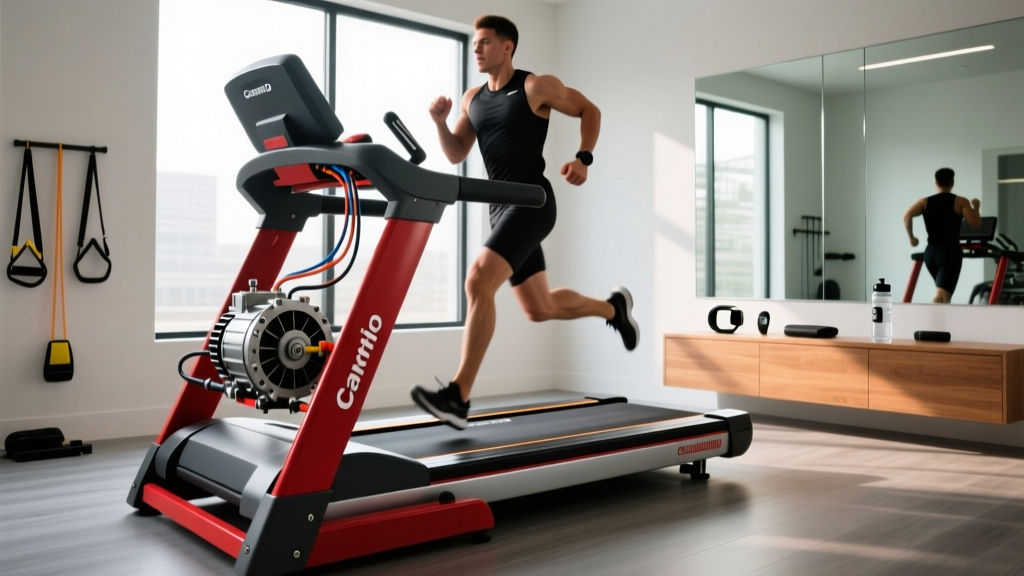
Treadmill Motor Setup for a 20 Minute HIIT Treadmill Workout

Air Bike vs Assault Bike: Treadmill Speeds to Mile Pace
Beyond the Sydney Sweeney Treadmill Scene: Top Folding Treadmills
Best Under Desk Treadmills With Smart Treadmill Programs (2026)
