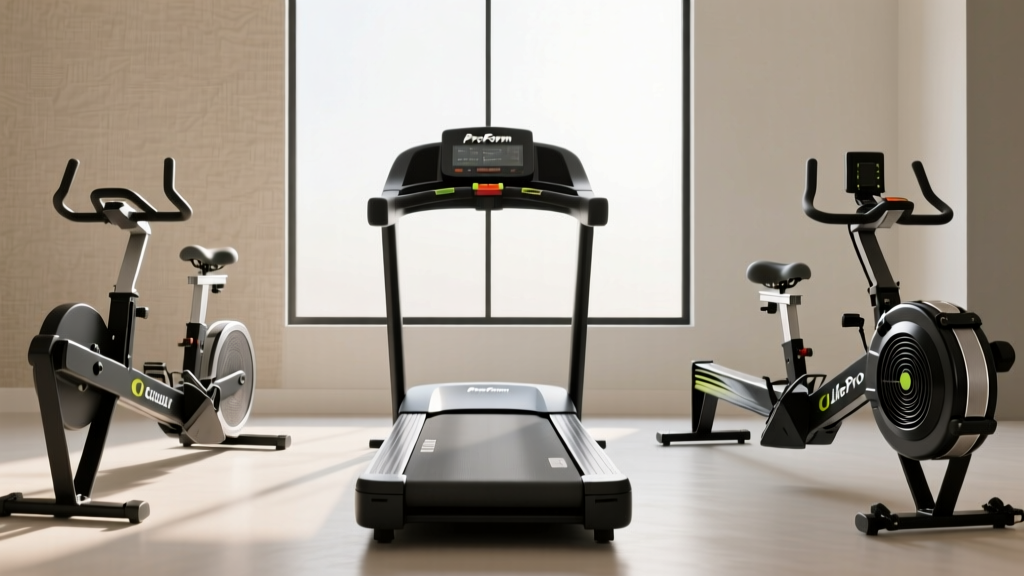
Stationary Bike Types vs Sole F80 Treadmills: 2026 Market Trends
Analyzing the 2026 market shift from heavy-duty treadmills to stationary bike types, including upright, recumbent, and spin models, for modern home gyms.

The 2026 Cardio Market Pivot: Space, Tech, and Joint Preservation
The home fitness equipment market in 2026 is undergoing a significant spatial and biomechanical correction. For the past decade, heavy-duty folding and motorized units—most notably benchmark models like Sole F80 treadmills—dominated the premium home gym sector. However, recent consumer behavior indicates a massive pivot toward stationary bike types. Driven by urbanization, shrinking square footage, and an aging demographic prioritizing joint longevity, upright, recumbent, and spin bikes are rapidly capturing market share from traditional motorized cardio.
According to Grand View Research, the indoor cycling and low-impact cardio segments are expanding at a compound annual growth rate (CAGR) that consistently outpaces traditional motorized treadmills. This report deconstructs the three primary stationary bike types, analyzing their engineering, market positioning, and how they compare to the spatial and financial footprint of legacy treadmill models.
2026 Market Insight: The Space-to-Performance Ratio
The average American home gym space has shrunk by 14% since 2021. While a standard Sole F80 treadmill requires a minimum operational footprint of 82 by 35 inches (plus 24 inches of rear clearance for safety), modern magnetic spin bikes demand less than half that area, offering equivalent or superior cardiovascular output without the structural floor-load concerns.
Deconstructing Stationary Bike Types
To understand the market shift, we must evaluate the distinct engineering and target demographics of the three dominant stationary bike types available in today's market.
1. Spin Bikes (Indoor Cycling): The High-Intensity Leader
Spin bikes prioritize aggressive ergonomics, heavy flywheels (or advanced electromagnetic resistance), and out-of-the-saddle riding capabilities. In 2026, the market has almost entirely abandoned friction-pad resistance in favor of eddy-current magnetic systems, which eliminate dust buildup, belt degradation, and the need for manual tension calibration.
- Market Leaders: Schwinn IC4, NordicTrack S22i, Peloton Bike+.
- Price Range: $899 (Entry-level magnetic) to $2,495 (Premium connected ecosystems).
- Biomechanics: High cadence, high resistance. Requires significant core engagement and hip mobility. Caloric expenditure can exceed 600 kcal/hour during HIIT protocols.
- Failure Modes: Cheaper models suffer from bottom-bracket bearing failure under high-torque, out-of-the-saddle stress. Sweat corrosion on unprotected steel frames remains a primary warranty claim in the budget tier.
2. Upright Bikes: The Traditional Ergonomic Standard
Upright bikes mimic the geometry of a standard road bicycle but feature a wider, more supportive saddle and a step-through or low-bar frame. They are the workhorses of commercial gyms and appeal to users seeking moderate-intensity steady-state (MISS) cardio without the aggressive forward lean of a spin bike.
- Market Leaders: Sole B94, Life Fitness Integrity Series.
- Price Range: $1,099 to $3,500.
- Biomechanics: Seated-only riding. Engages the quadriceps and glutes with minimal upper body involvement. Ideal for users with lower back restrictions who still want a traditional cycling motion.
- Failure Modes: Seat post slippage and console potentiometer degradation. Upright bikes rely heavily on electronic consoles; when the motherboard fails, the machine is often rendered useless due to proprietary part locks and software DRM.
3. Recumbent Bikes: The Longevity and Rehab Choice
Driven by the 'Silver Tsunami' and physical therapy crossover, recumbent bikes feature a bucket seat with a backrest and front-mounted pedals. This design eliminates axial loading on the spine, making it the undisputed king of rehabilitative cardio.
- Market Leaders: Sole R92, Schwinn 270, NuStep (for recumbent cross-trainers).
- Price Range: $1,299 to $4,200.
- Biomechanics: Closed-chain, zero-impact. The seated position reduces heart rate drift compared to upright cycling at the same wattage, making it highly specific for cardiac rehab and hypertensive users.
- Failure Modes: Linear motor failure in the pedal adjustment rail. Because recumbent bikes are heavier and harder to move, users often neglect cleaning the seat rail tracks, leading to dust-clogged optical sensors and jerky seat adjustments.
Comparative Matrix: Bikes vs. The Sole F80 Baseline
To contextualize why consumers are migrating away from motorized treadmills, we must compare the physical and financial realities. The Sole F80 remains a gold standard for home running, but its spatial and electrical requirements are substantial.
| Feature | Sole F80 Treadmill (Baseline) | Spin Bike (e.g., Schwinn IC4) | Recumbent Bike (e.g., Sole R92) |
|---|---|---|---|
| Footprint (L x W) | 82" x 35" (Requires 106" depth for safety) | 45" x 21" | 63" x 28" |
| Unit Weight | 280 lbs | 112 lbs | 155 lbs |
| Joint Impact | Moderate-High (2.5x body weight) | Low (Closed-chain) | Zero (Supported spine) |
| Maintenance | Belt lubrication, motor dusting, deck waxing | Sweat wiping, occasional bearing grease | Rail cleaning, sensor dusting |
| 2026 Avg. Price | $1,199 | $999 | $1,499 |
Supply Chain and Manufacturing Shifts in 2026
The pricing stability of stationary bike types in 2026 is directly tied to a maturation in the global supply chain. During the pandemic-era fitness boom, magnetic resistance components and neodymium magnets faced severe shortages, driving spin bike prices up by 30%. Today, diversified manufacturing hubs in Southeast Asia have stabilized the cost of eddy-current braking systems. Conversely, the heavy copper windings required for 3.5 CHP treadmill motors (like the one found in the Sole F80) remain subject to volatile commodity pricing, making high-quality treadmills increasingly expensive to produce and ship due to their sheer mass.
The Biomechanical and Spatial Economics
The transition from treadmills to stationary bike types is not merely a trend; it is a response to architectural and physiological realities. Running on a treadmill, even one equipped with advanced cushioning systems, generates significant ground reaction forces. The World Health Organization emphasizes sustainable, lifelong physical activity, and for the growing demographic of users over 45, the repetitive axial loading of running accelerates cartilage degradation in the knees and lumbar spine.
Furthermore, the spatial economics favor bikes. A Sole F80 treadmill requires a dedicated 110V high-amperage circuit to prevent motor surges during heavy user impact. In contrast, spin and upright bikes draw minimal amperage, and many modern magnetic bikes utilize self-generating alternators, requiring zero wall power. This allows urban dwellers to place a spin bike in a bedroom or home office without tripping breakers or violating lease agreements regarding heavy motorized equipment.
Consumer Buying Framework: Selecting Your 2026 Cardio Anchor
When deciding between upright, recumbent, spin, or sticking with traditional treadmills, use this diagnostic framework to match the equipment to your specific lifestyle constraints:
- Assess Joint Health: If you have a history of meniscus tears, plantar fasciitis, or lumbar herniations, immediately eliminate motorized treadmills and upright bikes. A recumbent bike is the only clinically safe option for high-volume cardio.
- Evaluate Space Constraints: If your designated workout area is under 20 square feet, a spin bike is the only viable high-output option. Upright and recumbent bikes require wider bases for lateral stability.
- Determine Engagement Style: Spin bikes require intrinsic motivation or subscription-based digital coaching (e.g., Peloton, JRNY). Upright and recumbent bikes are highly conducive to passive entertainment (reading, watching television) due to the stable upper body.
- Calculate Total Cost of Ownership (TCO): Treadmills require periodic belt replacements ($150-$250) and motor brush inspections. Magnetic bikes have virtually zero wearable parts aside from the poly-v drive belt, which typically lasts 5-7 years under normal home use.
Future Outlook: The Convergence of Hardware and Software
As we move deeper into 2026, the hardware distinctions between premium upright, recumbent, and spin bikes are narrowing, with the true battleground shifting to software integration and automatic resistance adjustment via AI coaching. While heavy-duty treadmills will always hold a niche for marathon purists and run-walk interval trainers, the broader consumer market has decisively crowned the stationary bike—particularly the compact, magnetic spin bike—as the most efficient, joint-friendly, and space-conscious cardiovascular investment for the modern home.
More gear to consider
All reviews
Stair Climber Troubleshooting: Mistakes & Echelon Treadmill Review

Recumbent Bike vs Treadmill Upkeep: Air vs Assault Bike Care
Echanfit Treadmill vs Elliptical: Maintenance & Longevity Guide

Treadmill Sunny Health and Fitness Belt Maintenance Value Guide

Best Folding Treadmill for Small Spaces & Beginner Running Programs