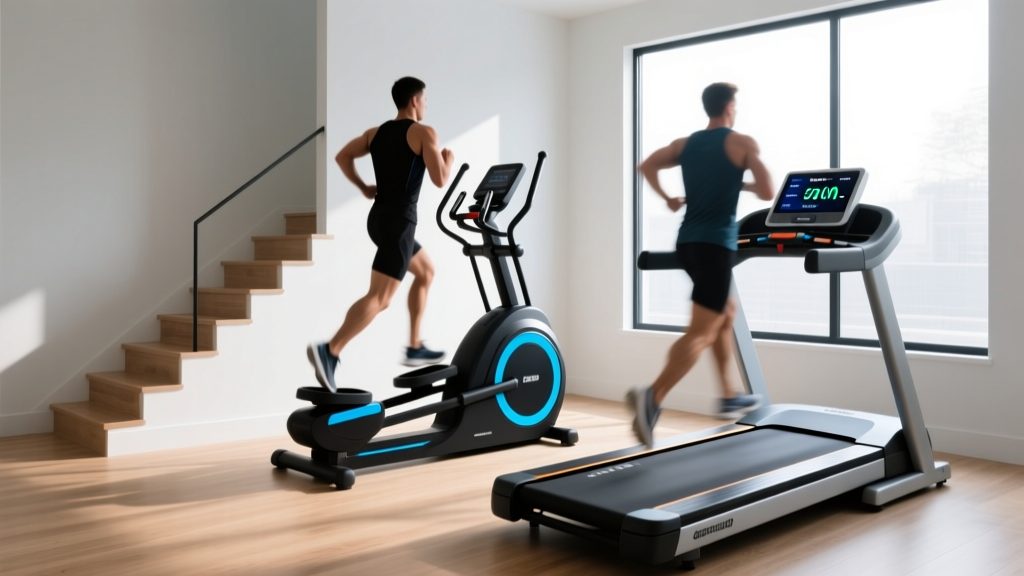
Stair Climber vs Treadmill Workouts for Sprinters: Home Guide
Discover how a home stair climber compares to treadmill workouts for sprinters. Step-by-step beginner guide, top 2026 models, and biomechanics.

When developing explosive speed, most athletes immediately default to track sessions or high-intensity treadmill workouts for sprinters. While horizontal force production on a treadmill is vital, integrating a stair climber machine for home use into your regimen offers a unique biomechanical advantage. For beginners and seasoned sprinters alike, the stair climber isolates the concentric drive phase of a sprint start, building massive hip extension power without the eccentric joint pounding of running.
This comprehensive 2026 guide will walk you through the biomechanics of stair climbing versus sprinting, provide a step-by-step beginner protocol, and review the best home stair climbers on the market. Whether you are supplementing your track days or looking for a low-impact alternative to standard treadmill workouts for sprinters, this guide has you covered.
The Biomechanics: Stair Climbers vs. Treadmill Workouts for Sprinters
To understand why a stair climber is a secret weapon for speed, we must look at ground reaction forces (GRF) and muscle activation. According to kinesiology data from ExRx.net, the stair climber heavily targets the gluteus maximus, vastus lateralis, and soleus. Unlike treadmill workouts for sprinters—which require rapid hamstring eccentric deceleration to pull the leg back under the body—the stair climber is purely concentric. You push down to elevate your center of mass, mimicking the explosive first 10 meters of a block start.
Expert Insight: Sprinters often suffer from hamstring strains during the late swing phase of running. Because the stair climber eliminates the eccentric 'catch and pull' phase of the running stride, it allows you to build immense glute and quad horsepower while giving your hamstrings a much-needed active recovery day.Force Vector Comparison Matrix
| Feature | Home Stair Climber | Treadmill (Incline Sprints) |
|---|---|---|
| Primary Force Vector | Vertical & Posterior Chain | Horizontal & Anterior Chain |
| Joint Impact (Eccentric) | Very Low (No strike phase) | Moderate to High (Foot strike) |
| Ankle Stiffness Demand | High (Continuous dorsiflexion) | Moderate (Varies by speed) |
| Best Sprint Phase Mimicked | Block Start / Acceleration (0-20m) | Max Velocity / Upright Sprinting |
| Core Anti-Rotation | High (If hands are off rails) | Low (Arms swing naturally) |
Step-by-Step Beginner Guide: Your First Sprinter’s Stair Session
Transitioning from the track or treadmill to a stair climber requires a shift in posture. The biggest mistake beginners make is 'rail-hanging,' which offloads the core and ruins the hip extension angle. Follow this step-by-step protocol endorsed by strength coaches at the National Strength and Conditioning Association (NSCA) to maximize your power output.
Step 1: The 'Sprinter's Posture' Setup
- Step on and brace: Step onto the pedals and lightly rest your fingertips on the handrails purely for balance, not support.
- Establish the lean: Hinge at the hips to create a 45-degree forward lean. This mimics the acceleration posture of a sprinter leaving the blocks.
- Engage the core: Brace your abdominals as if preparing for a punch. This prevents your lower back from hyperextending as the steps descend.
Step 2: Foot Placement and the 'Toe-Off'
- Ball of the foot: Never place your entire foot flat on the pedal. Keep your weight on the metatarsals (ball of the foot) to maintain Achilles tendon stiffness and calf activation.
- Drive through the heel: As you push the pedal down, imagine driving your heel toward the floor to fully engage the gluteus maximus at the bottom of the stroke.
- Dorsiflexion: Keep your non-working toe pulled up toward your shin (dorsiflexed) in the air, exactly as you would when recovering your leg during a sprint.
Step 3: The Beginner Power Protocol (20 Minutes)
Do not jump into max-speed climbing. Treat this like a track session with structured work-to-rest ratios.
- Warm-up (5 mins): 50-60 Steps Per Minute (SPM). Focus on deep hip flexion and posture.
- Block 1 (Drive Phase): 30 seconds at 80-90 SPM (heavy resistance). Drive hard, mimicking a 10m burst.
- Active Recovery: 90 seconds at 40 SPM (light resistance). Keep the legs moving to clear lactate.
- Repeat: Complete 6 total blocks.
- Cool Down (3 mins): 40 SPM, gradually reducing range of motion.
Top Home Stair Climbers in 2026 for Athletes
Not all stair climbers are built for the explosive force generated by sprinters. Cheap friction-based machines will slip under heavy loads. Here are the top three models for home use in 2026, categorized by budget and drive-train durability.
1. The Commercial Standard: StairMaster FreeClimber
- Price: ~$3,499
- Drive System: Heavy-duty chain and sprocket with an alternator generator.
- Why Sprinters Love It: The FreeClimber allows independent pedal movement and features a 6-inch step height. The alternator provides instant, smooth resistance the millisecond you push, meaning there is zero 'lag' during explosive intervals. It supports users up to 275 lbs and handles high-SPM sprint intervals without belt slip.
2. The Space-Saving Hybrid: Bowflex Max Trainer M9
- Price: ~$2,299
- Drive System: Magnetic resistance with a stepper-elliptical hybrid motion.
- Why Sprinters Love It: While technically a hybrid, the M9 offers a steep, stair-like climb with zero joint impact. It features a 20-inch stride and advanced magnetic resistance that can be cranked to level 20 for brutal hill-sprint simulations. It connects seamlessly to the JRNY app for adaptive coaching. Check out more on their engineering at Bowflex.
3. The Budget Entry: Sunny Health & Fitness SF-S902025
- Price: ~$450
- Drive System: Belt-driven with manual/magnetic tension.
- Why Sprinters Love It: For beginners on a strict budget, this mini-stepper with a high-rise frame offers decent concentric loading. Warning: The belt drive will stretch over time under explosive loads, and the max weight capacity is 220 lbs. It is best for warm-ups and endurance hip-flexor work rather than max-velocity power output.
Machine Maintenance: Avoiding Failure Modes
Sprinters generate massive downward force. If you buy a mid-tier or budget machine, you must maintain it to prevent catastrophic failure during a high-SPM interval.
⚠️ Critical Maintenance Warning: Sweat corrosion is the #1 killer of home stair climbers. Sweat drips directly onto the optical encoder (the sensor that counts your steps and adjusts magnetic resistance). Once salt builds up on the optical lens, the machine will 'ghost' step counts or suddenly drop resistance to zero mid-sprint, causing dangerous stumbles.- Wipe the Encoder Weekly: Locate the optical sensor near the flywheel (refer to your manual) and wipe it with a dry microfiber cloth and a drop of isopropyl alcohol.
- Check Belt Tension (Belt-Drive Models): Every 30 days, check the tension on the internal drive belt. If it deflects more than 1/2 inch when pressed, tighten the tensioner bolt to prevent pedal slip.
- Lubricate the Pivot Arms: The lateral pivot arms connecting the pedals to the frame endure high shear force. Apply a silicone-based lubricant (never WD-40, which attracts dust) to the bronze bushings every 90 days.
Frequently Asked Questions (FAQ)
Q: Can a stair climber completely replace treadmill workouts for sprinters?
A: No. Sprinting requires horizontal force application and specific neuromuscular timing (the stretch-shortening cycle) that only running can provide. The stair climber is a supplemental tool for building concentric power, hip flexor endurance, and ankle stiffness, but you still need track time or a high-quality curved treadmill for max-velocity mechanics.
Q: Why do my shins burn after 5 minutes on the stair climber?
A: This is due to the constant active dorsiflexion required to keep your toes from catching the descending steps. This is actually highly beneficial for sprinters, as it strengthens the tibialis anterior, which is crucial for foot strike preparation and preventing shin splints on the track. The burn will subside as your localized muscular endurance improves over 2-3 weeks.
Q: Should I use the handrails during my sprint intervals?
A: Absolutely not. Gripping the rails shifts your center of gravity backward, reducing glute activation by up to 30% and promoting a 'seated' climbing posture. If you need balance, lightly rest your index fingers on the console or use a 'ghost grip' (hovering your hands just above the rails) to force your core and hip stabilizers to do the work.
More gear to consider
All reviews
Air Bike vs Assault Bike: Space & 12 3 30 Treadmill Workout
How Fast Is 7.0 on a Treadmill? Belt Maintenance & Speed Fixes

Stationary Bike Types & Hand Walking on Treadmill: Budget Analysis
Rowing Guide: NordicTrack Commercial 2450 Folding Treadmill Alternative

Gold's Gym Trainer 410 Treadmill vs Ellipticals: 2026 Market Trends
