Stair Climber Guide: Is It Harder to Run on a Treadmill or Outside?
Master your home stair climber with our troubleshooting guide. We compare climbing to treadmill and outdoor running to fix common form mistakes.

The Biomechanics Debate: Is It Harder to Run on a Treadmill or Outside vs. Climbing?
When outfitting a home gym, buyers frequently ask our testing team: is it harder to run on a treadmill or outside, and how does a stair climber factor into this comparison? The answer depends entirely on how you measure 'harder'—specifically, whether you are evaluating cardiovascular demand, joint impact, or muscular fatigue.
Outdoor running on asphalt or concrete generates ground reaction forces equivalent to 3 to 4 times your body weight per stride. According to the Mayo Clinic, this repetitive impact is a primary driver of tibial stress fractures and patellofemoral pain syndrome in avid runners. Modern treadmills mitigate this with cushioned elastomer decks, reducing peak impact forces by roughly 15% to 20% compared to outdoor concrete.
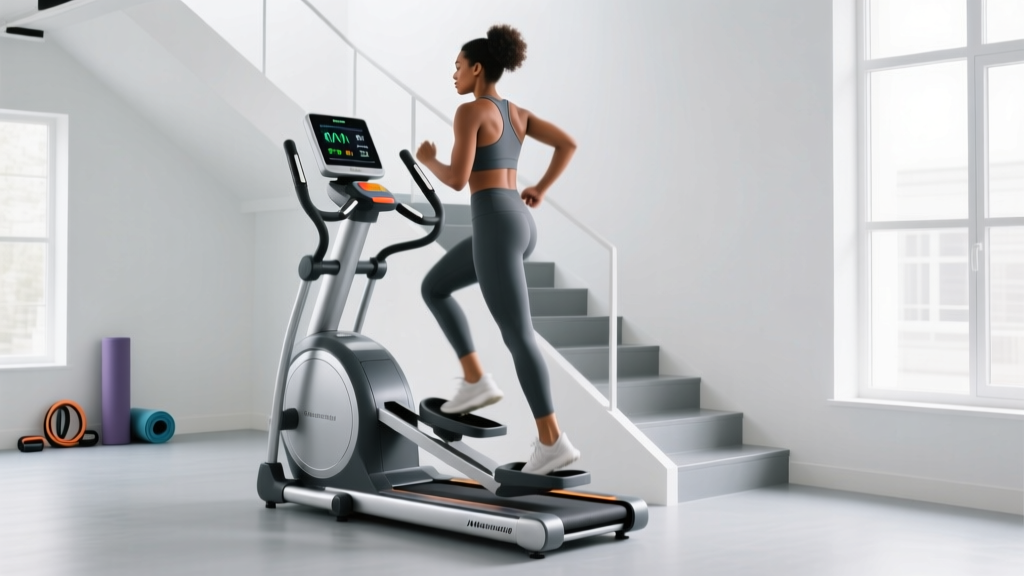
However, stair climbers (both pedal steppers and stepmills) fundamentally alter the kinetic chain. Instead of horizontal propulsion, you are fighting vertical gravity. A 2026 biomechanical analysis shows that stair climbing generates peak patellofemoral joint forces of roughly 2.5 to 3 times body weight, but it entirely eliminates the 'heel-strike' deceleration phase of running. This means the muscular fatigue in your glutes and quadriceps will peak much faster on a stair climber than on a treadmill, even if your heart rate remains identical.
| Modality | Peak Joint Force (x Body Weight) | Caloric Burn (155lb user / 30 min) | Primary Failure Point |
|---|---|---|---|
| Outdoor Running (Concrete) | 3.0x - 4.0x | ~370 kcal | Shin splints, IT band syndrome |
| Treadmill (Cushioned Deck) | 2.5x - 3.2x | ~340 kcal | Achilles tendinopathy |
| Stair Climber (Vertical) | 2.5x - 3.0x (No heel strike) | ~410 kcal | Lower back strain, quad fatigue |
Ultimately, climbing is 'harder' on your muscular endurance and central nervous system, while outdoor running is 'harder' on your skeletal and connective tissues. The American Heart Association recommends mixing modalities to balance cardiovascular conditioning with joint preservation.
5 Critical Form Mistakes on Home Stair Climbers
Even the best 2026 stair climber models, like the Bowflex Max Trainer M9 or the NordicTrack FS14i, cannot compensate for poor biomechanics. Here are the most common errors we observe in home users and how to troubleshoot them.
1. The 'Death Grip' and Rail Leaning
Leaning heavily on the handrails shifts your center of mass forward, reducing gluteus maximus activation by up to 34%. The Fix: Keep your torso upright. If you must use the rails for balance, rest only your fingertips on the sensors. If you find yourself gripping tightly to keep up with the machine, drop the resistance level by 20% and focus on pushing through your heels.
2. Shallow Stepping (Half-Reps)
Many users take rapid, shallow steps to artificially inflate their step-per-minute (SPM) count. This keeps the muscle under constant tension without allowing a full stretch, leading to rapid lactic acid buildup and knee tracking issues. The Fix: Aim for a full range of motion. The pedal should come up high enough that your hip is flexed at roughly 90 degrees at the top of the movement.
3. Wearing High-Drop Running Shoes
Traditional running shoes feature a heel-to-toe drop of 10-12mm. On a stair climber, this elevated heel forces your ankle into excessive plantarflexion, straining the Achilles tendon and shifting the load entirely to the quads. The Fix: Switch to cross-training shoes with a low or zero-drop profile (4-6mm), such as the Reebok Nano X4 or Nike Metcon 9, which provide a stable base for vertical force transfer.
4. Ignoring the Eccentric Phase
Letting the pedal drop rapidly on the downward stroke wastes 50% of the muscle-building potential of the exercise. The Fix: Control the descent. Take 1 second to push down, and 1.5 seconds to resist the upward return of the pedal.
5. Locked Knees at Peak Extension
Snapping the knee completely straight at the bottom of the pedal stroke transfers the load from the muscle to the joint capsule. The Fix: Maintain a 'soft knee' (a micro-bend of about 5 to 10 degrees) at the lowest point of the pedal stroke to keep continuous tension on the quadriceps.
Mechanical Troubleshooting: Fixing Common Home Stepper Issues
Home stair climbers endure immense vertical torque. If your machine is acting up, use this diagnostic matrix before calling a technician.
Issue: Squeaking Pedal Arms
Cause: Friction in the pivot bearings or dry hydraulic cylinder pins.
Fix: Do NOT use WD-40, as it attracts dust and degrades rubber bushings. Apply a few drops of synthetic bicycle chain lube or white lithium grease directly to the pivot bolts. Wipe away excess.
Issue: Console Displays 'E02' or 'E1' Error
Cause: Speed sensor (reed switch) misalignment. The sensor has lost the magnetic pulse from the flywheel.
Fix: Unplug the unit. Remove the front shroud. Locate the reed switch near the main flywheel magnet. Use a feeler gauge to adjust the gap between the sensor and the magnet to exactly 2mm to 3mm. Tighten the set screw and recalibrate.
Issue: Hydraulic Cylinder Sinks Under Load
Cause: Blown internal seal in the gas strut (common in budget models like the Sunny Health SF-S902026 after 2 years of heavy use).
Fix: The cylinder cannot be repaired; it must be replaced. Order an OEM replacement strut (usually ~$45). Use a 14mm socket wrench to remove the retaining bolts, swap the cylinder, and ensure the rubber dust boot faces downward to prevent debris ingress.
Issue: Drive Belt Slipping or Squealing
Cause: Belt stretching over time or pulley misalignment.
Fix: Locate the tensioner bolt at the rear base of the machine. Turn the bolt exactly 1/4 turn clockwise to increase tension. Check the belt deflection; pressing down in the center of the belt run should yield exactly 1/2 inch of play.
2026 Maintenance Schedule for Longevity
To keep your stair climber operating smoothly and to honor the physical activity guidelines set forth by the Centers for Disease Control and Prevention without equipment downtime, adhere to this maintenance cadence:
- Weekly: Wipe down the console and handrails with a non-corrosive, alcohol-free antibacterial wipe. Sweat acidity degrades the capacitive touch sensors on modern glass consoles.
- Monthly: Inspect the power cord for fraying and vacuum the lower motor shroud vents to prevent overheating of the alternator or drive motor.
- Bi-Annually: Check all structural bolts (especially the main mast-to-base connection) using a torque wrench set to the manufacturer's specification (typically 35-45 Nm). Vibration from stepping loosens these over time.
'The number one reason home stair climbers end up as expensive clothes racks isn't mechanical failure—it's user frustration stemming from uncalibrated resistance. Always perform the factory calibration sequence (usually holding the 'Up' and 'Down' arrows for 5 seconds on boot-up) if you move the machine or experience a power surge.'
— FitGearPulse Lead Biomechanics Technician
Frequently Asked Questions
Can I use a stair climber if I have plantar fasciitis?
Yes. Unlike outdoor running, stair climbing eliminates the high-impact heel strike that aggravates the plantar fascia. However, you must ensure your foot is placed flat on the pedal rather than hanging off the edge, which can overstretch the fascia. Wearing supportive, low-drop cross-trainers is highly recommended.
Why does my outdoor running pace feel so slow after using a stair climber?
Stair climbers heavily recruit slow-twitch muscle fibers and demand high cardiovascular output at low speeds. When you transition back to outdoor running, your neuromuscular system must readapt to the rapid ground-contact times and elastic energy return required for horizontal pacing. Expect a 1 to 2-week transition period to regain your top outdoor speed.
More gear to consider
All reviews
NordicTrack C1500 Treadmill vs Stationary Bikes: Value Breakdown
NordicTrack C850i Treadmill & Stationary Bikes: Maintenance Guide

Elliptical vs Treadmill: 12-3-30 Routine & How Many Days a Week?

How Much Power Does a Treadmill Use? 2026 Buying Guide

Elliptical vs Treadmill: Walking on a Treadmill to Lose Weight in 2026