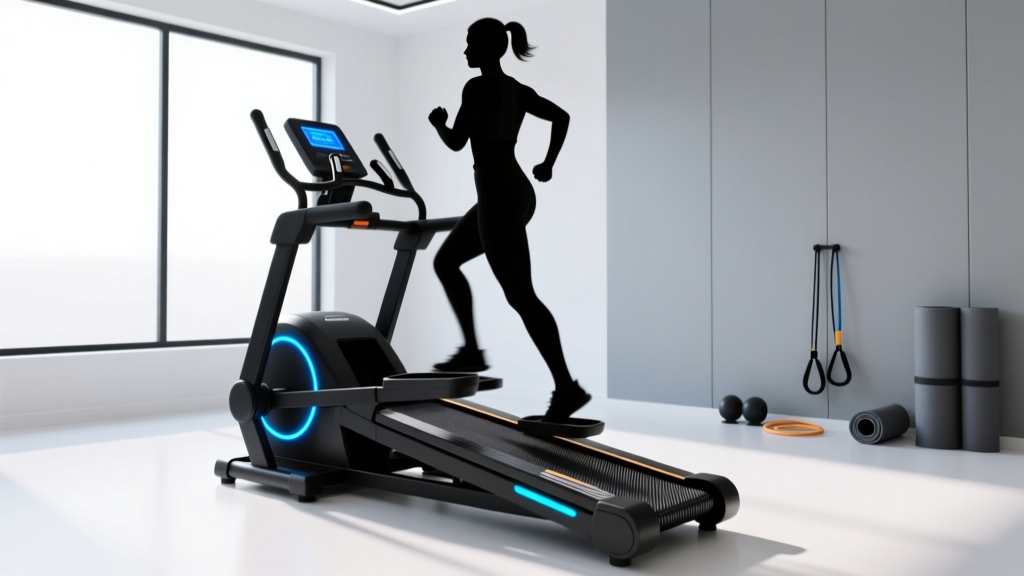
Home Stair Climber Guide: How Much Incline on Treadmill Matches It?
Discover the best stair climber machines for home use in our beginner guide. Plus, learn how much incline on treadmill settings matches a vertical climb.

The Biomechanics: Stair Climber vs. Treadmill Incline
When transitioning from a standard walking routine to a dedicated climbing regimen, a common question arises among home gym builders: how much incline on treadmill settings is required to mimic the intensity of a stair climber? The short answer is that a standard 15% treadmill incline does not fully replicate the biomechanical load of a true vertical stair climber, but it comes closer than most people realize if you adjust your speed.
A standard treadmill maxing out at a 15% grade means the belt rises 15 inches for every 100 inches of forward travel. This creates an 8.5-degree angle. While this heavily engages the posterior chain (glutes and hamstrings), your foot still strikes a flat, moving surface. In contrast, a revolving stair climber (like a StepMill) requires a true vertical step-up against gravity, engaging the quadriceps and gluteus maximus through a much deeper range of motion without the forward momentum of a treadmill belt.
Expert Insight: To approximate the caloric expenditure and muscle activation of a moderate stair climb (about 50 steps per minute) on a standard treadmill, you must set the incline to the maximum 15% and walk at a brisk 3.0 to 3.5 mph without holding onto the handrails. However, high-end incline trainers (like the NordicTrack X32i) that reach a 40% grade offer a much closer biomechanical match to a stair climber.Comparison Matrix: Muscle Activation and Impact
| Machine Type | Grade / Incline | Primary Muscle Focus | Joint Impact Level |
|---|---|---|---|
| Standard Treadmill | 15% (8.5° angle) | Calves, Quads, Hamstrings | High (Running) / Med (Walking) |
| Incline Trainer | 40% (21.8° angle) | Glutes, Quads, Core | Medium |
| Hydraulic Pedal Stepper | Variable (Step Height) | Quads, Calves | Low |
| Revolving StepMill | 100% Vertical Step | Glutes, Hamstrings, Quads | Low to Medium |
Step-by-Step: Choosing the Right Home Stair Climber
The home fitness market in 2026 offers three distinct categories of stair climbers. Selecting the right one depends on your budget, ceiling height, and joint health. According to the Centers for Disease Control and Prevention (CDC), adults need at least 150 minutes of moderate-intensity aerobic activity weekly, and stair climbing is one of the most time-efficient ways to achieve this.
1. Revolving Stair Climbers (The Gold Standard)
These machines feature a continuously rotating set of actual stairs. They are the most challenging and effective option.
- Top Model: StairMaster StepMill SM5
- 2026 Pricing: ~$3,199
- Pros: Unmatched calorie burn, true vertical biomechanics, highly durable chain-drive system.
- Cons: Requires significant vertical clearance; steep learning curve for beginners.
2. Hybrid Elliptical/Steppers
These combine the low-impact, fluid motion of an elliptical with the vertical resistance of a stepper.
- Top Model: Bowflex Max Trainer M9
- 2026 Pricing: ~$2,299
- Pros: Extremely low joint impact (ideal for rehab or older adults), compact footprint, upper body engagement.
- Cons: Does not perfectly replicate the functional movement of climbing real stairs.
3. Hydraulic Pedal Steppers (Budget Option)
Compact, independent pedal machines driven by hydraulic cylinders.
- Top Model: Sunny Health & Fitness SF-S0978
- 2026 Pricing: ~$120
- Pros: Affordable, easily stored under a bed or in a closet.
- Cons: Failure Mode Alert: Hydraulic cylinders tend to overheat and lose resistance after 20–30 minutes of continuous use. Not suitable for long endurance sessions.
Space, Power, and Installation Requirements
Before purchasing a revolving stair climber, you must measure your ceiling height. This is the number one reason these machines are returned. The formula for required ceiling clearance is: User Height + 16 inches (for the step height at the peak) + 2 inches (for safety clearance).
For example, if you are 6'0" (72 inches), you need a minimum ceiling height of 90 inches (7 feet, 6 inches). Standard modern homes feature 8-foot (96-inch) ceilings on the main floor, which accommodates most users. However, if you are building a basement gym with drop ceilings or HVAC ducting, you may run into clearance issues. Furthermore, revolving stair climbers require a dedicated 120V/15A electrical outlet, whereas hydraulic steppers are entirely manual and require no power.
The Beginner’s 4-Week Stair Climber Progression Plan
Jumping onto a StepMill at a high speed is a recipe for cardiovascular burnout and lower back pain. The Mayo Clinic recommends gradually increasing aerobic intensity to allow your tendons and cardiovascular system to adapt. Follow this step-by-step 4-week framework.
- Week 1: Base Building (Focus on Form)
- Frequency: 3 days/week
- Duration: 10 minutes
- Pace: 40-45 Steps Per Minute (SPM)
- Goal: Learn to balance without gripping the handrails. Keep your core braced and torso upright.
- Week 2: Endurance Extension
- Frequency: 3 days/week
- Duration: 15 minutes
- Pace: 45-50 SPM
- Goal: Maintain a steady heart rate in Zone 2 (60-70% of your max heart rate). You should be able to speak in short sentences.
- Week 3: Interval Introduction
- Frequency: 3 days/week
- Duration: 20 minutes total
- Pace: Alternate 3 minutes at 50 SPM with 1 minute at 65 SPM.
- Goal: Push into Zone 4 (anaerobic threshold) during the fast intervals to improve VO2 max.
- Week 4: The 30-Minute Milestone
- Frequency: 2 steady days, 1 interval day
- Duration: 30 minutes (steady days)
- Pace: 55 SPM steady state
- Goal: Build muscular endurance in the glutes and quads without form breakdown.
Leaning heavily on the handrails and draping your torso over the console shifts the workload away from your glutes and lower body, transferring it to your shoulders and lower back. This can reduce your caloric expenditure by up to 30%. Rest your fingertips lightly on the rails for balance only.
Frequently Asked Questions
Is a stair climber better than a treadmill for weight loss?
Both machines are excellent for weight loss, but they serve different purposes. A stair climber generally burns more calories per minute at lower perceived exertion levels because it requires you to lift your entire body weight vertically against gravity with every step. However, treadmills offer more versatility for sprinting and long-distance endurance training.
Will using a stair climber make my legs bulky?
No. Stair climbing is primarily a cardiovascular and muscular endurance exercise. While it will heavily tone and define your quadriceps, hamstrings, and glutes, it does not provide the progressive mechanical overload required for significant muscle hypertrophy (bulk). To build bulky legs, you would need to incorporate heavy barbell squats and deadlifts into your routine.
How do I maintain a hydraulic pedal stepper?
Hydraulic steppers require minimal maintenance, but you should periodically check the pivot joints for squeaking and apply a silicone-based lubricant every 6 months. More importantly, monitor the hydraulic cylinders for fluid leaks or a sudden drop in resistance, which indicates the internal seals have blown and the cylinder needs replacement.
Can I use a stair climber if I have knee pain?
It depends on the source of the pain. According to the American Heart Association, low-impact aerobic exercises are vital for overall joint health. Revolving stair climbers are generally low-impact because there is no foot-strike shock. However, the deep knee flexion required to step up can aggravate patellofemoral pain syndrome (runner's knee). If you have knee issues, a hybrid elliptical-stepper or a treadmill set to a 10% incline is usually a safer starting point.
More gear to consider
All reviews
Hockey Training Treadmill Motor Size & HP Guide 2026

Does Holding Onto the Treadmill Burn Less Calories? Noise Guide

4.0 HP Treadmill Noise vs. Quiet Cardio: 2026 Buying Guide

Navigating the Walking Treadmill Bicycle Debate: 2026 Setup & Feature Guide

ProShox 2 Treadmill vs Elliptical: 2026 Home Cardio Trends
