
Home Stair Climber Guide: Avoiding Jump Rope vs Treadmill Mistakes
Master your home stair climber with our troubleshooting guide. Learn to avoid common form mistakes often carried over from the jump rope vs treadmill debate.

The 2026 Home Cardio Landscape: Beyond the Basics
When designing a home gym, fitness enthusiasts frequently weigh the pros and cons of the classic jump rope vs treadmill debate. While both offer exceptional cardiovascular conditioning, many ultimately pivot to a stair climber machine for home use to maximize glute activation while minimizing the repetitive impact forces associated with running or jumping. However, a critical issue arises in 2026: users are bringing the biomechanical habits of treadmills and jump ropes onto their stair climbers, leading to premature joint fatigue, lower back pain, and accelerated machine degradation.
This comprehensive troubleshooting and form-correction guide will help you identify these carryover mistakes, optimize your stride, and perform essential hardware maintenance on today's leading models.
The Biomechanical Trap: Form Carryovers
The human body is highly adaptive, which is a blessing for muscle memory but a curse when switching modalities. If you have spent months analyzing the jump rope vs treadmill comparison and alternating between the two, your central nervous system is wired for specific ground-reaction forces. Applying these forces to a vertical stair climber (whether a pedal-based stepper or a stairmill with a rotating staircase) creates a kinetic chain mismatch.
Warning: According to the Mayo Clinic, weight-bearing aerobic exercises are crucial for bone density, but improper load distribution on stair climbers can shift stress from the skeletal system to the lumbar spine and patellar tendons.Top 3 Form Mistakes & Troubleshooting Solutions
1. The "Treadmill Lean" (Handrail Weight-Bearing)
The Mistake: On a treadmill, users often lean forward and grip the handrails during high-incline walking. When transitioning to a home stair climber, users replicate this "treadmill lean," supporting 20% to 30% of their body weight on the console handrails. This completely disengages the gluteus maximus and places severe shear force on the lumbar spine.
The Fix: Adopt a "soft grip" or completely hands-free approach. Your torso should remain upright with a slight 5-degree forward hinge at the hips, not the waist. If you cannot maintain the cadence without heavily gripping the rails, the resistance is too high. Drop the resistance level by 20% and focus on driving through the heel.
2. The "Jump Rope Bounce" (Forefoot Striking)
The Mistake: Jump rope mechanics rely on staying on the balls of the feet (forefoot striking) to utilize the Achilles tendon's elastic energy. Many users unconsciously apply this "jump rope bounce" to the stair climber, stepping only with their toes and letting their heels hang off the pedals.
The Fix: Plant the entire foot flat on the pedal. Driving through the midfoot and heel is non-negotiable for activating the posterior chain (glutes and hamstrings). Toe-striking on a climber isolates the calves and rapidly induces plantar fasciitis. Aim for a step depth of at least 8 to 10 inches per pedal press.
3. Shallow Step Syndrome (Half-Repping)
The Mistake: Taking rapid, shallow steps to artificially inflate the Steps Per Minute (SPM) metric on the console.
The Fix: Quality supersedes speed. The American Heart Association recommends 75 minutes of vigorous aerobic activity per week. You achieve vigorous intensity through full range-of-motion muscle recruitment, not just rapid twitching. Aim for 50-60 SPM with full pedal depression rather than 100+ SPM with half-steps.
Hardware Troubleshooting Matrix: 2026 Home Models
Even with perfect form, home stair climbers require specific maintenance. Below is a diagnostic matrix for three of the most popular home models currently on the market.
| Model (2026 Pricing) | Common Failure Mode | Diagnostic & Troubleshooting Fix |
|---|---|---|
| Bowflex Max Trainer M9 ($2,299) |
Squeaking pedal arm or crank bearing during heavy resistance climbs. | Do NOT use standard WD-40. Apply white lithium grease to the main crank bearing. Ensure the internal magnetic flywheel housing is free of dust, which causes friction drag. |
| Sunny Health SF-S901055 ($380) |
Console displays "0 SPM" despite active pedaling. | The magnetic reed switch is misaligned. Remove the front plastic shroud (usually 4 Phillips screws). Adjust the sensor so there is exactly a 3mm gap between the magnet on the flywheel and the reed switch. |
| NordicTrack CLM9.9 ($1,499) |
iFIT app sync drops or lags during HIIT auto-adjustments. | The Android-based console is running out of RAM. Clear the app cache in the hidden developer settings, and ensure your router is broadcasting a dedicated 5GHz band specifically for the machine. |
Advanced Maintenance: Belt Tension and Drive Systems
Unlike treadmills that require silicone belt lubrication, or jump ropes that need occasional cable kink-removal, pedal-based stair climbers rely on internal drive belts and tensioners. If your pedals feel "slack" at the top of the movement or exhibit a half-second delay when you reverse direction, the internal V-belt has stretched.
- Unplug the machine and remove the side shroud panels.
- Locate the idler pulley bracket (usually secured by two 14mm hex bolts).
- Loosen the bolts, apply outward pressure to the pulley to increase belt tension, and retighten.
- Test the pedal response. There should be zero dead-zone when transitioning from the upstroke to the downstroke.
Programming: Hypertrophy vs. Endurance
To get the most out of your machine, you must program your sessions based on your specific physiological goals. Here is a step-by-step framework for structuring your week, aligned with CDC physical activity guidelines.
Protocol A: Glute Hypertrophy (2x Per Week)
- Cadence: 45-55 SPM (Slow and controlled).
- Resistance: High (Level 12-15 on Bowflex; Level 16-20 on NordicTrack).
- Form Cue: Slight hip hinge, drive exclusively through the heel. Imagine you are performing a single-leg leg press.
- Duration: 15-20 minutes.
Protocol B: Cardiovascular Endurance (3x Per Week)
- Cadence: 75-90 SPM (Brisk, rhythmic pace).
- Resistance: Moderate (Level 6-8).
- Form Cue: Upright torso, flat foot plant, engage the core to stabilize the pelvis.
- Duration: 30-45 minutes.
"The stair climber is unparalleled for lower-body muscular endurance, but only if the user respects the vertical vector of force. Stop treating it like a horizontal treadmill." — Biomechanics Insight, FitGearPulse Lab
Final Thoughts on Your Home Gym Setup
Ultimately, the decision between different cardio modalities comes down to your joint health, spatial constraints, and fitness goals. While the jump rope vs treadmill comparison will always dominate forums regarding pure calorie burn and agility, the home stair climber remains the undisputed king of low-impact, high-yield lower-body conditioning. By eliminating these common form mistakes, performing routine hardware diagnostics, and programming your SPM with intention, your 2026 home gym setup will deliver unparalleled results without the physical wear and tear.
More gear to consider
All reviews
Stair Climber vs F80 Treadmill: Beginner Home Guide
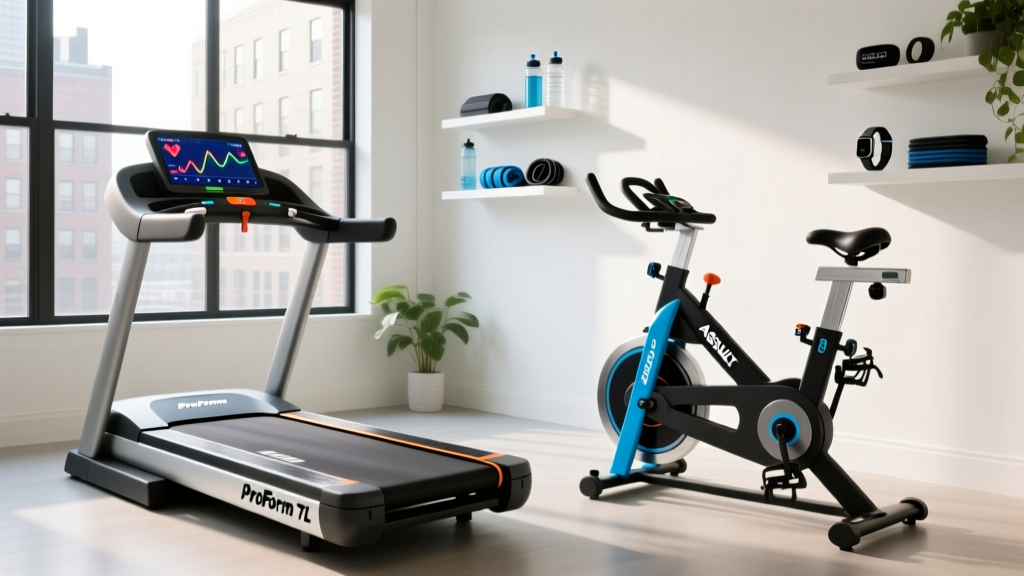
ProForm TL Treadmill vs Air Bikes: 2026 Assault Bike Market Trends

Compact Cardio Guide: Walking Pads & Treadmill Belt Lubricant

Curved vs Motorized: Best Treadmill Workout to Lose Weight

Curved Manual Treadmill vs Motorized: Pro 9000 Treadmill Compared
