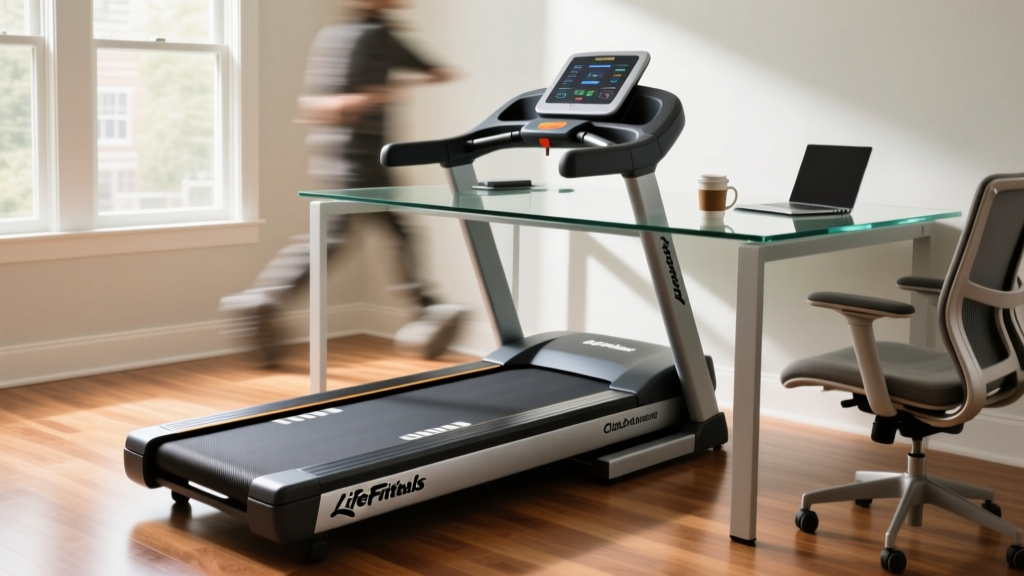
Under Desk Treadmill Review: LifeFitness Club Series Treadmill Care
Compare under desk treadmills for office use with the LifeFitness Club Series treadmill. Expert maintenance, longevity tips, and failure mode analysis.

The Hidden Costs of Active Workspaces: A Maintenance-First Review
The modern office in 2026 has fully embraced Non-Exercise Activity Thermogenesis (NEAT). According to the Mayo Clinic, integrating low-intensity movement into your workday can significantly offset the metabolic damage of prolonged sitting. Consequently, the demand for under-desk treadmills has skyrocketed. However, when consumers request an under desk treadmill for office use review, they typically focus on footprint, noise levels, and price. As equipment longevity experts at FitGearPulse, we look at a different metric: maintenance burden and mechanical failure rates.
To provide a truly comprehensive evaluation, we cannot review light-duty office treadmills in a vacuum. We must contrast their maintenance requirements and failure modes against the gold standard of commercial cardio durability: the LifeFitness Club Series treadmill. By understanding the engineering gap between a $300 office walker and a $3,500 commercial-grade machine, you can make an informed decision about total cost of ownership and daily maintenance care.
Top Under Desk Treadmills for Office Use (2026 Longevity Review)
Most under-desk treadmills utilize direct-current (DC) motors and low-friction composite decks. While adequate for walking, these components require specific, often overlooked, maintenance routines to survive past their one-year warranty windows.
WalkingPad R2 Pro: The Folding Hinge Challenge
The WalkingPad R2 Pro (retailing around $499) remains a top seller due to its 180-degree folding capability and 1.25 HP continuous motor. From a maintenance perspective, the folding mechanism is its greatest vulnerability. The central hinge houses a complex wiring harness that flexes every time the unit is folded. Longevity Tip: Never fold or unfold the R2 Pro while the belt is in motion. Additionally, the hinge pivot points require a drop of white lithium grease every six months to prevent micro-fractures in the aluminum chassis.
UREVO Strol 2E: Belt Tension and Dust Ingestion
Priced aggressively at $299, the UREVO Strol 2E features a 2.25 HP peak (1.0 HP continuous) motor. Because it sits merely two inches off the ground, the motor intake fan acts as a vacuum for office dust, pet hair, and debris. Longevity Tip: You must use a compressed air duster to blow out the motor hood every 30 days. Furthermore, the Strol 2E lacks an auto-lubrication system. You must apply exactly 15ml of 100% pure silicone treadmill lubricant under the belt every 40 miles of use to prevent the deck from delaminating.
WARNING: The Low-Speed Motor TrapMost users operate under-desk treadmills at 1.0 to 2.0 MPH. In standard DC motors, the internal cooling fan is directly attached to the motor shaft. At 1.5 MPH, the fan spins too slowly to dissipate the high torque heat generated by continuous walking. This low-speed thermal buildup is the number one cause of premature motor controller failure in office treadmills. Always allow the treadmill to run at 4.0 MPH for two minutes after your work session to let the internal fan cool the copper windings.
The Benchmark: LifeFitness Club Series Treadmill Maintenance
When evaluating longevity, the LifeFitness Club Series treadmill serves as the ultimate benchmark. Designed for light commercial and premium home use (priced between $3,200 and $3,800), it incorporates engineering solutions that eliminate the most common maintenance headaches found in budget office treadmills.
The EverWax Lubrication System
Unlike the manual silicone applications required on the UREVO or WalkingPad, the LifeFitness Club Series treadmill utilizes the proprietary EverWax system. An integrated wax reservoir slowly wicks lubricant onto the deck surface via a felt applicator pad. According to Life Fitness Support documentation, this system provides consistent, friction-free belt movement for up to 3,000 miles before the wax cartridge requires replacement. This completely eliminates the risk of user error—such as over-lubrication, which can cause the belt to slip and destroy the drive roller.
Motor Hood and Deck Inspection Protocol
The Club Series features a 3.0 HP continuous-duty commercial motor with an independent, thermally protected cooling system that does not rely solely on belt speed. Maintenance here shifts from daily survival to quarterly preservation:
- Quarterly: Remove the four hex-screws on the motor hood and vacuum the interior using a soft brush attachment. Inspect the drive belt for micro-cracking.
- Bi-Annually: Check belt tracking. The Club Series uses a heavy-duty tensioning roller; adjust the rear roller bolts exactly one-quarter turn clockwise if the belt drifts left.
- Annually: Inspect the FlexDeck shock absorption system. The elastomer cushions compress over time and should be swapped out if you notice increased joint impact or a 'bottoming out' sensation.
Maintenance Matrix: Light-Duty vs. Commercial-Grade
To visualize the true time and financial investment of your workspace cardio, compare the annual maintenance requirements of a standard under-desk model versus the LifeFitness Club Series treadmill.
| Maintenance Task | Standard Under-Desk Treadmill | LifeFitness Club Series Treadmill |
|---|---|---|
| Belt Lubrication | Manual (Every 40 miles / ~$15/yr) | EverWax Auto-System (Every 3000 miles / ~$30/yr) |
| Motor Dusting | Monthly (Compressed air required) | Quarterly (Standard vacuum) |
| Deck Replacement | 12-18 months (Non-reversible) | 5-7 years (Reversible phenolic deck) |
| Belt Tensioning | Frequent (Stretch-prone PVC belts) | Rare (Kevlar-reinforced multi-ply belts) |
Common Failure Modes in Office Environments
Office environments present unique hazards for cardio equipment that do not exist in standard home gyms. Understanding these edge cases is critical for maximizing the lifespan of your investment.
Static Electricity and PCB Frying
Office spaces typically feature low-humidity HVAC systems and synthetic carpeting. As your shoes strike the treadmill belt, static electricity builds up. In cheap under-desk treadmills, this static charge can arc through the handrails or console directly into the Printed Circuit Board (PCB), instantly frying the motor controller. The Fix: Always use an anti-static mat beneath your under-desk treadmill, and apply a silicone-based anti-static spray to the belt edges once a month. The LifeFitness Club Series treadmill mitigates this via integrated static-dissipation strips woven directly into the belt grounding wire.
Continuous Micro-Adjustments and Edge Fraying
When typing at a desk, users unconsciously shift their weight, walking slightly to the left or right. This uneven lateral force causes the belt to constantly rub against the side rails. Over time, this edge friction frays the belt and strips the tracking wax from the deck margins. As noted in comprehensive equipment guides by Runner's World, uneven belt wear is a primary indicator of poor user biomechanics combined with inadequate side-rail clearance. Ensure your under-desk treadmill has at least 2 inches of clearance on either side of the walking path to prevent catastrophic belt shredding.
Expert Longevity Protocol for Workspace Treadmills
Whether you opt for a budget-friendly office walker or invest in a commercial-grade unit, implementing this strict weekly and monthly protocol will drastically extend the operational life of your machine.
- The Post-Shift Cooldown: Never power off the treadmill immediately after stepping off. Allow it to run unloaded at 3.0 MPH for 90 seconds. This disperses localized heat from the motor windings and redistributes liquid silicone across the deck.
- The Tension Check: Once a week, perform the 'stomp test.' Walk at 1.0 MPH and abruptly stop your foot. If the belt slips under your weight while the front roller continues to spin, the drive belt tension needs adjustment. Ignoring this will strip the roller pulley teeth within a month.
- Fastener Auditing: The micro-vibrations of a treadmill operating 4 hours a day on a hard office floor will slowly back out console and handrail bolts. Every 90 days, use a metric Allen key set to tighten all structural fasteners, applying a drop of blue Loctite to the threads to prevent future loosening.
Frequently Asked Maintenance Questions
Can I use WD-40 to lubricate my under-desk treadmill belt?
Absolutely not. WD-40 is a petroleum-based solvent, not a lubricant. It will immediately dissolve the factory-applied wax on the deck, destroy the PVC integrity of the belt, and create a massive slipping hazard. Only use 100% pure liquid silicone specifically formulated for fitness equipment.
Is the LifeFitness Club Series treadmill too loud for a shared office?
Surprisingly, no. Because the Club Series utilizes a heavy, commercial-grade flywheel and a thick, multi-ply belt, it actually produces less high-frequency 'whine' than the small, high-RPM DC motors found in budget under-desk models. The primary noise is the low-frequency thud of footfalls, which can be entirely eliminated by placing a 1-inch thick EVA foam equipment mat beneath the unit.
How do I know if my treadmill deck is worn out?
Slide your hand under the belt and feel the deck surface. If it feels rough, splintered, or has visible grooves worn into the phenolic coating, the deck is compromised. Running a machine with a worn deck increases motor amp-draw by up to 40%, which will rapidly lead to motor burnout. On reversible decks like those found on higher-end models, you can simply unbolt the rollers, flip the deck over, and expose a fresh surface.
"The true cost of a treadmill is not its retail price, but the friction it generates over time. A well-maintained commercial deck yields thousands of hours of silent operation, while a neglected budget deck becomes a noisy, motor-killing liability within a single fiscal quarter."
— FitGearPulse Equipment Engineering Team, 2026 Longevity Report
More gear to consider
All reviews
Stair Climber Home Guide: Connect Apple Watch to Star Trac Treadmill
ProForm CC500 Treadmill vs Ellipticals: Home Space Layout Guide

Why Your Knees Hurt From Running on a Treadmill: The Motor Size Guide

How to Center a Treadmill Belt: Ultimate Maintenance Guide

Life Fitness T3 Treadmill Review: A Motor Horsepower Guide
