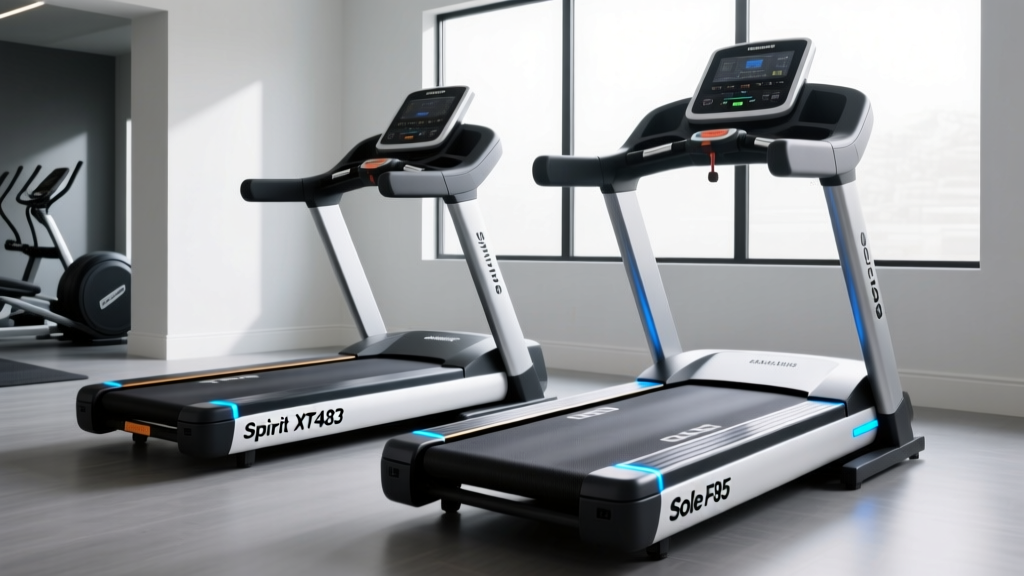
Spirit XT485 Treadmill vs Sole F85: 2026 Heavy-Duty Comparison
We compare the Spirit XT485 treadmill against the Sole F85. Discover motor specs, deck cushioning, and pricing to choose the best heavy-duty runner.

The Heavy-Duty Home Treadmill Showdown
When outfitting a home gym in 2026, the line between light-commercial and premium residential equipment has completely blurred. Runners and walkers investing in the $2,000 to $2,500 bracket expect marathon-level durability, advanced biomechanical support, and decades of use. In this tier, the Spirit XT485 treadmill and the Sole F85 stand as the undisputed heavyweights. Both machines boast 4.0 continuous horsepower (CHP) motors, 400-pound weight capacities, and lifetime frame warranties. But beneath the identical spec sheets lie distinct engineering philosophies that will dictate which machine is right for your specific stride, tech preferences, and long-term maintenance tolerance.
This head-to-head comparison strips away the marketing fluff. We are diving deep into motor controller architecture, deck elastomer durometers, real-world failure modes, and the true cost of ownership to help you make a definitive choice.
Core Specifications Matrix
Before dissecting the engineering, here is how the 2026 models stack up on paper. Note that while both machines are priced similarly, their physical footprints and user interfaces diverge significantly.
| Specification | Spirit XT485 Treadmill | Sole F85 (2026 Refresh) |
|---|---|---|
| Street Price | $2,299 | $2,299 - $2,499 |
| Motor | 4.0 CHP (DC Motor) | 4.0 CHP (DC Motor) |
| Belt Dimensions | 20' x 60' | 22' x 60' |
| Roller Diameter | 2.5' (Crowned) | 2.75' (Crowned) |
| Top Speed / Incline | 12 MPH / 15% | 12 MPH / 15% |
| Console Display | 9' Blue-Grey LCD (Physical Buttons) | 15.6' Android Touchscreen |
| Weight Capacity | 400 lbs | 400 lbs |
| Machine Weight | 280 lbs | 280 lbs |
Motor Architecture and Drive System Dynamics
Both the Spirit XT485 and Sole F85 utilize 4.0 CHP direct-current (DC) motors. In the treadmill industry, a 4.0 CHP motor is the gold standard for heavy-duty home use, capable of dissipating heat efficiently during 90+ minute endurance runs without thermal throttling. However, the controller feeding power to these motors is where the difference emerges.
Pulse Width Modulation (PWM) and Low-Speed Tracking
Historically, heavy-duty treadmills struggled with 'surging' at walking speeds (under 3.0 MPH) because the motor controllers couldn't deliver micro-adjustments in voltage smoothly. In 2026, both Spirit and Sole have upgraded to high-frequency PWM motor controllers. This means that whether you are doing a 1.5 MPH recovery walk or a 12 MPH sprint, the belt tension remains mathematically consistent. The Spirit XT485's motor runs slightly cooler under sustained incline loads due to an upgraded internal cooling fan design introduced in their late-2024 revision, which pulls ambient air more efficiently across the copper windings.
Deck, Belt, and Biomechanics: The 2-Inch Dilemma
The most glaring physical difference between these two machines is the running surface. The Sole F85 offers a expansive 22-inch wide belt, while the Spirit XT485 treadmill utilizes a more traditional 20-inch width. Both are 60 inches long, which is adequate for runners up to 6'4'.
Expert Insight: According to biomechanical research published in the National Institutes of Health (PMC), runners exhibit natural lateral drift (side-to-side movement) when fatigued. A narrower belt requires heightened spatial awareness, which can subtly alter your natural gait and increase cognitive fatigue during marathon-pace training blocks.
Cushioning Systems Compared
Joint preservation is a primary reason buyers invest in premium treadmills over asphalt running. The Mayo Clinic notes that reducing impact forces is critical for runners with a history of Achilles or patellar tendinopathy.
- Sole F85 (Cushion Flex Whisper Deck): Sole uses a variable-durometer elastomer system. The deck is firmer at the toe-off zone (for energy return) and softer at the strike zone (for shock absorption). It reduces impact by up to 40% compared to asphalt.
- Spirit XT485 (Multi-Zone Cushioning): Spirit employs a slightly firmer overall deck with targeted rubber bumpers. It offers a more 'road-like' feel, which is highly preferred by competitive runners training for outdoor marathons who need to condition their lower legs for the stiffness of real pavement.
Console, Tech, and the Touchscreen Debate
This is where the two brands diverge most aggressively, representing a fundamental split in fitness equipment philosophy.
Sole F85: The Entertainment Hub
The 2026 Sole F85 features a massive 15.6-inch Android-based touchscreen. It supports native app streaming, screen mirroring, and built-in Wi-Fi. If you want to watch Netflix or follow live scenic routes natively on the console, the F85 wins effortlessly. However, touchscreens in high-vibration environments (like a treadmill deck) are prone to digitizer failure over a 5-to-10-year lifespan.
Spirit XT485: The Utilitarian Workhorse
The Spirit XT485 treadmill uses a 9-inch blue-grey LCD screen surrounded by heavy-duty, tactile membrane buttons. There is no native video streaming. Instead, Spirit relies on a robust Bluetooth FTMS (Fitness Machine Service) protocol. You place your own iPad or tablet on the included shelf and connect it to Zwift, Kinomap, or the Peloton App. The advantage? When Apple releases a new iPad in 2028, your treadmill's 'screen' gets an upgrade. The physical membrane buttons on the Spirit are rated for over 1 million presses and are virtually immune to the sweat-induced ghost-touches that plague capacitive touchscreens.
Real-World Failure Modes and Warranty Edge Cases
Understanding what actually breaks on a treadmill is crucial. The Federal Trade Commission (FTC) advises consumers to look beyond the headline 'Lifetime' warranties and scrutinize the labor and parts terms. Both Spirit and Sole offer Lifetime coverage on the frame and motor, but the fine print tells a different story.
Common Failure Points at 1,500+ Miles
- Roller Bearings: The 608zz bearings inside the rollers eventually degrade. The Sole F85's larger 2.75-inch rollers distribute belt tension over a wider surface area, slightly extending bearing life compared to the Spirit's 2.5-inch rollers.
- Incline Motor Gears: Both use plastic internal gears for the incline lift to reduce noise. Dropping heavy dumbbells on the deck while the treadmill is at a 15% incline can strip these gears on either machine.
- Drive Belt Slippage: Requires manual tensioning every 500 miles. Spirit's ribbed drive belt design grips the motor pulley slightly better under high-torque, low-speed incline walking.
The Warranty Gap: Sole offers 3 years on parts and electronics, and 1 year of in-home labor. Spirit offers 5 years on parts and electronics, but also only 1 year of in-home labor. Spirit's extended electronics coverage is a massive advantage, specifically protecting the PWM motor controller and console PCBs against power surge damage (provided you use a dedicated 20-amp circuit).
The Final Verdict: Which Should You Buy?
Choosing between the Spirit XT485 treadmill and the Sole F85 comes down to your physical dimensions, your tech philosophy, and your training goals.
Choose the Sole F85 If:
- You are taller than 6'2' or have a wide, lateral-heavy running gait that requires the 22-inch belt width.
- You prefer an all-in-one entertainment and fitness ecosystem with a native touchscreen and built-in speakers.
- You prioritize maximum shock absorption for joint preservation over road-simulation.
Choose the Spirit XT485 Treadmill If:
- You are a competitive runner who prefers a firmer, more responsive deck that mimics outdoor asphalt.
- You want a 'buy it for life' machine with physical buttons and a bring-your-own-device (BYOD) screen setup that won't become technologically obsolete.
- You value the 5-year parts and electronics warranty, which provides superior long-term protection for the machine's internal computer boards.
Both machines represent the absolute pinnacle of 2026 residential cardio engineering. By aligning your specific biomechanical needs with the engineering nuances outlined above, you will secure a heavy-duty treadmill that serves your mileage goals for the next decade and beyond.
More gear to consider
All reviews
Compact Cardio Layouts: Beyond the Person on a Treadmill

Cursor C70 Treadmill Review: 2026 Walking Pad Comparison Guide

Walmart Black Friday Treadmill Deals: Features & Setup Guide
Assault Curved Treadmill vs Motorized: HP & Motor Guide

Elliptical vs T5 Treadmill: 2026 Home Cardio Trend Report
