Sole F85 Treadmill Assembly vs Walking Pad Setup 2026
Compare the Sole F85 treadmill assembly process and performance against top 2026 walking pads. Find out which cardio machine fits your home gym.

The Home Gym Dilemma: Heavy-Duty Performance vs. Ultra-Compact Convenience
As home fitness trends evolve in 2026, the cardio equipment market has sharply divided into two distinct camps: the ultra-durable, high-performance traditional treadmill and the minimalist, space-saving walking pad. For serious runners and walking enthusiasts alike, choosing between these two formats requires looking far beyond the marketing brochures. It demands a rigorous evaluation of spatial footprint, biomechanical support, and—perhaps most importantly for the DIY home gym builder—the actual setup experience.
In this head-to-head comparison, we are pitting the industry-standard heavy-duty runner, the Sole F85, against the latest generation of premium walking pads (specifically the 2026 KingSmith WalkingPad X21). By analyzing the Sole F85 treadmill assembly process alongside the plug-and-play nature of modern walking pads, we will uncover which machine truly deserves the floor space in your home.
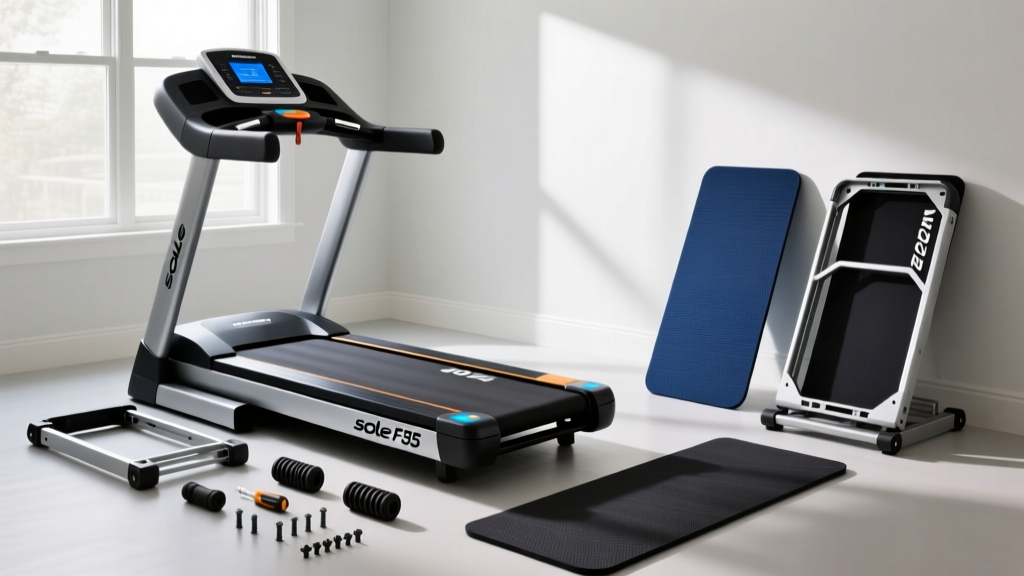
The Sole F85 Treadmill Assembly Reality: A Two-Person Job
The Sole F85 remains a cornerstone of the residential treadmill market, boasting a 4.0 CHP motor, a 22" x 60" running belt, and a 350-pound user capacity. However, this performance comes with significant physical mass. The F85 ships in a single, massive crate weighing approximately 280 pounds.
⚠️ Safety Warning: Never attempt to move the Sole F85 shipping crate alone. The center of gravity is heavily biased toward the front motor hood. Use a furniture dolly and a second person to navigate doorways and hallways.Step-by-Step Assembly Breakdown
When you begin the Sole F85 treadmill assembly, the first thing you notice is the sheer volume of hardware. While Sole provides the necessary Allen wrenches, you will need your own 15mm socket wrench to properly torque the stabilizer bolts. Expect the process to take 90 to 120 minutes.
- Deck Positioning: After cutting the crate, you must carefully roll the pre-assembled deck off the pallet. The deck is fully folded, but still weighs over 200 lbs.
- Stabilizer Attachment: You will bolt the front and rear T-stabilizers to the main frame using heavy-duty M10 and M12 carriage bolts. This is where the 15mm socket wrench is mandatory to ensure the frame doesn't wobble during high-speed sprints.
- Upright Mast Wiring (The Critical Step): This is where most home assemblers make mistakes. You must route the console data cable through the left upright mast. Pro Tip: Use the included wire pull-string and apply a light coating of dielectric grease to the connector pins to prevent future corrosion and console error codes (like the dreaded E1 error).
- Console Mounting & Calibration: Once the console is secured, you must run the factory incline calibration sequence (usually holding the 'Speed Up' and 'Incline Up' buttons simultaneously for 5 seconds) to synchronize the lift motor.
Walking Pad Unboxing: The 5-Minute Contrast
Transitioning from the Sole F85 to a premium walking pad like the KingSmith WalkingPad X21 is a study in contrasts. The X21 ships in a box roughly the size of a large flat-screen TV, weighing a manageable 62 pounds. One person can easily carry it into a bedroom or home office without breaking a sweat.
According to Consumer Reports' treadmill and walking pad buying guides, the primary appeal of walking pads is their "zero-assembly" design. The X21 features a patented 180-degree folding hinge. Setup involves:
- Cutting the zip-ties and unfolding the handrail (if using the R2/X21 hybrid model).
- Tightening four hand-screws on the handrail base—no tools required.
- Plugging the power cord into a standard 120V outlet and pairing the Bluetooth remote.
The entire process takes less than five minutes. There are no data cables to route, no heavy stabilizers to torque, and no incline motors to calibrate, as the vast majority of walking pads operate on a fixed, zero-incline plane.
Head-to-Head Specification Matrix
To understand the trade-offs between the heavy-duty assembly of the F85 and the lightweight convenience of the walking pad, review the core specifications below.
| Feature | Sole F85 (Traditional Treadmill) | KingSmith WalkingPad X21 (2026 Model) |
|---|---|---|
| Motor Size | 4.0 CHP (Continuous Duty) | 2.5 HP (Peak Duty) |
| Belt Dimensions | 22" x 60" | 17.3" x 47.2" |
| Top Speed | 12.0 MPH | 7.6 MPH |
| Incline | 0% to 15% Power Incline | 0% (Fixed Flat) |
| User Capacity | 350 lbs | 240 lbs |
| Machine Weight | 280 lbs | 62 lbs |
| Assembly Time | 90 - 120 Minutes (2 People) | 5 Minutes (1 Person) |
| 2026 Retail Price | ~$1,999 | ~$599 |
Biomechanics, Stride, and Joint Impact
The most critical divergence between these two machines is not how they are assembled, but how they affect your body during use. The Sole F85 features Sole's proprietary Cushion Flex Whisper Deck system, which clinical testing has shown to reduce joint impact by up to 40% compared to running on asphalt. The 60-inch belt length accommodates a full, natural running stride for users up to 6'4" tall.
Conversely, walking pads require significant biomechanical compromises. The 47-inch belt length forces users taller than 5'10" to shorten their natural stride, which can lead to altered gait mechanics and lower back strain over prolonged sessions. Furthermore, walking pads lack shock absorption. As noted by Mayo Clinic fitness experts, while walking is an excellent low-impact cardiovascular exercise, doing so on a hard, unyielding surface without proper footwear can transfer shock directly to the knees and hips.
"If your primary goal is Zone 2 cardio while working at a standing desk, a walking pad is unparalleled. But if you are training for a 10K, require incline walking for glute activation, or suffer from joint pain, the biomechanical superiority of a full-sized treadmill is non-negotiable."
Long-Term Maintenance and Durability
When investing in cardio equipment, the initial assembly is just day one. Long-term maintenance dictates the lifespan of the machine.
Sole F85 Maintenance Profile
The F85 is built like a tank, utilizing a heavy-gauge steel frame and a commercial-grade motor. However, it requires active maintenance:
- Belt Lubrication: You must apply 100% silicone treadmill lubricant under the belt every 150 miles or every 3 months. Failure to do so will cause the deck to overheat, increasing amp-draw on the 4.0 CHP motor and eventually frying the motor control board.
- Belt Tensioning: Over time, the belt will stretch. You will need to use the included Allen wrench to adjust the rear roller bolts (usually a quarter-turn clockwise on each side) to prevent belt slip during heavy sprinting.
- Dust Management: The motor hood must be vacuumed every six months to prevent dust buildup on the motor fan, which is a leading cause of thermal shutdowns.
Walking Pad Maintenance Profile
Walking pads are largely maintenance-free, but they are also largely unrepairable. The X21 uses a sealed, low-profile deck that does not require traditional silicone lubrication. However, because the motor is smaller and works harder relative to its size (especially if used by individuals near the 240 lb weight limit), the internal components experience higher thermal stress. If the motherboard or motor fails on a walking pad out of warranty, the unit is generally considered disposable, whereas the Sole F85 features modular, replaceable parts that can be sourced directly from Sole Fitness or third-party fitness repair technicians.
The Final Verdict: Choosing Your 2026 Cardio Hub
The decision between the Sole F85 and a premium walking pad ultimately comes down to your spatial constraints, fitness objectives, and willingness to manage equipment setup and maintenance.
Buy the Sole F85 If:
- You are a dedicated runner or require high-speed interval training (up to 12 MPH).
- You need power incline (up to 15%) for hiking simulation and targeted glute/hamstring work.
- You have a dedicated home gym space (requiring at least 7' x 3' of permanent floor space plus 3' of clearance behind the deck).
- You are willing to invest 90 minutes into a precise, two-person assembly process to secure a machine that will last a decade.
Buy the WalkingPad X21 If:
- Your primary goal is achieving 10,000 daily steps while working at a standing desk.
- You live in an apartment or multi-use room where the machine must be slid under a bed or sofa when not in use.
- You are strictly a walker or light jogger (under 7.5 MPH) and do not require incline training.
- You want a true "plug-and-play" experience with zero tools, zero heavy lifting, and zero complex wiring.
Both machines excel in their specific niches. The Sole F85 demands respect, space, and a bit of elbow grease during assembly, but rewards you with commercial-grade biomechanics and longevity. The walking pad sacrifices performance metrics for ultimate spatial efficiency and instant gratification. Assess your room dimensions, measure your natural stride, and choose the tool that will actually keep you moving in 2026 and beyond.
More gear to consider
All reviews
Compact Portable Cardio: Maintenance & Normal Heart Rate on Treadmill

Can an Under Desk Treadmill Hit an 8.0 Treadmill Pace? 2026 Review
Compact Incline Treadmill Walking for Weight Loss: 2026 Review

ProForm Treadmill Safety Key & Belt Lubrication Guide

QVC Treadmill vs Rowing Machine: In-Depth Buying Guide & Technique