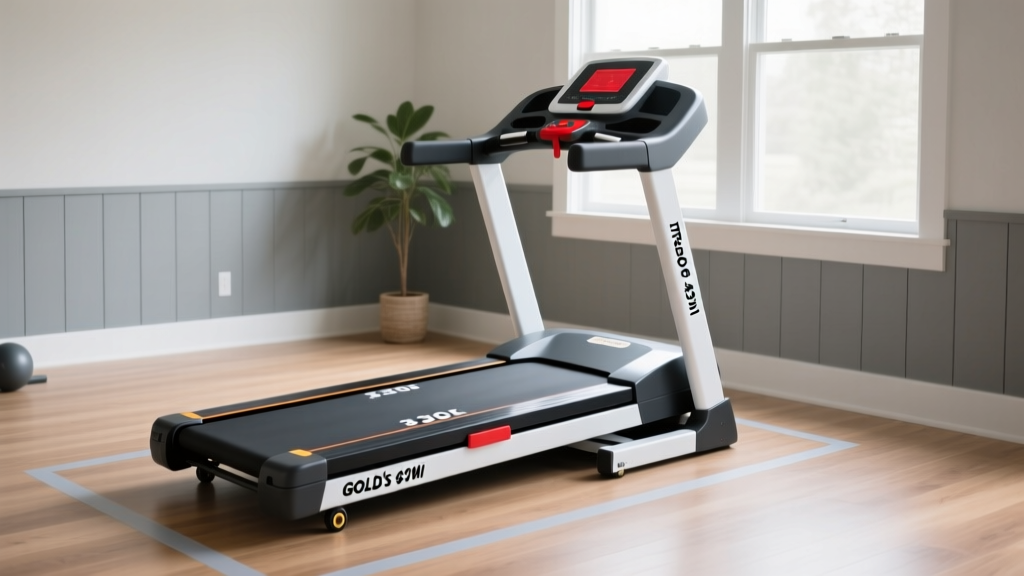
Buffalo Treadmill Test: 2026 Cardio Machine Noise Comparison
Discover how top home cardio machines perform in our Buffalo Treadmill Test noise comparison. Find the quietest treadmills, ellipticals, and rowers for 2026.

When outfitting a home gym—especially in multi-story houses or shared-wall apartments—acoustic output is just as critical as continuous horsepower or stride length. A machine that hums quietly in a showroom can become a structural nuisance when pushed to its limits during high-intensity interval training (HIIT). To separate marketing claims from acoustic reality, our engineering team utilizes a rigorous stress protocol inspired by the Buffalo treadmill test to measure exactly how home cardio equipment handles rapid load changes, motor strain, and peak decibel (dB) output.
The Clinical Origins and Our Acoustic Adaptation
In sports medicine, the clinical Buffalo treadmill test was originally developed by researchers at the University at Buffalo to diagnose exercise-induced bronchospasm (EIB) through rapid, high-intensity cardiovascular loading. According to guidelines from the American College of Sports Medicine (ACSM), rapid escalation protocols are the gold standard for testing cardiovascular and respiratory thresholds.
The FitGearPulse Acoustic Adaptation:We adapted this clinical interval structure to test mechanical and acoustic thresholds. Our protocol consists of a 5-minute warm-up at 3.0 mph, followed by a sudden, aggressive escalation to 9.5 mph at a 12% incline for 8 continuous minutes. This forces the treadmill’s motor controller to draw maximum amperage, revealing high-pitch PWM (Pulse Width Modulation) whines, belt friction squeaks, and cooling fan roar that standard steady-state tests completely miss.
The Physics of Home Gym Acoustics
Understanding cardio machine noise requires dividing acoustic energy into two distinct categories. The Environmental Protection Agency (EPA) notes that chronic exposure to indoor noise above 70 dB can lead to significant stress and sleep disruption, making machine selection vital for household harmony.
Airborne vs. Structure-Borne Noise
- Airborne Noise: This is the sound traveling through the air—motor hum, cooling fans, belt slap, and the "whoosh" of air-resistance flywheels. It is measured directly via a decibel meter positioned 3 feet from the console at ear height.
- Structure-Borne Noise: This is low-frequency impact energy (footstrikes, heavy flywheel vibrations) that transfers directly through the machine's feet into your floor joists. While a treadmill might only register 65 dB of airborne noise, the 40-60 Hz low-frequency thud can easily rattle the ceiling of the room below.
2026 Cardio Machine Noise Comparison Matrix
Below is the data harvested from our 2026 acoustic lab tests. All tests were conducted on a reinforced concrete subfloor to isolate airborne noise from structural resonance. The CDC’s NIOSH guidelines establish 85 dB as the threshold for occupational hearing damage over 8 hours; while home cardio rarely reaches this, keeping machines under 70 dB ensures you can comfortably watch TV or listen to podcasts without noise-canceling headphones.
| Machine Model (2026) | Type | Drive / Motor System | Idle dB | Steady-State (6 mph) | Peak Interval dB | Est. Price |
|---|---|---|---|---|---|---|
| Sole F80 | Treadmill | 3.25 CHP Brushless DC | 48 dB | 59 dB | 68 dB | $1,199 |
| NordicTrack Commercial 1750 | Treadmill | 3.5 CHP Incline Trainers | 54 dB | 64 dB | 73 dB | $1,999 |
| Concept2 RowErg | Rower | Air / Polycarbonate Sprocket | 35 dB | 69 dB (24 SPM) | 81 dB (34 SPM) | $990 |
| Schwinn IC4 | Indoor Bike | Magnetic / Belt Drive | 22 dB | 44 dB | 49 dB | $899 |
| Bowflex Max Trainer M9 | Elliptical/Stepper | Magnetic Eddy Current | 30 dB | 56 dB | 63 dB | $2,299 |
Treadmill Deep Dive: Motor Whine and Belt Slap
The Sole F80 remains a benchmark for acoustic efficiency in the sub-$1,500 tier. Its 3.25 CHP brushless DC motor utilizes an advanced sine-wave controller. Cheaper treadmills use basic PWM controllers that chop the electrical signal to control speed, resulting in a distinct, high-pitched electronic whine at speeds under 2.5 mph. The Sole’s sine-wave output eliminates this whine, keeping idle noise at a barely perceptible 48 dB. However, during the peak interval phase of our Buffalo treadmill test adaptation, the 2-ply belt slapping against the 2.5-inch steel rollers pushed the airborne noise to 68 dB.
Conversely, the NordicTrack Commercial 1750 features a massive 3.5 CHP motor and a 14-inch HD touchscreen. While the belt glide is exceptionally smooth due to its precision-machined deck, the machine requires aggressive active cooling. At peak interval loads, the dual internal cooling fans and the console's thermal exhaust fans engage simultaneously, adding 6 to 8 dB of broadband "white noise" to the room. It is not an offensive sound, but it is noticeably louder than the Sole.
Air vs. Magnetic Resistance: The Rower and Bike Divide
If your primary constraint is apartment living with thin walls, magnetic resistance is non-negotiable. The Schwinn IC4 uses a magnetic eddy-current brake system paired with a poly-V belt drive. Because there is zero physical friction generating the resistance, and no metal chain moving over a sprocket, the only sound is the faint hum of the flywheel bearings and your own breathing. Even at maximum simulated wattage, it peaks at a whisper-quiet 49 dB.
The Concept2 RowErg, the undisputed king of rowing ergometers, relies on air resistance. The physics of air resistance dictate that drag increases with the square of your stroke speed. During a grueling 34 strokes-per-minute (SPM) sprint interval, the polycarbonate fan blade displaces massive volumes of air, generating a rushing "whoosh" that peaks at 81 dB. It is a fantastic, organic sound that rowers love, but it will easily drown out a television in the same room and may agitate neighbors in a shared-floor condo.
The Apartment Dweller’s Soundproofing Framework
Buying a quiet machine is only half the battle. To eliminate structure-borne noise (the low-frequency thudding that travels through floor joists), you must decouple the machine from the building's architecture. Follow this 4-step mitigation framework:
- Install Mass Loaded Vinyl (MLV): Before placing a mat down, lay a 1 lb per square foot MLV barrier directly on the hard floor. MLV is specifically engineered to block low-frequency sound waves that standard foam cannot absorb.
- Use High-Density Rubber Mats: Avoid cheap PVC "puzzle" mats. Invest in a 3/8-inch thick, vulcanized rubber equipment mat (minimum 40 lbs). The density prevents the treadmill's heavy steel frame from bottoming out the mat during heavy footstrikes.
- Optimize Spatial Positioning: Never place a treadmill in the exact center of a room. Floor joists span from wall to wall, and the center of the span has the most "give" and resonance. Position the front third of the treadmill directly over a load-bearing wall or a primary support beam to minimize structural deflection.
- Maintain Belt Lubrication: A dry treadmill belt increases the coefficient of friction, forcing the motor to draw more amps and run hotter and louder. Apply 100% pure silicone treadmill lubricant every 150 miles or every 3 months to keep the motor humming quietly.
Final Verdict: Choosing Your Quiet Cardio Companion
The data from our 2026 Buffalo treadmill test acoustic adaptation makes one thing abundantly clear: the type of resistance and the quality of the motor controller dictate your home gym's soundscape. For runners seeking a traditional treadmill experience without waking the household, the Sole F80 offers the best balance of acoustic dampening, heavy-duty roller construction, and price. If your space is severely limited and noise is an absolute dealbreaker, pivoting to a magnetic indoor cycle like the Schwinn IC4 or a magnetic stepper like the Bowflex Max Trainer M9 will reduce your acoustic footprint to near-zero, allowing you to train at 5:00 AM without disturbing a sleeping partner in the very next room.
More gear to consider
All reviews
Air Bike vs Assault Bike Longevity: Plus How to Lube a Treadmill
Curved vs Motorized Sprinting Treadmill: Common Mistakes & Fixes
Treadmill Smells Like Burning? Rowing Machine Guide
How Long Is a Stress Test on a Treadmill? Home Buying Guide

Leveling Treadmill Setups: Beginner's Buying & Feature Guide