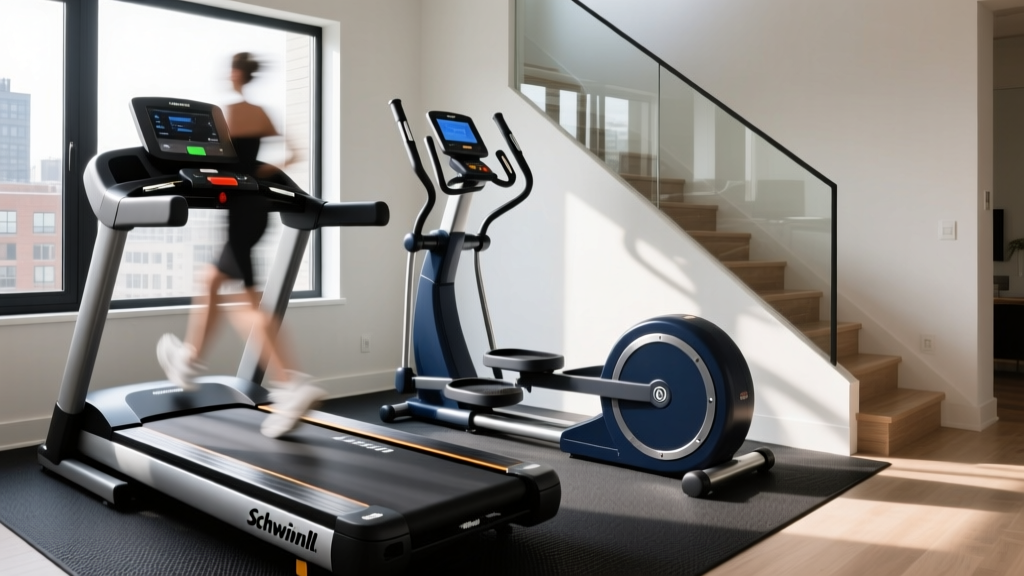
Schwinn Treadmill vs Stair Climber: 2026 Home Guide
Deciding between a Schwinn treadmill and a stair climber? Our 2026 head-to-head home use guide compares space, joint impact, and top models.

The Cardio Crossroads: Why Look Beyond the Standard Treadmill?
For over a decade, the traditional treadmill has been the undisputed king of the home gym. Models like the reliable Schwinn 810 treadmill have provided millions of users with accessible, straightforward cardiovascular conditioning. However, as home fitness spaces evolve in 2026, a significant shift is occurring toward vertical conditioning. The stair climber machine for home use has surged in popularity, driven by its superior posterior chain activation and space-efficient footprint.
If you are currently weighing a standard walking/running machine against a dedicated vertical climber, this head-to-head guide breaks down the biomechanics, spatial requirements, and long-term maintenance realities you need to know before making a four-figure investment.
Quick Snapshot: The Core DilemmaChoosing between a Schwinn treadmill and a stair climber comes down to three factors: ceiling clearance, joint impact tolerance, and target muscle groups. Treadmills excel at horizontal pacing and marathon prep; stair climbers dominate in high-intensity interval training (HIIT) and glute/quad hypertrophy.
Head-to-Head Comparison Matrix: Baseline vs. Vertical
To provide a concrete comparison, we are pitting a standard budget-friendly treadmill (the Schwinn 810) against two dominant categories of home stair climbers available in 2026: the premium hybrid (Bowflex Max M9) and the budget hydraulic stepper (Sunny Health & Fitness SF-E3861).
| Feature | Schwinn 810 Treadmill | Bowflex Max M9 | Sunny Health SF-E3861 |
|---|---|---|---|
| 2026 Retail Price | ~$599 | ~$2,299 | ~$169 |
| Footprint (L x W) | 70" x 28" | 49" x 30" | 24" x 17" |
| Ceiling Req. | Standard (7 ft) | User Height + 15" | User Height + 10" |
| Drive Mechanism | 2.6 CHP Motor & Belt | Magnetic Flywheel | Hydraulic Pistons |
| Calorie Burn (30m) | ~220 kcal (Walking) | ~380 kcal (HIIT) | ~290 kcal (Steady) |
Biomechanics and Joint Health: What the Experts Say
When transitioning from a treadmill to a stair climber, the most immediate difference is the kinetic chain. Running or walking on a treadmill involves repetitive heel-strike or mid-foot impact forces that can reach 2.5 times your body weight. According to the Mayo Clinic's guidelines on aerobic exercise, low-impact, closed-chain exercises are vastly superior for individuals managing osteoarthritis or recovering from lower-extremity injuries.
Stair climbers keep your feet planted on pedals, eliminating the ground-reaction shock associated with treadmill running. Furthermore, data from Harvard Health Publishing indicates that stair climbing burns approximately 20% to 30% more calories per minute than walking on a flat surface, primarily due to the continuous vertical displacement of body weight against gravity, which heavily recruits the gluteus maximus and quadriceps.
The Cardiovascular Demand
The American Heart Association recommends at least 150 minutes of moderate-intensity aerobic activity per week. Achieving this on a Schwinn treadmill requires a sustained brisk walk or light jog. On a stair climber, users typically hit their target heart rate zones (Zone 3 and Zone 4) within the first 4 minutes of use, making it a highly time-efficient modality for busy professionals.
Space and Footprint: The Home Gym Reality Check
The most common mistake home gym buyers make in 2026 is ignoring vertical clearance. While a Schwinn treadmill only requires standard ceiling height (usually 8 feet), stair climbers elevate your body significantly.
The Ceiling Clearance Formula: To safely use a stair climber without head trauma or psychological claustrophobia, measure your exact height in inches and add 15 inches. If you are 6'0" (72 inches), your ceiling must be at least 7'3" (87 inches) high. Do not forget to account for ceiling fans and recessed lighting fixtures.
While the Bowflex Max M9 requires this vertical clearance, its floor footprint (49" x 30") is roughly 30% smaller than a standard treadmill, making it ideal for apartment dwellers or bedroom gym setups where floor space is at a premium.
Top 3 Stair Climbers for Home Use (2026 Edition)
If you have decided to pivot from a traditional treadmill to a vertical climber, here are the top-performing models currently dominating the market.
1. Bowflex Max M9 (The Premium Hybrid)
- Price: $2,299
- Best For: HIIT enthusiasts and smart-home integrators.
- Pros: JRNY adaptive fitness app integration, ultra-quiet magnetic resistance, 20 resistance levels, low-impact pedal stride.
- Cons: Requires a $49/month subscription for full app features; heavy 145 lb shipping weight.
2. Sunny Health & Fitness SF-E3861 (The Budget Stepper)
- Price: $169
- Best For: Small apartments and beginners.
- Pros: Extremely compact, hydraulic resistance is adjustable, includes resistance bands for upper body.
- Cons: Hydraulic cylinders can overheat during sessions exceeding 45 minutes; limited stride depth.
3. NordicTrack FS14i (The FreeStride Climber)
- Price: $2,799
- Best For: Users who want the option to run, climb, and stride.
- Pros: 32-inch adjustable stride length mimics a true stair climber or an elliptical; -3 to 10% incline/decline.
- Cons: Massive footprint (69" x 35"); requires dedicated 20-amp electrical circuit.
Maintenance and Failure Modes: What Breaks First?
Understanding the mechanical failure points of these machines will save you hundreds of dollars in out-of-warranty repairs.
Treadmill Maintenance (e.g., Schwinn 810)
The number one failure mode for home treadmills is deck friction. If you do not apply 100% silicone lubricant between the belt and the deck every 150 miles (or every 3 months), the increased friction will draw excess amperage, eventually frying the motor control board. Replacement control boards cost between $150 and $300.
Stair Climber Maintenance
Stair climbers do not require belt lubrication, but they suffer from pivot-point wear. For hydraulic steppers like the Sunny Health models, the hydraulic fluid can degrade or leak if the cylinder seals fail from lateral torque (leaning too heavily on the handlebars). For magnetic flywheel climbers like the Bowflex, the primary maintenance task is checking the drive belt tension annually and applying white lithium grease to the pedal arm pivot bearings to prevent squeaking.
Frequently Asked Questions
Can I use a stair climber if I have knee pain?
Yes, but with a caveat. Stair climbers are low-impact (no striking force), but they do require deep knee flexion under load. If you have patellofemoral pain syndrome, keep the resistance low and focus on a slower, controlled cadence rather than high-resistance grinding.
Is a mini-stepper as effective as a full-size stair climber?
Mini-steppers (hydraulic) provide a good baseline cardiovascular stimulus and burn roughly 8-10 calories per minute. However, they lack the stride depth of a full-size machine, meaning glute activation is significantly lower. They are best used as supplemental movement tools rather than primary conditioning machines.
Why is my treadmill motor shutting off mid-workout?
This is almost always a thermal overload trip caused by a dry, high-friction belt, or a failing drive belt. Unplug the machine, clean the deck, apply silicone lubricant, and check the motor hood for dust buildup blocking the cooling fan before attempting to use it again.
More gear to consider
All reviews
Best Folding Treadmills for a Treadmill Virtual Run Setup (2026)

GymKit Treadmill to Rower: Buying Guide and Technique Mistakes
What's Better a Treadmill or an Elliptical? 2026 Folding Reviews
Bike Maintenance: Upright, Recumbent, Spin vs Apple Treadmill Myths

ProForm Sport TL Treadmill Noise Test vs. Top Quiet Rivals
