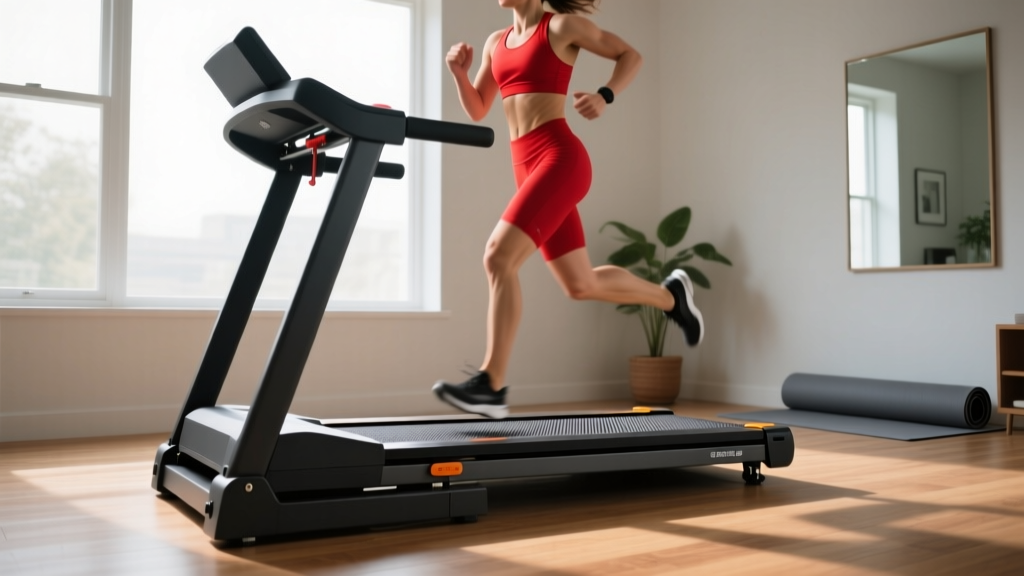
Running Sprints on Treadmill Folding Models: Review & Care Guide
Discover which folding treadmills for small spaces survive running sprints on treadmill decks. Expert reviews, hinge care, and motor longevity tips.

The Biomechanical Conflict: Small Spaces vs. High-Impact Sprints
Living in a compact apartment or home often forces a compromise: you either sacrifice floor space for a commercial-grade treadmill, or you buy a folding treadmill for small spaces and sacrifice performance. But what if your training regimen demands high-intensity interval training (HIIT)? According to the Mayo Clinic, sprint intervals are among the most efficient ways to boost cardiovascular health and metabolic rate. However, running sprints on treadmill models designed for folding storage introduces severe mechanical and biomechanical challenges.
When you are running sprints on treadmill decks at speeds of 8 to 12 MPH, your footstrike generates impact forces equivalent to 2.5 to 3 times your body weight. For a 180-pound runner, that is over 500 pounds of localized downward force per step. On a rigid, welded commercial frame, this energy is absorbed. On a folding treadmill, that kinetic shockwave travels directly into the folding hinge mechanism and the motor control board. If the machine is not engineered for this specific stress, the hinge will warp, the belt will slip, and the motor will overheat.
⚠️ Biomechanical Safety Warning: Never attempt sprints on a folding treadmill with a deck shorter than 55 inches. At 10 MPH, an average adult's stride length exceeds 6 feet. Compact 45-inch 'walking pad' decks will cause you to overstride, leading to severe hamstring strains or falls off the rear of the machine.2026 Folding Treadmill Review: Which Models Survive Sprints?
Not all folding treadmills are created equal. The market is flooded with 'compact' models featuring 2.0 CHP (Continuous Horsepower) motors that will instantly trip their thermal breakers during a sprint interval. Below is our 2026 assessment of the top folding treadmills for small spaces, graded specifically on their ability to handle sprint-level torque and their long-term durability.
| Model | Motor (CHP) | Deck Size | Folding Mechanism | Sprint Viability | 2026 Price |
|---|---|---|---|---|---|
| Horizon 7.4 AT | 3.0 CHP | 55" x 20" | Hydraulic Soft-Drop | A (Excellent) | $999 |
| Sole F63 | 3.0 CHP | 55" x 20" | Manual Drop-Lock | B+ (Good) | $799 |
| NordicTrack T Series 7 | 2.6 CHP | 50" x 18" | Manual Pivot | D (Avoid) | $499 |
Deep Dive: Horizon 7.4 AT (The Small-Space Sprint Champion)
The Horizon 7.4 AT remains the undisputed king of small-space HIIT. Its 3.0 CHP motor is specifically tuned for rapid acceleration, which is critical when you are transitioning from a 3 MPH jog to a 10 MPH sprint in under 15 seconds. The frame utilizes a heavy-gauge steel hydraulic folding hinge. Unlike manual pin-lock hinges, the hydraulic system dampens the vibrational shock of sprinting, preventing the micro-fractures that eventually snap cheaper folding joints.
Deep Dive: Sole F63 (The Budget Compromise)
The Sole F63 offers a 55-inch deck and a 3.0 CHP motor, making it safe for running sprints on treadmill decks from a spatial perspective. However, its manual folding latch is a known failure point under high-impact use. If you choose the F63 for sprinting, strict adherence to the hinge maintenance protocol outlined below is non-negotiable to prevent the deck from sagging over time.
The Hidden Casualty: Motor Heat and Control Board Failure
When researching the science of HIIT, most guides focus on human physiology. Few discuss the physiology of the treadmill motor. Sprinting requires massive torque. A 3.0 CHP motor might draw 15 to 20 amps during the acceleration phase of a sprint. This electrical draw generates intense heat inside the motor housing and the adjacent MOSFETs (transistors) on the motor control board.
In a folding treadmill, the motor shroud is often placed flush against the wall when stored upright, restricting ambient airflow. If dust accumulates on the motor's internal cooling fan, the heat from sprint intervals cannot escape. The result? The control board's thermal fuse blows, or worse, the MOSFETs melt, resulting in a $250 to $400 replacement bill.
Longevity Protocol: Maintaining a Folding Sprint Treadmill
To safely perform sprint intervals on a folding machine, you must implement a rigorous, high-intensity maintenance schedule. Standard 'walking' maintenance is insufficient.
- The 60-Day Motor Shroud Vacuum: Because sprinting generates excessive heat, you must remove the plastic motor shroud (usually 4 to 6 Phillips-head screws) every 60 days. Use a shop vac with a brush attachment to remove dust from the motor fins and the control board. Never use compressed air, as it will blow conductive metal shavings deeper into the electronics.
- Folding Hinge Lubrication: The pivot point of a folding treadmill bears the brunt of your sprinting impact. Every 6 months, apply a generous coat of white lithium grease to the left and right folding hinges. Do not use WD-40; it is a solvent that will strip existing factory grease and accelerate metal-on-metal wear.
- Belt Tension and Deflection Test: Sprinting causes belt slip if the tension is inadequate. A slipping belt creates friction, melting the underside of the belt and straining the motor. Lift the running belt in the exact center of the deck. It should raise exactly 2 to 3 inches. If it lifts higher, use a 3/16" Allen wrench to tighten the rear roller bolts by exactly one-quarter turn on each side.
- 100% Silicone Deck Lubrication: High-speed sprinting strips standard lubricants rapidly. Apply 100% liquid silicone treadmill lubricant (never petroleum-based) under the belt every 150 miles of use. If you do 3 sprint sessions a week, this means lubricating the deck every 6 to 8 weeks.
💡 Pro-Tip: The 'Cool-Down' Storage Rule
Never fold your treadmill immediately after a sprint session. The motor and deck retain massive amounts of thermal energy. Allow the machine to run at 2 MPH for 3 minutes with the cooling fan active, then let it sit flat for an additional 15 minutes before folding it upright. Trapping heat inside a folded, vertical motor housing degrades the internal wiring insulation over time.
Troubleshooting Sprint-Specific Failure Modes
Even with meticulous care, running sprints on treadmill folding models can trigger specific mechanical issues. Here is how to diagnose them:
- Symptom: The belt hesitates or 'stutters' exactly when your foot strikes during a sprint.
Diagnosis: This is rarely a motor issue; it is almost always a worn drive belt or a loose motor mount. The sudden torque of a sprint footstrike pulls the motor away from the front roller. Fix: Tighten the motor mount tension bolt located under the front shroud. - Symptom: The machine shuts off abruptly at the 12-minute mark of a HIIT workout.
Diagnosis: Thermal overload. The motor is overheating due to friction or dust. Fix: Clean the motor compartment and verify your deck is properly lubricated to reduce amp draw. - Symptom: A loud 'clanking' noise from the rear of the deck during high-speed intervals.
Diagnosis: The folding latch pins are worn and allowing the deck to micro-shift vertically under impact. Fix: Replace the latch pins and apply marine-grade grease to the receiving sleeves.
Final Verdict on Small-Space Sprinting
You do not need to sacrifice high-intensity sprint training just because you live in a small apartment. However, you must respect the physics of folding mechanisms. By selecting a model with a true 3.0 CHP motor and a 55-inch deck—like the Horizon 7.4 AT—and strictly adhering to a high-intensity maintenance protocol focusing on thermal management and hinge lubrication, your folding treadmill will safely survive your toughest sprint intervals for years to come.
More gear to consider
All reviews
ProForm Treadmill Folding & Motor HP Troubleshooting

Elliptical vs Treadmill: Home Cardio Budget & Treadmill Plug Costs

NordicTrack 3.0 CHP Treadmill: Best Folding Fit for Small Spaces

Understanding Treadmill Motor Size: A Buyer's Guide & How to Record Treadmill on Strava
NordicTrack T Series 5 Starter Treadmill for Real Results: Troubleshooting
