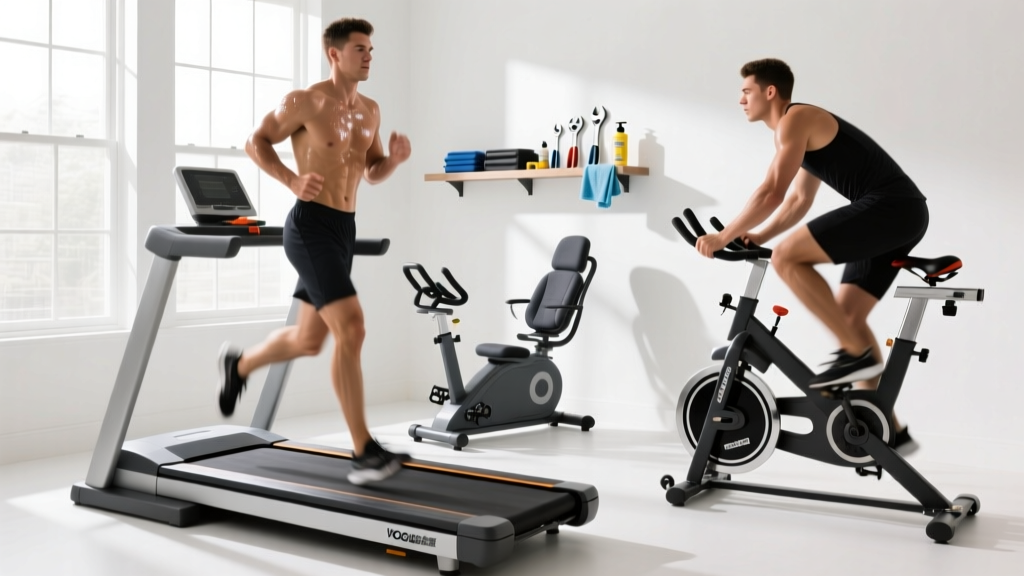
How to Run on a Treadmill Properly & Stationary Bike Maintenance
Learn how to run on a treadmill properly while mastering deep maintenance routines for upright, recumbent, and spin bikes to maximize equipment longevity.

The Cross-Training Imperative: Biomechanics Meets Mechanical Care
Building a comprehensive home cardio sanctuary in 2026 requires mastering both human biomechanics and mechanical engineering. While learning how to run on a treadmill properly is essential to protect your joints from repetitive impact stress, your stationary bikes demand an equally rigorous approach to maintenance to prevent catastrophic mechanical failure. According to the Mayo Clinic, maintaining proper aerobic form—such as a midfoot strike and a cadence of 170-180 steps per minute on a treadmill—drastically reduces tibial shock. However, when you transition from the treadmill belt to the saddle for active recovery, your equipment takes over the burden of stress.
Cross-training between the treadmill and the bike is a staple of modern fitness programming endorsed by the American Council on Exercise (ACE). Yet, most home gym owners treat their stationary bikes as maintenance-free appliances. This is a costly mistake. Whether you are riding an upright, recumbent, or indoor spin bike, each archetype features distinct mechanical vulnerabilities. Below, we break down the exact maintenance protocols, failure modes, and longevity hacks for every major stationary bike type.
Upright Stationary Bikes: Cable Tension and Crank Bearings
Upright bikes, such as the Schwinn IC4 or Sole SB700, mimic the geometry of a traditional road bike. They rely on either friction pads or magnetic resistance systems paired with a heavy perimeter-weighted flywheel. The most common point of failure in mid-tier upright bikes is not the console, but the drivetrain and resistance calibration.
1. Crank Arm and Pedal Thread Maintenance
The pedal spindle and crank arm interface endure immense lateral torque during out-of-saddle sprints. In 2026, most premium uprights use standard 9/16-inch pedal threads.
- The Failure Mode: Pedals loosen over time, stripping the aluminum crank arm threads. Once stripped, the entire crankset must be replaced ($80-$120).
- The Fix: Every 90 days, remove the pedals, clean the threads with a brass wire brush, and reapply a marine-grade anti-seize compound. Reinstall and torque to exactly 35-40 Nm using a calibrated torque wrench.
2. Magnetic Resistance Cable Stretch
If your upright bike uses a manual tension knob connected to a neodymium magnet bracket via a steel cable, that cable will stretch over time. This results in a 'dead zone' where turning the knob produces no change in resistance. To fix this, locate the cable barrel adjuster near the flywheel housing and turn it counter-clockwise to remove slack until the magnet bracket sits exactly 4mm from the flywheel at the lowest resistance setting.
Warning: Never apply silicone spray or WD-40 to the flywheel or magnetic resistance bracket. Lubricants will attract metallic dust from the brake pads or environment, creating a grinding paste that will permanently score the aluminum flywheel.Recumbent Bikes: Seat Track Sludge and Stepper Motors
Recumbent bikes like the Spirit XBR95 or NordicTrack Commercial R30 prioritize lumbar support and low-impact rehabilitation. Because the rider is seated in a reclined position, the mechanical stress shifts entirely to the seat adjustment mechanism and the internal stepper motors.
The Hidden Killer: Seat Track Sludge
Recumbent bikes feature a long aluminum or steel rail that allows the seat to slide forward and backward. In a home environment, this rail acts as a magnet for dust, pet hair, and dead skin cells. When mixed with ambient humidity or sweat drippings, this debris forms a dense sludge.
- Step 1: Slide the seat completely to the rear.
- Step 2: Wipe the exposed rail with a microfiber cloth dampened with 90% isopropyl alcohol to dissolve organic oils.
- Step 3: Apply a microscopic layer of dry PTFE (Teflon) lubricant. Do not use wet chain lube, which will attract more dust.
Stepper Motor Burnout
High-end recumbents use a 12V DC stepper motor to micro-adjust the magnetic resistance bracket. If the seat track or resistance pivot points are jammed with debris, the stepper motor draws excessive amperage trying to force the movement, eventually burning out the internal copper windings. Replacing a stepper motor requires soldering and sourcing OEM parts, often costing upwards of $150. Keeping the pivot points clean with compressed air every six months is non-negotiable for longevity.
Spin Bikes (Indoor Cycles): Galvanic Corrosion and Belt Drive
Indoor cycles, notably the Peloton Bike+ and Keiser M3i, are designed for high-cadence, high-sweat interval training. The primary enemy of the spin bike is not mechanical friction, but chemical corrosion.
Combating Galvanic Sweat Corrosion
Human sweat is highly corrosive, containing urea, lactic acid, and sodium chloride. When sweat drips onto the steel bottom bracket spindle and the surrounding aluminum frame, it triggers galvanic corrosion. This electrochemical reaction literally eats away the aluminum, causing the bottom bracket bearings to seize and the frame to pit.
Expert Insight: Never clean your spin bike with bleach, ammonia, or harsh alkaline degreasers. These chemicals accelerate aluminum pitting. Instead, use a 50/50 mixture of distilled water and white vinegar, followed by a dry microfiber wipe-down immediately after every ride.
Belt Drive vs. Chain Drive Tension
While older spin bikes used chains requiring frequent lubrication, 2026's premium models utilize Gates Carbon Drive polyurethane belts. According to Park Tool's drivetrain maintenance guidelines, belt drives do not require lubrication but are highly sensitive to tension. A belt that is too tight will destroy the bottom bracket bearings within 500 miles; a belt that is too loose will slip and snap under heavy sprint loads. Use a sonic tension meter app to ensure the belt frequency rests between 45Hz and 60Hz when plucked at the midpoint.
Comparative Maintenance Matrix: Upright vs. Recumbent vs. Spin
| Maintenance Task | Upright Bike | Recumbent Bike | Spin Bike (Indoor Cycle) |
|---|---|---|---|
| Post-Ride Wipe Down | Handlebars & Console | Seat Mesh & Armrests | Entire Frame & Flywheel Guard |
| Monthly Inspection | Pedal Threads & Cable Tension | Seat Track Debris & Stepper Motor | Bottom Bracket Play & Belt Tension |
| Annual Overhaul | Crank Bearing Greasing | Rail Lubrication (Dry PTFE) | Bottom Bracket Replacement |
| Estimated Annual Cost | $15 - $30 | $10 - $25 | $40 - $85 |
The $50 Annual Maintenance Kit for Home Cardio
To execute the longevity protocols outlined above, you do not need a professional mechanic's toolbox. Assemble this specific kit to cover 95% of all stationary bike maintenance needs:
- 3/8-inch Drive Torque Wrench (10-50 Nm range): Essential for crank arms and seat post clamps ($25).
- Dry PTFE Bicycle Chain Lube: Safe for seat tracks and non-magnetic pivot points; repels dust ($8).
- Marine-Grade Anti-Seize Compound: Prevents galvanic corrosion on steel pedal threads inside aluminum cranks ($6).
- Brass Detail Wire Brush: Safely cleans threads and flywheel edges without scratching soft metals ($5).
- Sonic Belt Tension Meter App: Downloadable on most smartphones to measure polyurethane belt drive frequencies via microphone (Free).
Final Thoughts on Equipment Longevity
Whether you are focused on perfecting how to run on a treadmill properly to save your knees, or pushing 400 watts on a spin bike to build your VO2 max, your equipment is an investment that requires active stewardship. By shifting your mindset from 'consumer' to 'equipment manager,' you will easily extend the lifespan of your upright, recumbent, and spin bikes well past their factory warranties, ensuring your home gym remains a reliable sanctuary for years to come.
More gear to consider
All reviews
Quiet Cardio for Beginner Treadmill Workouts for Weight Loss
Elliptical vs Treadmill Space & Exercise Plan for Treadmill to Lose Weight
Home Stair Climber Guide: How Much Incline on Treadmill Matches It?

Air Bike vs Assault Bike: Better Than Orange Theory Treadmills?
Treadmill Squeaking When Running? Concept2 vs Hydrow Rower Guide
