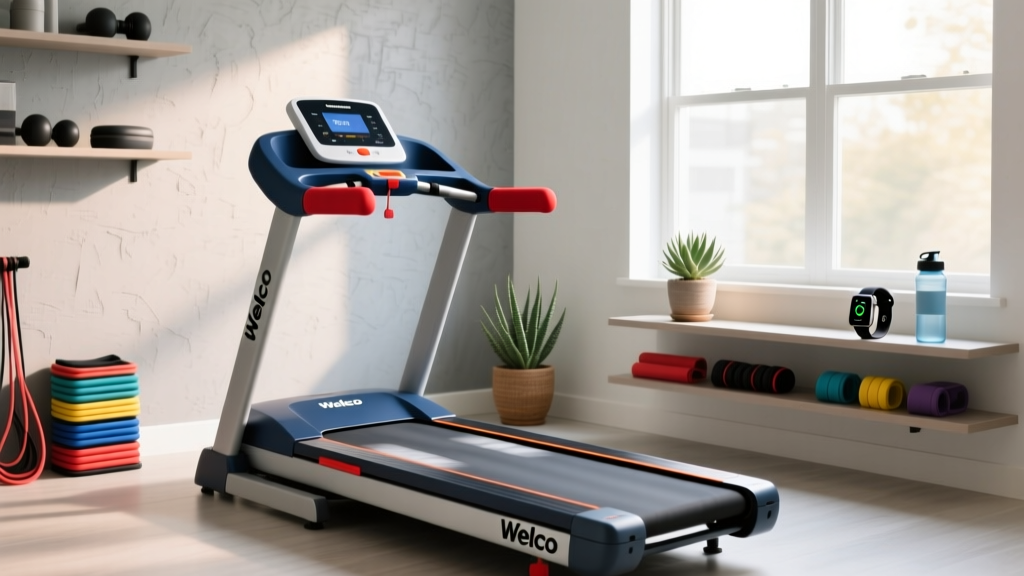
Welco Treadmill Setup & Cardio Machine Noise Comparison
Master your Welco treadmill installation with our step-by-step walkthrough. Compare cardio machine noise levels and learn soundproofing tips for quiet workouts.

The Acoustics of Home Cardio: Why Setup Dictates Sound
As multi-family housing and dense urban living continue to dominate in 2026, the acoustic footprint of home gym equipment has never been more critical. The Welco treadmill (particularly the popular WT-Series folding models) offers an excellent balance of compact design and 2.25 HP continuous-duty performance. However, out-of-the-box assembly often ignores acoustic optimization. A poorly installed treadmill can generate upward of 82 decibels (dB) of combined motor and impact noise, while a precision-calibrated setup can drop that output to a highly manageable 65 dB.
Understanding the difference between airborne noise (motor fan, belt friction, electronics) and structure-borne noise (footfall impact transferring through floor joists) is the first step in our installation walkthrough. According to the World Health Organization's guidelines on community noise, continuous indoor noise levels should ideally remain below 55 dB to prevent annoyance and sleep disturbance in adjacent rooms. While a treadmill in use will exceed this, proper installation ensures the noise is muffled, low-frequency, and contained.
⚠️ Apartment Dweller Warning: If you live in a second-story unit or higher, structure-borne impact noise is your primary enemy. The Welco treadmill's factory rubber feet are insufficient for blocking low-frequency bass transfer. You must pair this installation with a 3/4-inch thick high-density EVA or vulcanized rubber anti-vibration mat (such as a horse stall mat cut to size) to decouple the machine from the subfloor.Pre-Installation Preparation and Staging
Before unboxing, prepare your space. The Welco WT-Series requires a footprint of at least 78" L x 32" W, plus 24" of clearance behind the deck for safety and airflow.
- Tools Required: Metric hex key set (included, but a torque wrench is recommended), Phillips head screwdriver, silicone-based treadmill lubricant, and a digital level.
- Electrical Check: Ensure the outlet is a dedicated 15-amp or 20-amp circuit. Sharing a circuit with a refrigerator or AC unit can cause voltage drops, making the Welco's motor controller work harder and generate excess electrical whine.
Step-by-Step Welco Treadmill Installation Walkthrough
Follow these exact steps to ensure structural rigidity. Loose components are the primary cause of the "rattling" noise frequently misattributed to motor defects.
Step 1: Base Placement and Decoupling
- Lay your 3/4-inch anti-vibration mat on the floor, ensuring it is perfectly flush with the wall to prevent tripping.
- With a partner, lift the Welco treadmill deck onto the mat. Never drag the deck, as this can misalign the internal roller bearings before you even begin.
- Use a digital level across the width of the running belt. Adjust the rear leveling feet until the bubble is perfectly centered. An unlevel deck causes the belt to track hard against one side rail, creating a high-pitched friction squeak.
Step 2: Upright Assembly and Torque Specifications
The uprights house the wiring harness and support the console. Vibration here translates directly into console rattle.
- Feed the data cable through the left upright. Secure the cable with foam tape or zip-ties every 6 inches. Pro Tip: Unsecured cables slapping against the inside of the metal shroud sound exactly like a failing motor bearing. Eliminate this "zipper rattle" now.
- Insert the M8 x 15mm hex bolts. Using a torque wrench, tighten them to exactly 15 Nm (Newton-meters). Overtightening can strip the internal threads or warp the plastic shroud, while undertightening guarantees metallic rattling during high-impact running.
Step 3: Belt Alignment and Tensioning
Friction between the walking belt and the deck generates heat and a distinct burning/rubbing noise. The Welco treadmill ships with the belt slightly loose to prevent deck warping during transit.
- Plug in the machine and start the belt at 2.0 MPH.
- Observe the rear roller. If the belt drifts left, insert the hex key into the left rear adjustment bolt and turn it exactly 1/4 turn clockwise. Do the same to the right if it drifts right.
- Wait 30 seconds between adjustments. The belt needs time to settle. Over-tensioning the belt puts excessive lateral load on the motor bearings, leading to a premature, high-pitched mechanical whine.
Step 4: Motor Hood Calibration
Remove the front motor hood (usually secured by four Phillips screws). Inspect the drive belt connecting the motor pulley to the front roller. It should have about 1/2 inch of deflection when pressed in the center. If it is too tight, it will emit a high-frequency hum; if too loose, it will slap the housing during sudden speed changes. Adjust the motor mount plate accordingly, then securely replace the hood, ensuring no plastic tabs are pinched.
Cardio Machine Noise Level Comparison Matrix
How does an optimized Welco treadmill compare to other popular home cardio equipment? The following data, cross-referenced with acoustic measurement standards outlined by the CDC's National Institute for Occupational Safety and Health (NIOSH), illustrates the baseline noise output measured at a distance of 3 feet during moderate-intensity use.
| Equipment Type | Motor/Mechanical Noise | Impact/User Noise | Total Output (3 ft) | Vibration Transfer Risk |
|---|---|---|---|---|
| Welco Treadmill (Optimized) | 55 - 60 dB | 65 - 72 dB | 68 - 74 dB | High (Requires Mat) |
| Standard Elliptical (Magnetic) | 40 - 45 dB | 45 - 50 dB | 48 - 52 dB | Very Low |
| Air Bike (e.g., Assault/Echo) | 30 - 35 dB | 75 - 85 dB (Wind) | 78 - 86 dB | Low |
| Concept2 RowErg | 35 - 40 dB | 65 - 75 dB (Air/Fan) | 68 - 76 dB | Moderate |
| Stair Climber (Stepper) | 50 - 55 dB | 60 - 65 dB | 62 - 68 dB | High |
"The primary differentiator between a treadmill and an elliptical isn't just the motor; it's the kinetic energy transfer. Every footstrike on a treadmill deck generates a low-frequency acoustic wave that travels through solid structures much faster than airborne sound. Decoupling the machine from the floor is non-negotiable for shared-wall living."
Advanced Troubleshooting: Welco Treadmill Noise Diagnostics
Even with a perfect installation, wear and environmental factors can introduce new sounds. Use this diagnostic framework to identify and resolve issues specific to the Welco WT-Series architecture.
1. The Incline Motor "Grind"
Symptom: A metallic grinding or clicking sound when the incline adjusts between 0% and 15%.
Root Cause: The incline lift tube relies on a threaded worm gear. If the factory grease dries out or collects dust, the metal-on-metal friction increases.
Fix: Unplug the machine. Remove the motor hood and locate the incline lift tube. Clean the exposed threads with a dry microfiber cloth, then apply a generous bead of white lithium grease. Cycle the incline from 0% to 15% three times to distribute the lubricant.
2. High-Pitched Squeal at Startup
Symptom: A loud squeak that occurs only during the first 60 seconds of a workout, then disappears.
Root Cause: Static electricity buildup or minor belt-to-deck friction before the silicone lubricant warms up and spreads evenly.
Fix: Apply 100% pure silicone treadmill lubricant under the belt. Avoid any petroleum-based products or WD-40, which will destroy the PVC walking belt and void your warranty. For comprehensive housing and acoustic standards regarding multi-family dwellings, refer to the U.S. Department of Housing and Urban Development (HUD) noise assessment guidelines, which highlight the importance of mitigating mechanical equipment noise at the source.
Frequently Asked Questions
Can I use a standard yoga mat under my Welco treadmill to reduce noise?
No. Standard PVC or TPE yoga mats (usually 4mm to 6mm thick) will compress entirely under the 115+ lbs weight of the treadmill and the dynamic load of a runner. You must use a high-density rubber mat (minimum 3/4-inch thick) with a Shore A hardness rating of at least 60 to effectively absorb low-frequency impact vibrations.
Does running speed affect the noise level exponentially?
Motor noise scales relatively linearly with speed, but impact noise scales exponentially based on user biomechanics. A heavy heel-strike at 7.0 MPH will generate significantly more structure-borne noise than a mid-foot strike at the same speed. Utilizing the treadmill's built-in shock absorption system (by ensuring the deck elastomers are properly seated) helps mitigate this.
Final Thoughts on Acoustic Optimization
Setting up your Welco treadmill is not merely about putting pieces together; it is an exercise in acoustic engineering. By focusing on precise bolt torquing, meticulous belt alignment, and aggressive floor decoupling, you transform a potentially disruptive piece of machinery into a quiet, neighborhood-friendly fitness station. When compared to the wind-shear noise of an air bike or the heavy mechanical thud of a stair climber, a properly tuned Welco treadmill offers one of the most acoustically controlled cardiovascular workouts available for the modern home gym.
More gear to consider
All reviews
Bowflex 7 Series Treadmill vs Compact Portable Cardio Options

Escaping Treadmill Bondage: Compact Cardio Budget Guide
Worn Treadmill Deck Repair vs Compact Portable Cardio Options

Bike Layouts & What Number is 10 Incline on Treadmill Clearances
Skip the 28 Day Treadmill Challenge Free: Rowing Machine Setup & Form
