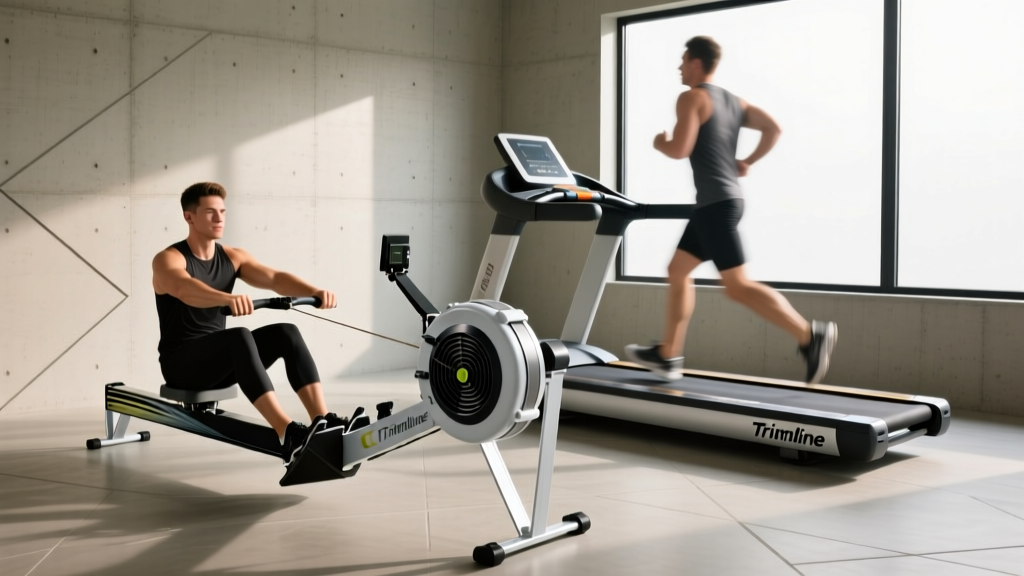
Rowing Machines vs Trimline Treadmills: Buying Guide & Technique
Compare rowing machines and Trimline treadmills with our 2026 buying guide. Master erg technique, explore top models, and find your perfect cardio fit.

The Cardio Crossroads: Rowing Machines vs. Trimline Treadmills
Outfitting a home gym in 2026 often comes down to a battle of biomechanics and spatial efficiency. On one side, you have the legacy and light-commercial reliability of Trimline treadmills, known for their durable motorized belts, folding mechanisms, and straightforward walking or running mechanics. On the other, the indoor rowing machine (ergometer) offers a zero-impact, full-body cardiovascular stimulus that engages 86% of your muscle mass per stroke.
Choosing between these two cardio titans requires more than just looking at the price tag; it demands an understanding of your joint health, spatial constraints, and fitness goals. While a Trimline treadmill excels at weight-bearing bone density work and specific run-pacing, the rowing machine provides unparalleled posterior chain development and cardiovascular endurance without the repetitive ground-reaction forces that often lead to shin splints or runner's knee.
Quick Decision Framework
- Choose a Rower if: You need zero-impact cardio, want to build upper-back and core strength, and have a long, narrow floor space (approx. 8' x 2').
- Choose a Trimline Treadmill if: You are training for a road race, require weight-bearing exercise for bone density, or prefer passive entertainment while walking at an incline.
The 2026 Rowing Machine Buying Matrix
If you have decided that the full-body engagement of an ergometer outweighs the belt-driven mechanics of Trimline treadmills, your next hurdle is selecting the right resistance profile. The market has segmented into air, magnetic, and water resistance, each offering distinct acoustic and tactile feedback.
| Model | Resistance Type | 2026 Price Range | Footprint | Best For |
|---|---|---|---|---|
| Concept2 RowErg | Air | $995 - $1,095 | 8' x 2' | Purists, CrossFit, Data Accuracy |
| Hydrow | Electromagnetic | $2,495 | 8' x 2.5' | Immersive Tech, Silent Operation |
| Echelon Row | Magnetic | $1,299 | 7' x 2' | Budget Smart-Rowing, Compact |
| NordicTrack RW900 | Air + Magnetic | $1,199 | 8.5' x 2' | iFIT Integration, Auto-Resistance |
According to the American Heart Association, adults should aim for at least 150 minutes of moderate-intensity aerobic activity per week. A high-quality magnetic or air rower allows you to hit these zones efficiently while simultaneously building muscular endurance in the lats, quads, and glutes—something a standard Trimline treadmill walk cannot achieve without extreme incline settings.
Mastering the Erg: Step-by-Step Technique Guide
The most common reason users abandon rowing machines and revert to treadmills is lower back pain. This pain is almost universally the result of poor sequencing. Unlike walking on a Trimline treadmill, where the belt dictates your pace and your body naturally self-organizes, rowing requires strict adherence to a kinetic chain. Power must transfer from the ground, through the legs, into the core, and finally out through the arms.
As outlined by the experts at Concept2, the stroke is divided into four distinct phases. Mastering these will eliminate lumbar strain and maximize your wattage output.
- The Catch (The Setup): Shins should be perfectly vertical (90 degrees to the floor). Your torso should be hinged forward at roughly the 11 o'clock position. Arms are fully extended, lats engaged, and heels are slightly lifted if your ankle mobility requires it. Do not over-compress; your hips should be slightly higher than your knees.
- The Drive (The Power Phase): This is where 60% of your power is generated. Push explosively with your legs while keeping your arms straight and your torso locked at 11 o'clock. Only when the handle passes your knees do you begin to swing your torso back (30% of power). Finally, draw the handle to your sternum with your biceps and rear delts (10% of power).
- The Finish: Legs are fully extended but not hyper-locked. The torso is leaning back slightly to the 1 o'clock position. The handle rests just below the pectoral muscles, elbows drawn back and wrists flat.
- The Recovery (The Reset): The exact reverse of the drive, performed at half the speed (a 1:2 drive-to-recovery ratio). Extend the arms first, hinge the torso forward past the knees, and only then allow the knees to bend as you slide back to the catch.
Expert Troubleshooting: If you feel your lower back burning during the first 5 minutes, you are likely 'shooting the slide'—meaning your legs are pushing back but your torso is staying upright, forcing your lumbar spine to act as a weak bridge. Lock your core at the catch and push the machine away with your legs.
Damper Settings vs. Drag Factor
A massive misconception among former treadmill users is that setting the damper to 10 is equivalent to setting a treadmill to a 15% incline. It is not. The damper simply controls how much air enters the flywheel cage. What actually matters is the drag factor. For most athletes, a drag factor between 110 and 130 (usually a damper setting of 3 to 5) accurately simulates the feel of a sleek racing shell on water. Cranking the damper to 10 causes rapid muscular fatigue before your cardiovascular system can reach its target heart rate.
Caloric Expenditure and Biomechanical Impact
When comparing a vigorous session on a rower versus a brisk walk on a Trimline treadmill, the metabolic demands differ significantly. According to data published by Harvard Health Publishing, a 155-pound individual rowing vigorously for 30 minutes will burn approximately 369 calories, compared to roughly 252 calories walking at a brisk 3.5 mph pace.
However, the treadmill offers something the rower cannot: axial loading. Weight-bearing exercises like walking or running on a Trimline treadmill are vital for maintaining bone mineral density, particularly in aging populations. If your primary medical directive is combating osteopenia, the treadmill is superior. If your goal is athletic conditioning, fat loss, and postural correction (counteracting the 'desk-worker' hunch by strengthening the rhomboids and rear deltoids), the rowing machine is the undisputed champion.
Maintenance Protocols and Edge Cases
Both machines require specific upkeep to prevent catastrophic failure modes, though the rower is vastly simpler to maintain.
- Rowing Machine Chain & Rail: The nickel-plated steel chain on an air rower requires 3-in-One oil or purified mineral oil every 50 hours of use. Wipe the monorail with a damp cloth daily to prevent dust from mixing with the roller bearings, which causes the dreaded 'catch stutter'.
- Trimline Treadmill Belt: Treadmills require 100% silicone lubricant applied between the belt and the deck every 150 miles or 3 months. Failure to do so increases friction, which spikes the amp draw on the motor control board, eventually frying the lower electronics—a repair that often exceeds $400.
Frequently Asked Questions
Can I use a rowing machine if I have a history of knee pain?
Yes, provided your form is correct. Because the foot is fixed to the strap and there is no impact shock, rowing is heavily utilized in physical therapy for ACL and meniscus rehabilitation. The key is ensuring you do not over-compress at the catch; your shins must remain vertical to prevent excessive shear force on the patellar tendon.
Which machine is better for a small apartment?
While many Trimline treadmills feature folding decks, they still maintain a massive footprint when unfolded and are incredibly heavy to move. Modern rowers like the Concept2 can be separated into two pieces in seconds and stood upright in a closet, requiring only a 2-foot by 2-foot vertical storage space.
More gear to consider
All reviews
Stair Stepper vs Treadmill: Beginner Motor Size Guide

2026 Techno Treadmill Showdown: Myrun vs. Skillrun

Fix Treadmill Tripping Breaker: Air Bike vs Assault Bike Space Guide

Treadmill SF-T4400 vs Walking Pads: Mistakes & Fixes
2026 Vibration Plate Treadmill Combos for Small Spaces
