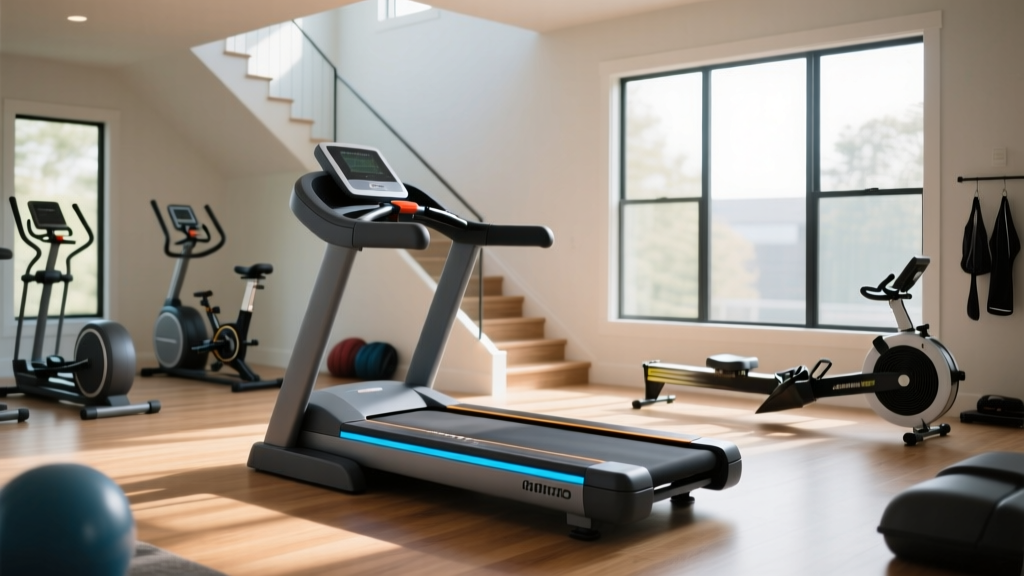
Rowing Machine Buying Guide: Technique vs Treadmill Heart Rate Sensor
Master rowing machine technique and explore our 2026 buying guide. Discover why rowers outperform the standard treadmill heart rate sensor for zone training.

When building a home gym for cardiovascular conditioning, the debate often narrows down to the mechanics of the stride versus the pull. While running is a foundational human movement, the way we track cardiovascular exertion on running machines is fundamentally flawed. Specifically, the standard treadmill heart rate sensor—those metallic grip plates mounted on the handrails—fails to provide the biometric accuracy required for serious zone training. This is where the rowing machine emerges not just as a superior full-body conditioning tool, but as a platform that forces you to adopt better tracking and technique habits.
The Biomechanical Failure of the Treadmill Heart Rate Sensor
Most commercial and home treadmills utilize galvanic skin response (GSR) or capacitive sensors embedded in the handlebars to estimate your pulse. In 2026, despite advancements in wearable tech, these built-in treadmill heart rate sensor arrays remain notoriously unreliable for three distinct reasons:
- Sweat and Conductivity Noise: As your core temperature rises and palmar sweating begins, the electrical conductivity between your skin and the metal plates fluctuates wildly, causing the console to display erratic BPM spikes or dropouts.
- Grip Tension and Blood Pressure: Holding onto treadmill handles alters your natural gait, reduces caloric expenditure by up to 20%, and artificially elevates peripheral blood pressure, which confuses the optical and galvanic algorithms attempting to read your pulse wave velocity.
- Upper Body Stabilization: Gripping the rails restricts the natural arm swing, limiting thoracic expansion and ultimately capping your VO2 max potential during high-intensity interval training (HIIT).
Why Rowing Machine Technique Dictates True Cardio Output
Unlike a treadmill where the motor dictates the pace and you simply react, a rowing machine is entirely user-generated. The resistance scales exactly with your effort. However, this requires impeccable technique to ensure your cardiovascular system is the limiting factor, rather than your lower back or grip strength.
According to biomechanical analyses by Concept2, the gold standard in rowing ergonomics, a proper stroke distributes power in a strict 60-30-10 ratio: 60% from the legs, 30% from the core hinge, and 10% from the arm draw. When you rely on a treadmill heart rate sensor while running, you are only engaging the lower body. Rowing recruits over 85% of the body's muscle mass, demanding higher cardiac output and resulting in a more accurate reflection of your true cardiovascular capacity.
2026 Rowing Machine Buying Guide: Comparison Matrix
Transitioning from a treadmill to a rower requires selecting a machine with a robust monitor capable of pairing with external heart rate straps via ANT+ or Bluetooth FTMS. Below is our 2026 comparison of the top-tier rowing machines that solve the tracking inaccuracies inherent to running consoles.
| Model | Resistance Type | Monitor & HR Connectivity | Price (2026) | Best For |
|---|---|---|---|---|
| Concept2 RowErg | Air | PM5 (ANT+ / Bluetooth) | $1,100 | Data purists & CrossFit |
| Hydrow | Electromagnetic | Touchscreen (Bluetooth only) | $2,495 | Immersive scenic coaching |
| NordicTrack RW900 | Magnetic/Air Hybrid | iFit Console (Bluetooth) | $1,699 | Interactive studio classes |
For athletes focused strictly on biometric accuracy and raw data, the Concept2 RowErg remains undefeated. Its PM5 monitor seamlessly pairs with chest straps, entirely bypassing the need for a flawed treadmill heart rate sensor setup.
Understanding Drag Factor and Heart Rate Response
On air rowers like the Concept2, the damper setting (1-10) does not dictate resistance; it dictates the drag factor. Setting the damper to 10 is akin to riding a bicycle in the heaviest gear—it will spike your heart rate into Zone 5 due to localized muscular failure in the quadriceps before your cardiovascular system reaches true threshold. For optimal Zone 2 and Zone 3 cardio training, set the damper between 3 and 5 (mimicking the drag of a standard racing shell) to allow for sustained, high-cadence cardiovascular output.
Step-by-Step Rowing Technique for Heart Rate Zone Training
To effectively use a rower for cardiovascular conditioning, you must master the four phases of the stroke. Poor technique will cause your heart rate to spike prematurely due to muscular fatigue rather than cardiovascular demand.
- The Catch: Shins vertical, torso hinged forward at 11 o'clock, arms straight. This is the loading phase. Do not rush the catch; let the heart rate stabilize during the recovery.
- The Drive: Initiate with the legs. Push the footplate away explosively. Only when the legs are 90% extended do you hinge the core back to 1 o'clock, followed finally by the arms drawing the handle to the sternum. This sequential firing is what drives the heart rate into Zone 3 or Zone 4.
- The Finish: Legs flat, core braced, handle hovering just below the pectoral line. A brief pause here ensures muscular tension is maintained.
- The Recovery: Reverse the sequence. Arms extend, core hinges forward, then knees bend. The recovery should take twice as long as the drive (a 1:2 stroke ratio), allowing your heart rate to micro-recover, mimicking the natural fluctuations of outdoor running without the joint impact.
"Rowing is one of the few exercises that provides a rigorous cardiovascular workout while simultaneously building muscular endurance, all without the high-impact joint stress associated with running." — Cleveland Clinic
The Ultimate Heart Rate Tracking Setup for Rowers
Since you are no longer restricted by the handrails of a treadmill, your hands are free to grip the rowing handle. This necessitates a wearable heart rate monitor. For 2026, we recommend the following setups to ensure clinical-grade accuracy:
1. Polar H10 Chest Strap ($89.95)
The Polar H10 uses ECG-based electrical pulse detection, completely immune to the motion artifacts that plague wrist-based optical sensors and the sweat issues that ruin a treadmill heart rate sensor. It broadcasts simultaneously via ANT+ and Bluetooth, ensuring it will connect to the Concept2 PM5 or any third-party app like ErgData.
2. Garmin HRM-Pro Plus ($129.99)
For triathletes who also run outdoors, the HRM-Pro Plus captures running dynamics and rowing stroke rate metrics, storing the data locally and uploading it to Garmin Connect when your watch is out of range.
Why Wrist-Based Optical Sensors Fail on Rowers
You might be tempted to use an Apple Watch or Garmin Forerunner on your wrist. However, the repetitive flexion and extension of the wrist during the rowing catch and finish causes the watch to shift, disrupting the optical LED sensors' ability to read capillary blood flow. A chest strap remains the non-negotiable standard for rowing.
Summary: Ditch the Rails, Grab the Handle
Upgrading your home cardio setup means upgrading how you measure your effort. Leaving behind the inaccuracy of the treadmill heart rate sensor in favor of a properly executed rowing stroke and a high-fidelity chest strap will transform your cardiovascular conditioning. By selecting a machine like the Concept2 RowErg and adhering to the 60-30-10 power distribution rule, you ensure that every drop of sweat translates directly to measurable, zone-specific cardiac adaptation.
More gear to consider
All reviews
Hamster Wheel Treadmill Noise: Curved vs Motorized Guide
LifeSmart TM4500 Treadmill Steering Gear E9 Fails? Try Compact Bikes

Running Barefoot on Treadmill: Compact Portable Gear Guide

Treadmill HIIT Beginner Buying Guide: 2026 Feature Comparison

Curved vs Motorized: Beginner Guide to Treadmill Elevation