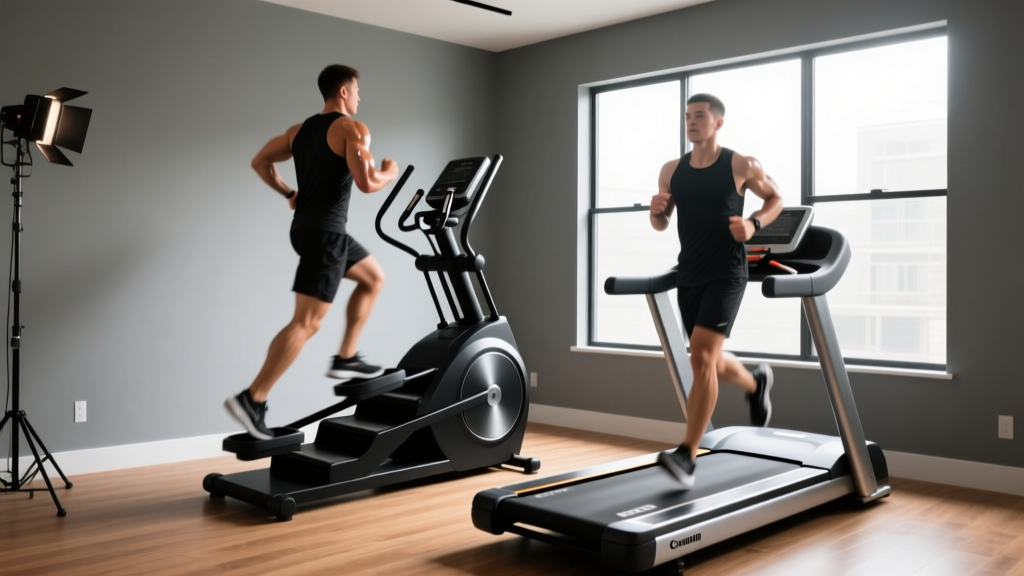
Stair Climbers vs High Intensity Treadmill Workouts for Weight Loss
Master the stair climber machine for home use. Our step-by-step beginner guide compares it to high intensity treadmill workouts for weight loss.

The Cardio Dilemma: Stepping vs. Sprinting
When building a home gym, most beginners immediately gravitate toward the treadmill. The promise of rapid calorie burn makes high intensity treadmill workouts for weight loss a dominant search trend and a staple of commercial fitness marketing. However, the stair climber machine is a vastly underutilized powerhouse that often yields superior body composition results with significantly less joint degradation. If you are setting up a home gym in 2026, understanding the biomechanical differences between these two cardio giants is critical. This step-by-step guide will teach you how to master the home stair climber, optimize your posture to avoid common failure modes, and execute a beginner-friendly routine that rivals any sprint interval session.
Quick Verdict: Stair Climber vs. Treadmill
- Joint Impact: Stair climbers offer low-impact continuous tension; treadmills introduce high-impact ground reaction forces (up to 2.5x body weight per stride).
- Posterior Chain Activation: Stepping heavily targets the gluteus maximus and hamstrings; treadmill running is predominantly quad and calf-dominant.
- Spatial Footprint: Vertical climbers require only 2x3 feet of floor space, whereas folding treadmills still demand a minimum of 3x6 feet of clearance.
Step-by-Step Beginner Guide to the Home Stair Climber
Transitioning from walking to continuous stair climbing requires specific neuromuscular adaptations. Follow this step-by-step protocol to ensure safety and maximize caloric expenditure.
Step 1: Machine Setup and Safety Checks
Before stepping onto the pedals, ensure the machine is on a level surface with at least 18 inches of clearance above your head (crucial for basement gyms). If you are using a continuous loop stair climber (like the Life Fitness Integrity series), step onto the pedals while holding the side rails, and press the 'Quick Start' button to begin the rotation at a slow 20 Steps Per Minute (SPM). Never attempt to jump onto a moving pedal.
Step 2: Mastering the "Anti-Lean" Posture Protocol
The most common failure mode for beginners is the "Rail Lean." Draping your torso over the handrails and supporting 30-40% of your body weight reduces caloric burn by up to 20% and severely limits glute activation. According to biomechanical analyses by the American Council on Exercise (ACE), proper stair climber posture requires a slight 10-to-15-degree forward hinge at the hips, with only a light, two-finger grip on the handrails for balance. Your core should be braced, and your chest proud.
Step 3: The 15-Minute Beginner Baseline Routine
Do not attempt high-intensity intervals on your first day. Use this 15-minute baseline protocol to build tendon stiffness and cardiovascular endurance:
- Minutes 0-3 (Warm-up): 40 SPM. Focus on placing your entire foot flat on the pedal. Avoid stepping only on your toes.
- Minutes 3-8 (Base Climb): 60 SPM. Shift your focus to "driving through the heel." This cue forces the glutes to fire rather than overloading the calves and Achilles tendon.
- Minutes 8-12 (Micro-Intervals): Alternate 30 seconds at 75 SPM with 30 seconds at 50 SPM. This introduces the cardiovascular spike similar to high intensity treadmill workouts for weight loss, but without the impact.
- Minutes 12-15 (Cooldown): 40 SPM. Deep diaphragmatic breathing to lower the heart rate gradually.
Caloric Expenditure: The Data Breakdown
How does the stair climber actually compare to the treadmill when it comes to raw energy expenditure? According to comprehensive metabolic data published by Harvard Health Publishing, the stair step machine is incredibly efficient. Below is a comparison based on a 155-pound (70kg) individual exercising for 30 minutes.
| Exercise Modality (30 Mins) | Estimated Calorie Burn | Impact Level | Primary Muscle Focus |
|---|---|---|---|
| Stair Step Machine (Moderate) | 216 kcal | Low | Glutes, Quads, Calves |
| Running (5.2 mph / 11.5 min mile) | 288 kcal | High | Quads, Hamstrings, Core |
| Stair Step Machine (Vigorous/HIIT) | 324+ kcal* | Low | Full Lower Body |
*Note: Vigorous stair climbing combined with Excess Post-exercise Oxygen Consumption (EPOC) can push total daily energy expenditure higher than steady-state treadmill jogging, making it a formidable tool for fat loss.
2026 Home Stair Climber Market: Top 3 Models for Beginners
If you are convinced to swap your treadmill for a stepper, the 2026 home fitness market offers distinct tiers based on budget and spatial constraints.
1. The Budget Space-Saver: Sunny Health & Fitness SF-E3865
- Price: ~$75 - $89
- Best For: Apartment dwellers and absolute beginners.
- The Reality: This is a hydraulic mini-stepper, not a continuous climber. It provides a decent cardiovascular stimulus and calf engagement but lacks the deep glute stretch of a full-sized machine. It is a great entry point before committing to a $2,000+ investment.
2. The Hybrid Powerhouse: Bowflex Max Trainer M9
- Price: ~$1,999
- Best For: Users who want the high-intensity interval training (HIIT) capabilities of a treadmill but need a low-impact, compact footprint.
- The Reality: The M9 combines an elliptical's fluid motion with a stepper's vertical climb. Its 14-inch stride length and magnetic resistance system allow for the exact type of high intensity treadmill workouts for weight loss you see online, but translated into a joint-friendly, vertical vector.
3. The Commercial Standard: Life Fitness Integrity CLS
- Price: ~$3,899+
- Best For: Dedicated home gym owners with high budgets and 8-foot ceilings.
- The Reality: Featuring an 8-inch step height and a self-generating power system (no wall outlet required), this is the exact machine you find in luxury health clubs. The continuous loop mimics real-world stair climbing perfectly, offering unparalleled biomechanical feedback.
Common Failure Modes and Troubleshooting
Even with perfect posture, beginners often encounter specific physiological edge cases. Here is how to troubleshoot them:
Edge Case: Numb Toes (Pedal Paresthesia)
Many beginners experience tingling or numbness in their toes after 10 minutes. This is caused by constant, unrelieved pressure on the plantar nerves at the ball of the foot. The Fix: Actively "pedal through the heel" and ensure you are wearing running shoes with a wide toe box and firm midsole support, rather than flat-soled lifting shoes.
Lower Back "Pump" or Fatigue: If your lower back aches before your legs burn out, you are likely hanging on the handrails, which forces the lumbar spine into extension. Release your grip, engage your transverse abdominis (imagine bracing for a punch), and reduce the SPM until you can maintain a neutral spine.
Knee Clicking (Crepitus): Painless clicking is usually just synovial fluid releasing gas. However, if clicking is accompanied by pain, your pedals may be too low, or you are pushing through your toes, altering the patellar tracking. Focus on keeping your knee aligned directly over your second toe during the downward phase of the step.
Final Verdict: Which Machine Wins Your Garage Space?
The American Heart Association recommends at least 150 minutes of moderate-intensity or 75 minutes of vigorous aerobic activity per week. Both machines can help you achieve this baseline. However, if your primary goal is maximizing posterior chain development, minimizing joint wear-and-tear, and optimizing a small home gym footprint, the stair climber is the undisputed champion. While high intensity treadmill workouts for weight loss will always have their place for sport-specific conditioning, the stair climber offers a more sustainable, high-yield cardiovascular stimulus for the lifelong fitness enthusiast.
More gear to consider
All reviews
Treadmill or Elliptical for Belly Fat? Motor Size & HP Guide

Elliptical vs Treadmill: The 2026 Arch Treadmill Market Shift

Walking Pad Setup Guide & ProForm Treadmill Troubleshooting Tips

How Many Steps is 2 Miles on a Treadmill? Motor HP Guide

Stair Climber Installation Guide & Fixing Treadmill Track Slipping
