Rowing Guide: Technique vs Treadmill Beginner Workouts Lose Weight
Explore our 2026 rowing machine buying guide and technique breakdown. See how rowing compares to treadmill beginner workouts to lose weight effectively.

The Biomechanics of Rowing: Why It Outpaces Treadmill Cardio
When newcomers to fitness begin their weight loss journey, it is incredibly common to search for treadmill beginner workouts lose weight routines, assuming that walking or jogging on a belt is the gold standard for fat oxidation. While treadmills are excellent for lower-body endurance and bone density, indoor rowing offers a vastly superior full-body stimulus for metabolic conditioning. According to the American Council on Exercise (ACE), rowing recruits approximately 86% of the body's musculature per stroke, compared to the 40% primarily lower-body engagement of treadmill walking.
This massive muscle recruitment translates directly to caloric expenditure. A 185-pound individual rowing at a moderate, steady-state pace (around 2:15 to 2:20 per 500m split) can burn between 400 and 500 calories in just 45 minutes. Furthermore, because rowing is a non-weight-bearing, low-impact exercise, it eliminates the repetitive joint sheer forces associated with treadmill running, making it a sustainable, long-term solution for weight management and cardiovascular health.
2026 Rowing Machine Buying Guide: Top Models Compared
Selecting the right ergometer (rowing machine) depends heavily on your budget, space constraints, and desired resistance profile. Below is a comprehensive comparison of the top rowing machines available in 2026, categorized by their primary use case.
| Model | Resistance Type | 2026 Price Range | Footprint (L x W) | Best For |
|---|---|---|---|---|
| Concept2 RowErg (Standard Legs) | Air (Flywheel) | $1,250 - $1,350 | 95" x 24" | CrossFit, competitive rowers, pure data accuracy |
| Hydrow (Gen 2) | Electromagnetic | $2,495 - $2,695 | 86" x 25" | Immersive classes, smart home gym integration |
| Echelon Row | Magnetic (32 levels) | $1,199 - $1,299 | 84" x 22" | Budget-conscious connected fitness users |
| Sunny Health SF-RW5515 | Magnetic | $220 - $280 | 82" x 19" | Entry-level buyers, small apartments, quiet operation |
Decoding Resistance: Air vs. Magnetic vs. Electromagnetic
Air Resistance (e.g., Concept2): The harder you pull, the more resistance the flywheel generates. This dynamic response perfectly mimics the feel of water. The damper setting (1-10) does not dictate 'difficulty' like a gear on a bike; rather, it changes the drag factor (how quickly the flywheel decelerates). For aerobic weight-loss workouts, a damper setting between 3 and 5 is recommended to simulate the drag of a sleek racing shell.
Magnetic/Electromagnetic (e.g., Sunny, Hydrow): These use magnets to create friction against the flywheel. They are exceptionally quiet, making them ideal for shared living spaces or early morning workouts. However, they lack the infinite, dynamic resistance curve of air rowers, meaning your stroke rate and power output won't naturally scale the resistance in real-time.
Mastering the Rowing Technique: The 4-Phase Stroke
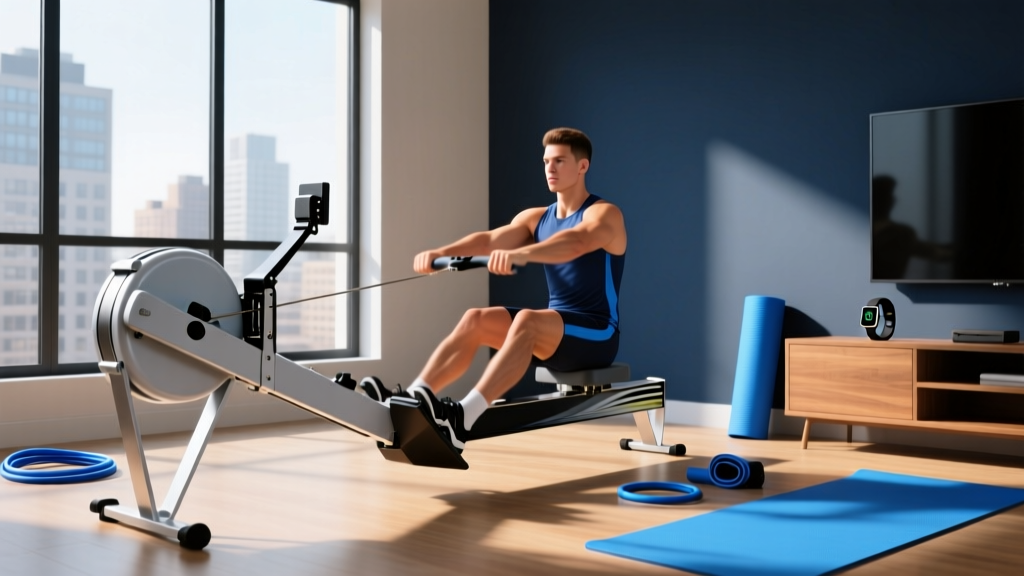
Poor technique on a rowing machine doesn't just rob you of calories; it invites lower back pain and wrist tendonitis. The Concept2 Technique Guide breaks the stroke down into four distinct phases. Mastering this sequence is non-negotiable for effective fat-loss programming.
- The Catch: Shins are vertical (or as close to vertical as your ankle mobility allows). Arms are straight, shoulders are relaxed and slightly in front of your hips. Your torso is leaning forward at roughly 11 o'clock.
- The Drive: This is a pushing motion, not a pulling one. Initiate the stroke by driving through your legs. Your arms remain straight and your torso angle stays locked until the handle passes your knees.
- The Finish: Once your legs are fully extended, swing your torso back to a 1 o'clock position, and finally, draw the handle to your lower sternum using your biceps and upper back. Keep your wrists flat.
- The Recovery: The exact reverse of the drive. Extend arms, hinge forward from the hips to 11 o'clock, and only then bend the knees to slide back to the Catch. The recovery should take twice as long as the drive (a 1:2 ratio).
Common Beginner Mistake: 'Shooting the Slide'
If your hips shoot backward before the handle moves, you are disengaging your lats and placing the entire load on your lumbar spine. Ensure the handle and the seat move simultaneously during the first half of the Drive.
Programming for Fat Loss: Rowing Intervals vs. Steady State
While steady-state rowing (LISS) is excellent for building an aerobic base, High-Intensity Interval Training (HIIT) on the ergometer triggers Excess Post-exercise Oxygen Consumption (EPOC), keeping your metabolic rate elevated for hours post-workout. The Mayo Clinic emphasizes that combining cardiovascular intervals with muscle-engaging resistance yields the most efficient weight loss outcomes.
The 20-Minute 'Fat Burner' Interval Protocol
- Warm-up: 5 minutes at a low stroke rate (18-20 s/m), focusing purely on technique.
- Work Interval: 8 rounds of 1 minute at maximum sustainable effort (aim for 26-30 s/m).
- Rest Interval: 1 minute of very light, active recovery rowing (do not stop completely, as the flywheel needs to keep the chain tensioned).
- Cool-down: 3 minutes of easy paddling, followed by hamstring and hip flexor stretches.
Maintenance and Edge Cases: What Breaks First?
Rowing machines are remarkably durable, but neglecting basic maintenance will lead to catastrophic failure modes. Here is what you need to monitor based on 2026 service data:
- Chain Maintenance (Air Rowers): The chain must be oiled every 50 hours of use. Never use WD-40. Use purified mineral oil or 3-in-One oil. Wipe the chain with a paper towel, apply oil, and pull the handle back and forth to distribute it.
- Bungee Cord Tension: Over time, the elastic bungee cord inside the handle mechanism loses tension, causing the chain to droop or fail to retract. Most premium models allow you to adjust the bungee tension via a set screw on the side of the flywheel housing.
- Rail and Roller Debris: Sweat and dust accumulate on the stainless steel monorail. If not wiped down with a non-abrasive cleaner (like Windex or a 50/50 water-vinegar mix) after every session, the plastic seat rollers will develop flat spots, resulting in a bumpy, jarring stroke.
Frequently Asked Questions
Will rowing make my legs too bulky for my weight loss goals?
No. Rowing is primarily an endurance and power-endurance sport. The resistance on an indoor rower is limited by your own power output and the drag factor, which is insufficient to induce the hypertrophy (muscle growth) associated with heavy barbell squats or leg presses. You will develop lean, dense muscle, which actually increases your basal metabolic rate.
How does rowing impact knee pain compared to the treadmill?
Because rowing is a closed-kinetic-chain, low-impact exercise, there is no ground reaction force striking your joints. However, if you have severe patellofemoral pain, you must ensure you do not over-compress at the Catch. Stop the slide when your shins are vertical; do not force your heels to lift off the foot stretchers just to get a longer slide.
What is a 'good' 2000-meter time for a beginner?
For a male beginner in his 30s, a sub-9:00 2K (averaging 2:15/500m) is a solid benchmark. For a female beginner in her 30s, a sub-10:30 2K (averaging 2:37/500m) is an excellent starting target. Focus on dropping your split time incrementally over 8 weeks rather than chasing elite times immediately.
More gear to consider
All reviews
When Can I Walk on a Treadmill After a Tummy Tuck? Recovery Mistakes & Walking Pad Reviews
3G Cardio Pro Runner Treadmill vs Rowing: Buying & Technique Mistakes

Elliptical vs Treadmill: XTERRA TR200 Treadmill 2026 Trends

Inspire Fitness Series T5 Treadmill vs Elliptical Care Guide

Folding Treadmill Small Space Review: Post-October 2025 Recall Trends