
Rowing Machine Guide: Technique & Universal Remote for Treadmill Tech
Master rowing machine technique and buying tips. Plus, learn if a universal remote for treadmill consoles works on smart rowers in our 2026 guide.

The Smart Gym Dilemma: Can You Use a Universal Remote for Treadmill on a Rower?
When outfitting a smart home gym in 2026, beginners often search for a universal remote for treadmill setups, assuming the same handheld clicker will seamlessly control their newly purchased rowing machine. It is a logical assumption, but technologically flawed. Understanding the difference between cardio machine ecosystems is the first step in building a frictionless workout space.
Most treadmill and walking pad remotes operate on basic Infrared (IR) or unencrypted 433MHz Radio Frequency (RF) signals designed to adjust speed and incline. Rowing machines, however, rely on entirely different architectures. The gold-standard Concept2 RowErg uses a Bluetooth Low Energy (BLE) and ANT+ enabled PM5 monitor. Premium smart rowers like the Hydrow or NordicTrack RW series utilize encrypted Wi-Fi and proprietary BLE protocols tied to their respective subscription apps (iFIT or Hydrow OS).
Tech Insight: A standard universal remote for treadmill consoles will not pause your Hydrow class or adjust the drag factor on a Concept2. To achieve 'universal' control over your rowing environment, bypass handheld remotes entirely. Instead, pair an Apple Watch or Garmin smartwatch via BLE to control music and track heart-rate zones, or use smart home voice routines (Alexa/Google Home) to control your gym's lighting and smart fans mid-stroke.Step-by-Step Rowing Machine Buying Guide
Choosing the right rowing machine requires matching the resistance type to your living space, budget, and fitness goals. Here is a breakdown of the primary resistance mechanisms available on the market today.
1. Resistance Types Explained
| Resistance Type | Pros | Cons | Best For |
|---|---|---|---|
| Air | Infinite resistance, highly durable, accurate metrics. | Loud 'whoosh' noise; requires chain maintenance. | CrossFitters, competitive athletes. |
| Magnetic | Whisper-quiet, smooth stroke, low maintenance. | Max resistance is capped; less dynamic feel. | Apartment dwellers, early-morning rowers. |
| Water | Authentic sound/feel, beautiful aesthetic. | Heavy, requires water purification tablets. | Design-conscious homes, purists. |
| Hydraulic | Extremely cheap, compact folding footprint. | Jerky stroke, pistons overheat and degrade. | Strict budgets, very tight spaces. |
2. 2026 Top Model Recommendations
- Concept2 RowErg (Standard Legs): Priced at $990, this remains the undisputed king of air rowers. The PM5 monitor is universally compatible with third-party apps like Zwift and EXR, making it the most versatile machine for tech-savvy users.
- Hydrow (22-inch Touchscreen): At $2,495 (plus a $44/month subscription), Hydrow offers an immersive, instructor-led experience with electromagnetic resistance that perfectly mimics the drag of water.
- Sunny Health SF-RW5515: A budget-friendly magnetic/hybrid option hovering around $159. It lacks advanced telemetry but provides a safe, quiet entry point for absolute beginners.
Mastering the Rowing Technique: A 4-Phase Breakdown
According to the Concept2 Technique Guide, rowing is not an upper-body pull; it is a coordinated push-pull sequence that recruits 86% of the body's musculature. Beginners often rely too heavily on their arms, leading to lower back fatigue. Memorize the power distribution: 60% Legs, 20% Core, 20% Arms.
Step 1: The Catch (The Setup)
Sit tall with your shins vertical. Crucial edge case: Do not let your shins compress past the ankle joint (over-compression), as this forces the hips to tuck and places immense shear stress on the lumbar spine. Your arms should be straight, shoulders relaxed, and torso leaning slightly forward from the hips (roughly a 1 o'clock position).
Step 2: The Drive (The Power)
Initiate the movement by pushing through your heels. Your arms remain completely straight until your legs are nearly fully extended. Once the handle passes your knees, hinge your torso backward to the 11 o'clock position, and finally, draw the handle to your lower ribcage. The mantra is: Legs, Body, Arms.
Step 3: The Finish (The Anchor)
At the end of the drive, your legs are flat, torso is slightly reclined, and the handle is resting just below the pectoral muscles. Keep your wrists flat and elbows tucked past your torso. Do not pull the handle up to your neck or collarbone.
Step 4: The Recovery (The Reset)
The recovery is the exact reverse of the drive and should take twice as long. Extend your arms straight out, hinge your torso forward past the knees, and only then allow the knees to bend as the seat slides back to the catch. The mantra is: Arms, Body, Legs.
Decoding the Monitor: SPM, Split, and Watts
Staring at a rowing monitor can be overwhelming. Here are the three metrics you must track to ensure an effective cardiovascular workout, aligning with the American Heart Association's guidelines for moderate-to-vigorous aerobic activity.
- SPM (Strokes Per Minute): Beginners often row at 30+ SPM, thinking faster is better. This is a mistake. For steady-state aerobic conditioning, target 18 to 22 SPM. This forces you to apply more power per stroke rather than rushing the slide.
- Split (/500m): This is your pace. It represents how long it would take you to row 500 meters at your current power output. A beginner male might aim for a 2:15/500m, while a beginner female might aim for a 2:30/500m.
- Watts: A pure measure of power output. Unlike the split, which is logarithmic (meaning it takes exponentially more energy to drop your split time), watts are linear. If you double your effort, your watts double.
Edge Cases & Maintenance Failure Modes
Cardio machines are subjected to high-cycle repetitive stress. Ignoring maintenance will lead to catastrophic failure modes that void warranties and ruin the workout experience.
⚠️ The WD-40 Trap: Never use WD-40 on an air rower chain. WD-40 is a solvent, not a long-term lubricant. It will strip the factory grease, attract micro-dust, and create a grinding paste that will destroy the sprocket and chain within months. Use only purified mineral oil or 20W-30W motor oil, applied via a paper towel every 50 hours of use.The Bungee Cord Failure: On air and water rowers, the handle retracts via an internal bungee cord. After 3 to 5 years of heavy use, this cord loses elasticity. If your handle does not snap back briskly to the cage during the recovery phase, the cord needs replacing. It is a $15 part and a 10-minute fix, but ignoring it will cause the chain to derail inside the housing.
Frequently Asked Questions
Can I use my smartwatch as a remote?
Yes. While a universal remote for treadmill setups won't work on modern rowers, BLE-enabled smartwatches (Apple Watch, Garmin) can pair directly with the Concept2 PM5 or smart rower consoles. This allows you to view real-time heart rate and stroke metrics on your wrist without taking your hands off the handle to tap a screen.
How much space do I really need?
A standard air rower requires roughly 8 feet by 2 feet of floor space during use. However, most modern rowers (including the Concept2 and Hydrow) can be stood up vertically or separated into two pieces for closet storage, requiring only a 2x2 foot footprint when not in use.
Is rowing safe for bad knees?
Rowing is a closed-chain, zero-impact exercise, making it highly recommended for joint rehabilitation. However, if you have severe patellofemoral pain, ensure you do not over-compress at the catch. Stop the slide when your shins are perfectly vertical to minimize knee flexion angles under load.
More gear to consider
All reviews
Elliptical vs Treadmill: Budget Breakdown for a 30 Minute Treadmill Workout
Stationary Bike or Treadmill for Belly Fat? Hidden Maintenance Costs

ProForm Front Runner Treadmill Review: Best for Small Spaces?
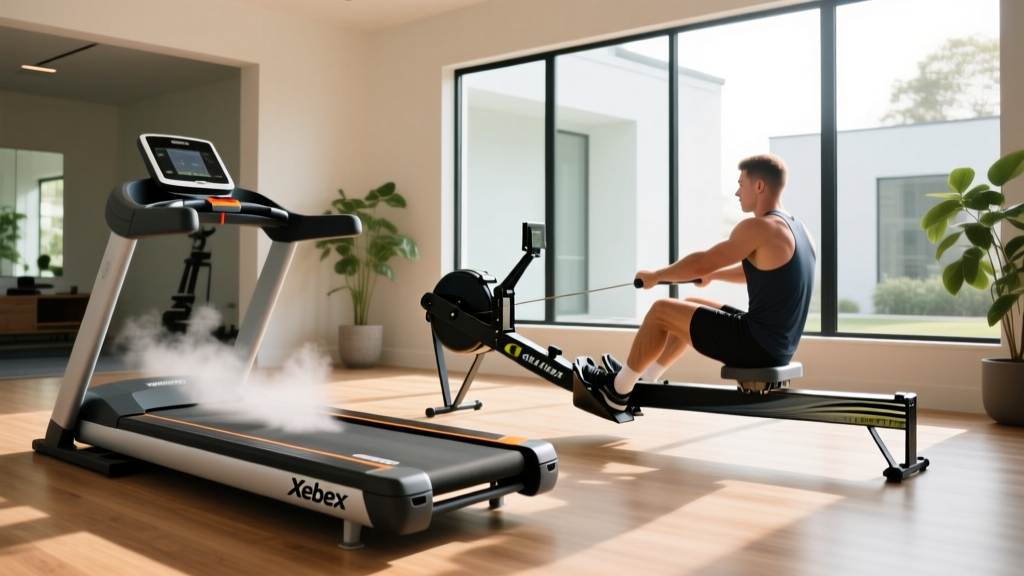
Xebex Treadmill vs Rowing Machine: Buying Guide & Technique
Treadmill Cycling Limits: Walking Pad Mistakes & Fixes
