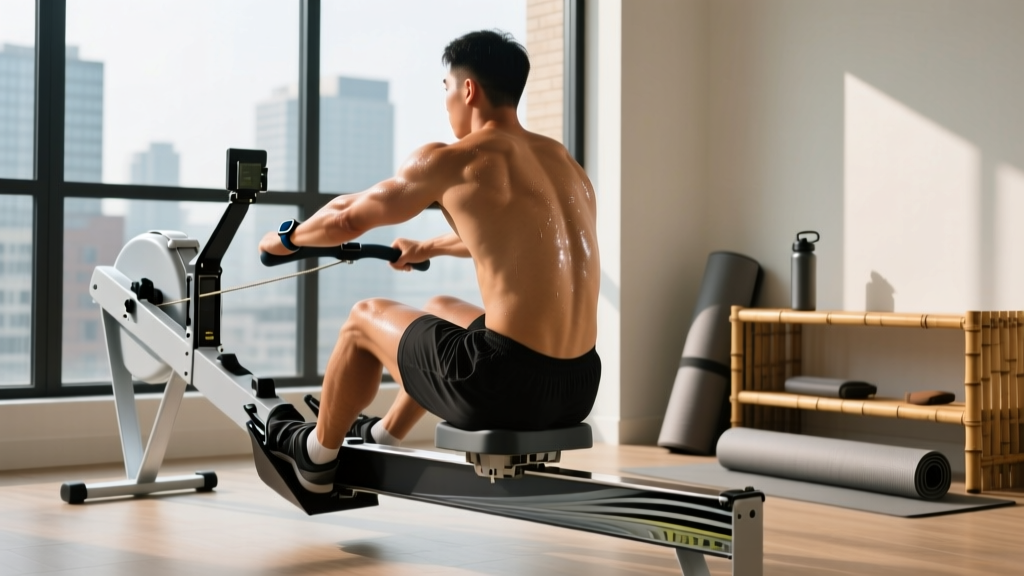
Rowing Machine Guide: Better Than Losing Weight on a Treadmill?
Master rowing machine technique and find the best 2026 models. Discover if erging burns more calories than losing weight on a treadmill.

For decades, the default strategy for cardiovascular conditioning and fat loss has been losing weight on a treadmill. While treadmills are excellent for building lower-body endurance and maintaining bone density, they leave the upper body completely unengaged and subject your knees, ankles, and hips to repetitive ground-reaction forces. In 2026, savvy home-gym builders and physical therapists increasingly recommend the rowing machine (ergometer) as a superior, full-body alternative.
Whether you are pivoting from the treadmill to the rower, or deciding between the two for your home gym, this comprehensive guide covers everything from biomechanical stroke technique to the best rowing machines on the market today.
The Calorie Burn Showdown: Rowing vs. Treadmill
Is rowing actually more efficient than losing weight on a treadmill? According to Harvard Health Publishing, a 155-pound person burns approximately 252 calories in 30 minutes of moderate stationary rowing, compared to 288 calories running at a 12-minute mile pace. However, raw calorie counts only tell half the story.
Rowing engages 86% of the body's musculature per stroke. This massive muscle recruitment triggers a higher Excess Post-exercise Oxygen Consumption (EPOC) effect, meaning you continue burning calories at an elevated rate long after the workout ends. Furthermore, the Mayo Clinic highlights low-impact aerobic exercises like rowing as ideal for sustainable joint health, making it a lifelong fitness tool rather than a short-term weight-loss fix.
| Metric | Rowing Machine (Ergometer) | Treadmill (Running/Walking) |
|---|---|---|
| Muscle Engagement | 86% (Legs, Core, Back, Arms) | 40-50% (Primarily Lower Body) |
| Joint Impact | Zero (Seated, Fluid Motion) | High (2.5x Bodyweight on Knees) |
| Posture Correction | High (Strengthens Posterior Chain) | Low (Can Exacerbate Hunching) |
| EPOC (Afterburn) | High (Due to Resistance Element) | Moderate (Unless Sprinting) |
Step-by-Step Rowing Technique for Beginners
Unlike a treadmill where you simply step on and press start, rowing requires technical proficiency. A flawed stroke not only limits your power output but can lead to lower back pain. According to Concept2's official technique guide, the stroke is divided into four distinct phases. The power sequence is always: Legs, Core, Arms. The recovery sequence is: Arms, Core, Legs.
1. The Catch (The Setup)
Slide forward until your shins are perfectly vertical. Do not compress past vertical, or you will strain your knees and lose power. Keep your chest tall, shoulders relaxed, and lats slightly engaged. Your arms should be straight, gripping the handle loosely with your fingers rather than a death grip.
2. The Drive (The Power Phase)
Push explosively through your heels. Do not pull with your arms yet. Your legs generate 60% of the stroke's power. Once your legs are nearly straight, hinge your torso backward (core engagement provides 30% of power). Finally, draw the handle to your lower ribs using your biceps and back (the remaining 10%).
3. The Finish
At the end of the drive, your legs are fully extended, your torso is leaned back slightly to the 11 o'clock position, and the handle is resting just below your chest. Your wrists should be flat, not bent.
4. The Recovery (The Reset)
This is the active rest phase. Extend your arms straight out first. Once the handle clears your knees, hinge your torso forward to the 1 o'clock position. Finally, bend your knees to slide back to the Catch. The recovery should take twice as long as the drive (a 1:2 ratio).
⚠️ Pro Tip: The Damper Setting MythBeginners often set the side damper lever to 10, thinking it mimics a heavy treadmill incline. This is a mistake. A setting of 10 causes rapid muscular fatigue before your cardiovascular system is challenged. Set the damper between 3 and 5 (a drag factor of 100-130 on the PM5 monitor) to perfectly simulate the drag of a real racing shell on water.
2026 Rowing Machine Buying Guide: Top Models & Specs
The indoor rowing market has bifurcated into two main categories: traditional air-resistance workhorses and smart electromagnetic rowers. Here is a deep dive into the top three models dominating home gyms in 2026.
1. Concept2 RowErg (The Gold Standard)
- Price: ~$1,100
- Resistance: Air (Nickel-plated steel chain)
- Monitor: PM5 (Bluetooth, ANT+, USB charging)
- Max User Weight: 500 lbs
- Expert Take: The RowErg remains the undisputed king of durability and accuracy. Every Olympic rower and CrossFit Games athlete uses Concept2. The trade-off? The air resistance is loud, and the chain requires a drop of purified mineral oil every 50 hours of use.
2. Hydrow Athlete (The Smart Premium Choice)
- Price: ~$2,495
- Resistance: Electromagnetic (Kevlar belt drive)
- Monitor: 22-inch HD Touchscreen
- Max User Weight: 375 lbs
- Expert Take: Hydrow uses a patented electromagnetic drag mechanism that is completely silent, making it ideal for apartments. The live outdoor rowing workouts are immersive, but the machine requires a $44/month subscription to access the full library, and it cannot be easily folded or stored upright without a separate wall anchor kit.
3. Echelon Row Connect s (The Budget Contender)
- Price: ~$799
- Resistance: Magnetic (32 levels)
- Monitor: Basic LCD + Tablet Holder
- Max User Weight: 300 lbs
- Expert Take: For those who want quiet magnetic resistance without the Hydrow price tag, Echelon delivers. The 32 resistance levels offer granular control, but the monitor lacks advanced metrics like exact drag factor or force curve analysis. It folds vertically for easy storage.
Common Beginner Mistakes & How to Fix Them
Mistake 1: Shooting the Slide
The Flaw: Your hips shoot up and your legs straighten before the handle moves. This transfers all the load to your lower back, causing pain and leaking wattage.
The Fix: Keep your hips and shoulders connected. Imagine a steel rod connecting your handle to your waist. When you push your legs, the handle and your torso must move backward at the exact same time.
Mistake 2: Over-Reaching at the Catch
The Flaw: Lunging forward with your shoulders to get an extra inch of reach at the front of the stroke. This collapses your chest and puts your spine in a vulnerable, flexed position.
The Fix: Hinge strictly from the hips. Stop leaning forward when your torso reaches the 1 o'clock angle. Let the slide do the work, not your lower back.
Your First 4-Week Rowing Progression Plan
To safely transition from losing weight on a treadmill to building aerobic capacity on the rower, follow this 4-week beginner framework. Focus on your Split Time (/500m) rather than total distance. A beginner split is typically between 2:15 and 2:45.
- Week 1 (Form & Neurological Adaptation): Row for 10 minutes continuously at a low stroke rate (18-20 SPM). Pause every 2 minutes to check your posture and reset your core.
- Week 2 (Interval Introduction): 5 rounds of: 2 minutes of rowing at a moderate pace (22-24 SPM), followed by 1 minute of complete rest. Focus on the 1:2 drive-to-recovery ratio.
- Week 3 (Steady State Endurance): 20 minutes continuous rowing. Keep your heart rate in Zone 2 (60-70% of max). This builds the mitochondrial density required for long-duration fat oxidation.
- Week 4 (The Benchmark): Warm up for 5 minutes. Then, row a 2,000-meter time trial. Record your time and average split. This is your baseline metric to beat in the coming months.
Final Thoughts: Making the Switch
While there is undeniable value in walking or running, relying solely on a treadmill limits your functional strength and exposes your joints to repetitive stress. By integrating a rowing machine into your routine, you unlock a highly efficient, full-body cardiovascular stimulus. Whether you invest in the indestructible Concept2 RowErg or the immersive Hydrow Athlete, mastering the ergometer will transform your home gym and accelerate your fitness results in 2026 and beyond.
More gear to consider
All reviews
Treadmill Slows Down When Running? Motor Size & HP Guide
2026 Stair Climber Guide: Setup & Treadmill TV Stand DIY Hacks

Bowflex Treadmill 10 Reviews vs Stationary Bikes: Budget Guide

Treadmill Motor Guide: Picking the Right CHP for Free Treadmill Apps
ProForm 400 Treadmill Noise Level Comparison: A Beginner's Guide
