
Noise Comparison: Finding a Quiet Exercising Treadmill & Cardio Gear
Compare decibel levels of top cardio machines. Learn how to choose a quiet exercising treadmill, elliptical, or bike for apartment living.

In the era of hybrid work and high-density apartment living, the acoustic footprint of your home gym is just as critical as its physical footprint. A machine that disrupts your downstairs neighbors or drowns out your podcast isn't just an inconvenience; it is a barrier to consistent training. When evaluating cardio equipment, most buyers obsess over screen size or incline percentages, entirely ignoring the decibel (dB) output and structural vibration transfer. According to the Environmental Protection Agency (EPA), chronic exposure to indoor noise pollution elevates stress hormones and disrupts cognitive function, making a quiet workout environment a genuine health priority.
This comprehensive guide breaks down the acoustic profiles of modern cardio machines, providing an in-depth noise level comparison to help you select the right equipment for shared living spaces, with a special focus on finding a quiet exercising treadmill.
Airborne vs. Structure-Borne Noise: The Acoustic Baseline
To make an informed purchase, you must understand the two distinct types of noise generated by fitness equipment:
- Airborne Noise: The sound traveling through the air, such as the hum of a drive motor, the whir of a cooling fan, or the 'whoosh' of an air resistance flywheel. This is measured in standard A-weighted decibels (dBA).
- Structure-Borne Noise (Impact): The kinetic energy transferred directly into your floor joists and subflooring. When your foot strikes a treadmill deck, the low-frequency vibration travels through the building's architecture, manifesting as a rhythmic, muffled thumping to the rooms below. This is notoriously difficult to mask and is measured by Impact Insulation Class (IIC) ratings in building codes.
2026 Cardio Machine Noise Level Comparison Matrix
The following table synthesizes acoustic data across the most popular home cardio categories, testing both airborne output at a 1-meter distance and structural vibration transfer.
| Machine Category | Airborne Noise (dBA) | Impact Vibration | Primary Noise Source | Apartment Friendly? |
|---|---|---|---|---|
| Magnetic Spin Bikes | 40 - 50 dB | Negligible | Drivetrain friction, cooling fan | Yes (Excellent) |
| Elliptical Cross-Trainers | 50 - 60 dB | Low | Pivot joints, magnetic braking | Yes (Very Good) |
| Magnetic Rowing Machines | 50 - 55 dB | Low-Medium | Seat rollers, magnetic brake | Yes (Good) |
| Air Resistance Rowers | 75 - 85 dB | Low | Air displacement (flywheel fan) | No (Too loud) |
| Motorized Treadmills (Walking) | 60 - 68 dB | Medium-High | DC Motor hum, belt friction | Conditional |
| Motorized Treadmills (Running) | 68 - 78 dB | Severe | Footstrike impact, motor strain | No (Without mitigation) |
Deep Dive: Selecting a Quiet Exercising Treadmill
If your primary cardio tool is an exercising treadmill, mitigating impact noise and motor hum is your biggest hurdle. The acoustic performance of a treadmill relies heavily on three engineering factors: motor type, deck suspension, and belt composition.
Motor and Belt Mechanics
Cheaper treadmills utilize small (2.0 to 2.5 Continuous Horsepower) DC motors that must spin at excessively high RPMs to maintain belt speed under load, resulting in a high-pitched, whining airborne noise. Premium models utilize 3.5 to 4.0 CHP DC motors or commercial-grade AC motors. Because these larger motors produce more torque, they operate at lower RPMs, generating a lower-frequency, quieter hum.
Furthermore, belt thickness plays a massive role in friction noise. A standard 1-ply belt will slap against the deck and generate static, while a premium 2-ply or 4-ply orthopedic belt absorbs micro-impacts and glides silently over a waxed deck.
Top Quiet Treadmill Models for Shared Spaces
- Sole F80 ($1,199): Features a 3.5 CHP motor and heavy-duty steel frame that resists harmonic vibration. The cushion flex whisper deck reduces impact transfer by up to 40% compared to outdoor asphalt. Airborne noise sits around 64 dBA at a brisk walk.
- Horizon 7.4 at Series ($1,299): Utilizes a rapid-charge motor system that prevents the 'bogging down' sound when a user's foot strikes. Its three-zone cushioning system specifically softens the impact zone, drastically reducing structure-borne thumping.
- WalkingPad R2 ($499): For those who only need walking or light jogging (up to 7.5 mph), this under-desk style folding treadmill uses a brushless 2.5 HP motor that operates at a mere 60 dBA. However, the lack of a heavy frame means vibration transfer can be high if not placed on a mat.
The Silent Contenders: Ellipticals and Magnetic Rowers
If structural limitations make an exercising treadmill impossible to use without angering neighbors, pivoting to zero-impact or magnetic resistance machines is the optimal solution.
Precision Ellipticals
Because your feet never leave the pedals, structure-borne impact noise is virtually eliminated. The Sole E95 Elliptical ($1,899) uses a heavy 27-pound flywheel and sealed cartridge bearings in all pivot points. The result is a machine that produces less than 55 dBA of airborne noise, consisting only of a soft mechanical gliding sound.
Magnetic vs. Air Rowing
The National Institute for Occupational Safety and Health (NIOSH) notes that prolonged exposure to noise above 70 dBA can cause fatigue and hearing strain. The iconic Concept2 RowErg, while the gold standard for performance, utilizes air resistance. At a 30-stroke-per-minute pace, the fan displacement generates upwards of 80 dBA—equivalent to a busy city street.
Conversely, the Hydrow Rower ($2,495) uses an electromagnetic drag system. Without a fan chopping air, the acoustic output drops to roughly 52 dBA. You will hear the seat rolling on the aluminum rail and the soft whir of the magnetic brake, making it entirely safe for use in a bedroom while a partner sleeps.
"Transitioning from an air rower to a magnetic rower dropped my workout noise from 'industrial vacuum' to 'gentle sliding door.' It completely changed my ability to train at 5:00 AM in an apartment." - Competitive amateur rower and home-gym owner.
Structural Decoupling: A Step-by-Step Mitigation Framework
Even the quietest exercising treadmill will transmit low-frequency vibrations through rigid flooring. To protect your downstairs neighbors, you must 'decouple' the machine from the building's architecture. Follow this layered approach:
- Base Layer (Mass Loaded Vinyl - MLV): Lay down a 1/8-inch sheet of MLV (approx. 1 lb per sq ft). MLV is dense and limp, acting as a sound barrier that blocks airborne noise from penetrating the floorboards.
- Isolation Pads (Sorbothane): Place 50-durometer Sorbothane vibration isolation pads under the four corners of the machine. Sorbothane is a proprietary viscoelastic polymer that absorbs up to 94% of kinetic impact energy, converting it into trace amounts of heat.
- Top Layer (Vulcanized Rubber Mat): Cover the MLV and pads with a 3/8-inch thick vulcanized rubber horse-stall mat. Avoid cheap PVC foam puzzle mats; they compress entirely under the weight of a treadmill, rendering them acoustically useless.
Preventative Maintenance for Acoustic Longevity
A machine that is quiet on day one will not remain quiet on day 300 without strict maintenance. Friction is the enemy of silence.
- Silicone Lubrication: Treadmill belts require 100% pure silicone lubricant. Apply 1 ounce under the belt every 150 miles or every 3 months. A dry belt increases the coefficient of friction, forcing the motor to draw more amps, which generates excess heat and a loud, grinding hum.
- Belt Tensioning: If the belt slips during footstrike, the motor will emit a sudden 'revving' sound. Ensure you can lift the belt exactly 2 to 3 inches off the deck at the center. Any looser causes slip; any tighter causes bearing strain.
- Joint Tightening: Every 6 months, use a torque wrench to check all chassis bolts on ellipticals and rowers. Metal-on-metal micro-movements in loose joints manifest as rhythmic clicking noises that amplify over time.
Frequently Asked Questions
Can I use a treadmill on the second floor of my house?
Yes, but only if you employ the structural decoupling framework mentioned above. The primary concern is not the floor collapsing (modern joists support 40 lbs per square foot live load, easily holding a 300 lb treadmill and user), but rather the resonant frequency of the floor joists amplifying the footstrike impact into the room below.
Are manual (non-motorized) treadmills quieter?
Curved manual treadmills, like the AssaultRunner, eliminate motor noise entirely. However, the aggressive footstrike required to move the heavy slat belt often creates severe structure-borne thumping, making them surprisingly disruptive in multi-story dwellings without heavy acoustic matting.
More gear to consider
All reviews
Rowing Machine Setup & Technique: Smarter Than a bdsm treadmill?
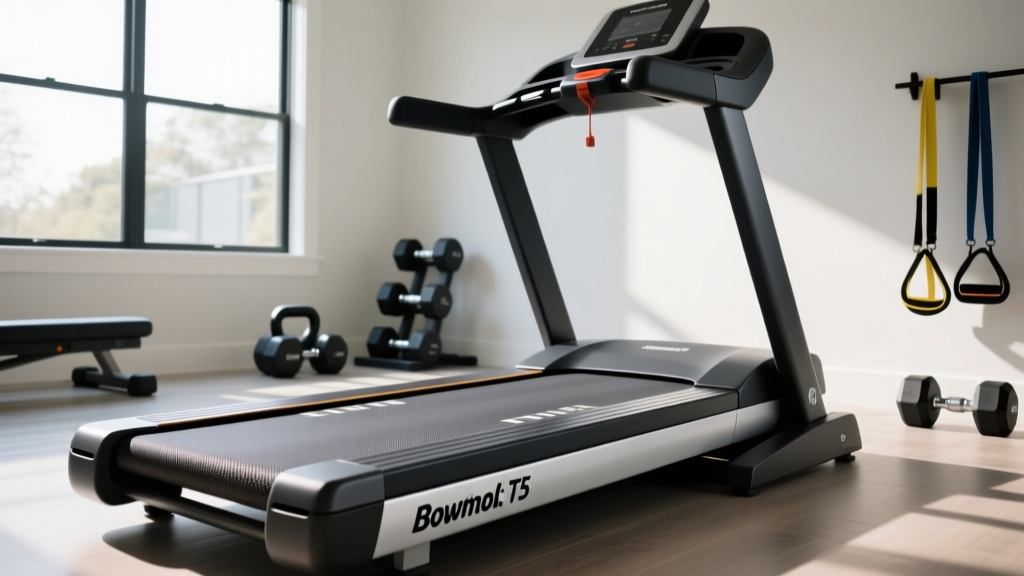
Bowflex T6 Treadmill Review: Long-Term Belt Maintenance Tips

Rowing Machine Setup vs Treadmill Belly Fat Workout

Elliptical vs Treadmill Space: Manual vs Electric Treadmill Layouts

X24 Treadmill Review: Best Under Desk Setup for 2026
