Space-Saving Cardio: ProForm Carbon XL Treadmill & Portable Options
Discover how the ProForm Carbon XL treadmill compares to truly portable cardio equipment. Expert layout tips for small-space home gyms in 2026.

As urban living spaces shrink and multi-use rooms become the standard in 2026, the demand for space-optimizing fitness equipment has never been higher. Interior designers and fitness experts constantly battle the marketing illusion of 'compact' cardio machines. A prime example is the folding treadmill market, where models like the ProForm Carbon XL treadmill are heavily marketed as space-savers. But does a folding treadmill truly optimize a small room, or do truly portable cardio options offer a superior spatial footprint?
Designing a home gym in a spare bedroom, apartment living room, or home office requires a rigorous analysis of operational footprints, folding clearances, and visual weight. In this guide, we deconstruct the spatial realities of the ProForm Carbon XL and compare it against genuinely compact, portable cardio alternatives to help you engineer the perfect small-space workout zone.
The 'Foldable' Illusion: Analyzing the ProForm Carbon XL Treadmill
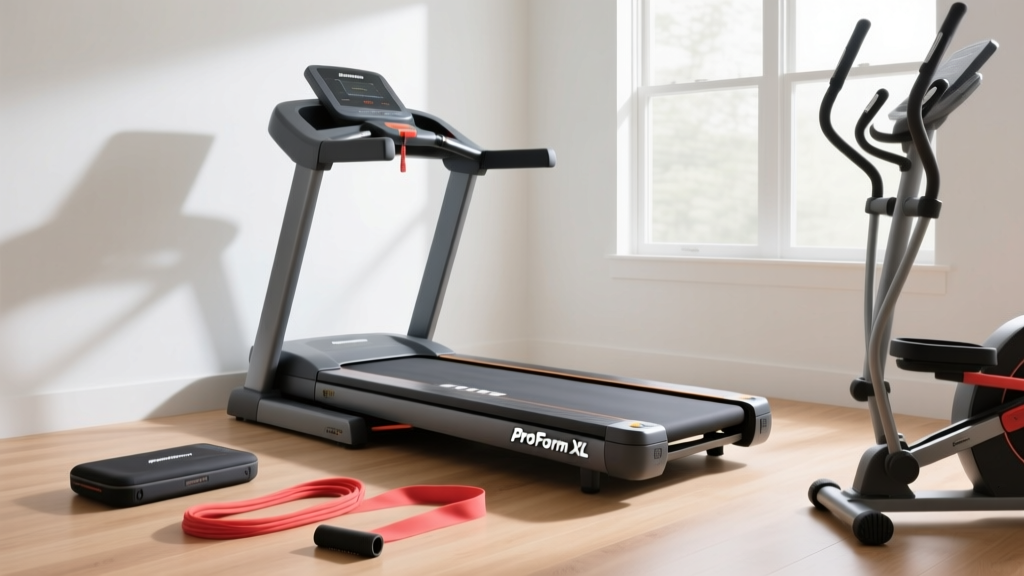
The ProForm Carbon XL is a staple in the entry-level folding treadmill category. Priced typically between $599 and $749 in 2026, it features a 2.25 CHP motor, a 300-pound user capacity, and a top speed of 10 mph. When folded, its footprint shrinks to roughly 4.5 square feet (approximately 30 inches wide by 32 inches long). On paper, this looks like a massive spatial victory.
However, from a layout design perspective, 'folded footprint' is only one metric. You must account for the folding arc and operational clearance.
The 30% Clearance Rule for Folding Treadmills
To safely deploy the ProForm Carbon XL's gas-shock assisted folding deck, you need a minimum vertical clearance of 78 inches and a horizontal swing arc of at least 6 feet. Furthermore, according to Mayo Clinic's guide to home gym setups, you must maintain a 2-foot safety buffer behind any treadmill to prevent injury in the event of a fall. This means the Carbon XL's true 'operational footprint' balloons to over 18 square feet during use.
Real-World Failure Modes in Small Spaces
- Baseboard Heater Conflicts: The Carbon XL's folded deck sits roughly 55 inches high. In many older apartments, wall-mounted thermostats or baseboard heaters block the wall, preventing the treadmill from sitting flush and creating a tripping hazard.
- Pneumatic Degradation: The hydraulic gas shock that assists in lowering the 135-pound deck is prone to pressure loss after 3 to 5 years of heavy use. When this fails, lowering the deck requires significant upper body strength, making it dangerous in tight spaces where you cannot leverage your body weight properly.
- Dust Accumulation: The pivot hinge at the base of the uprights collects dust and pet hair rapidly when pushed against a wall, requiring you to pull the heavy machine out monthly for maintenance.
True Compact & Portable Cardio Alternatives
If your primary design constraint is square footage, you must look beyond folding treadmills to genuinely portable equipment that can be stowed under furniture or in closets.
1. Under-Desk Walking Pads (e.g., UREVO Strol 2E or KingSmith R2)
Walking pads have evolved significantly by 2026, offering shock absorption and speeds up to 7.6 mph. The UREVO Strol 2E features a 180-degree folding handle, reducing its stored dimensions to roughly 25 x 21 x 10 inches. Weighing just 62 pounds and equipped with transport wheels, it can be slid under a standard bed (which typically requires 11 inches of clearance) or stood vertically in a closet corner. While it lacks the incline and 10+ mph sprinting capabilities of the Carbon XL, it fulfills the CDC's physical activity guidelines for daily zone-2 cardiovascular health without dominating the room.
2. Foldable Magnetic Resistance Bikes (e.g., XTERRA Fitness FB150)
X-frame foldable bikes remain the kings of micro-apartments. The XTERRA FB150 folds down to a footprint of less than 2 square feet (approx. 18 x 18 inches). Because they rely on magnetic resistance rather than friction or heavy flywheels, they weigh under 40 pounds. You can easily carry them from a bedroom closet to the living room for a 30-minute session, then fold and store them behind a sofa. The trade-off is a lower maximum caloric burn compared to weight-bearing treadmill running, but the spatial efficiency is unmatched.
3. Upright-Storing Rowers (e.g., Sunny Health & Fitness SF-RW5515)
Rowing machines provide a full-body cardiovascular workout, engaging 86% of the body's musculature. While they are long during operation (up to 8 feet), magnetic rowers like the SF-RW5515 can be stood upright on their stabilizer bars. In this vertical storage position, they occupy less than 3 square feet of floor space. According to Johns Hopkins Medicine, rowing is exceptionally joint-friendly, making it an ideal high-yield, low-impact alternative to treadmill running in compact home environments.
Spatial Layout Matrix: Footprint vs. Output
To make an informed purchasing decision, compare the spatial metrics of these categories side-by-side.
| Equipment Type | Stored Footprint | Operational Footprint | Weight | Noise Profile |
|---|---|---|---|---|
| ProForm Carbon XL | 4.5 sq ft | 18.5 sq ft (with safety buffer) | 135 lbs | 65-75 dB (Motor + Footstrike) |
| Folding Walking Pad | 1.5 sq ft (Under-bed) | 7.5 sq ft | 55-65 lbs | 50-60 dB (Quiet Motor) |
| X-Frame Foldable Bike | 2.0 sq ft | 4.5 sq ft | 35-45 lbs | 30-40 dB (Near Silent) |
| Compact Magnetic Rower | 2.5 sq ft (Vertical) | 14.0 sq ft | 60-70 lbs | 45-55 dB (Rail Rollers) |
Designing Your Multi-Use Cardio Zone
Integrating cardio equipment into a living space requires more than just measuring the floor. You must manage visual weight, acoustic transfer, and traffic flow.
Managing Visual Weight
In interior design, 'visual weight' dictates how heavy an object feels in a room. The ProForm Carbon XL, with its thick black plastic shrouds and wide console, carries immense visual weight, making a small room feel claustrophobic even when folded. To mitigate this:
1. Color Matching: If purchasing portable equipment, opt for white, grey, or wood-grain finishes that blend with baseboards and flooring.
2. Line of Sight: Never place a folded treadmill in the direct line of sight from the room's entrance. Tuck it into an alcove or behind a room divider to preserve the psychological openness of the space.
Acoustic and Vibration Dampening
Apartment dwellers must manage impact noise. A 180-pound runner on a Carbon XL generates significant low-frequency vibrations that travel through floor joists.
- The Mat Strategy: Do not use cheap PVC mats. Invest in a 3/8-inch thick, high-density vulcanized rubber mat (often sold as horse stall mats) cut to size. This adds mass that absorbs kinetic energy before it reaches the subfloor.
- Decoupling: For walking pads, place a thick wool rug underneath the rubber mat to further decouple the machine from hardwood or laminate flooring.
'When designing a home gym in a multi-use room, prioritize equipment that can be completely hidden. If a machine remains visible 24/7, it transitions from a fitness tool to a piece of bulky furniture, which often leads to a psychological aversion and decreased usage over time.'
— Ergonomic Space Planning Guidelines, 2025
Frequently Asked Questions
Can I place the ProForm Carbon XL on the second floor of an older home?
Yes, but with caveats. Standard residential floor joists are rated for 40 pounds per square foot of live load. The Carbon XL weighs 135 pounds, and a 200-pound user adds dynamic impact forces that can exceed 500 pounds of localized downward force during a sprint. Always place the treadmill perpendicular to the floor joists (not parallel) to distribute the load across multiple beams, and use a thick rubber mat to disperse the impact.
Are walking pads powerful enough for serious cardiovascular training?
While walking pads max out around 7.6 mph (a fast jog), they are exceptional for Zone 2 cardio training—long, steady-state sessions that build aerobic base and mitochondrial density. For high-intensity interval training (HIIT) requiring heavy sprints or steep inclines, you will need a traditional treadmill like the Carbon XL or a compact air bike.
How do I hide cords for portable cardio equipment?
Use flat, paintable cord covers that run along the baseboard. For equipment that is frequently moved (like a folding bike or portable rower), utilize a retractable ceiling-mounted cord reel or a heavy-duty fabric cord sleeve that lays flat on the floor to prevent tripping hazards when the machine is in its operational position.
More gear to consider
All reviews
Elliptical vs Treadmill: Are Deer Run Treadmills Any Good?

DeerRun Treadmill Reviews & Spin, Upright, Recumbent Bike Care
NordicTrack NTL17915 Treadmill vs Rowers: Buying Guide

Life Fitness T5 Treadmill Motor Guide: Head-to-Head vs Sole F80

Rowing Machine Buying Guide & Technique vs ProForm LM Treadmill