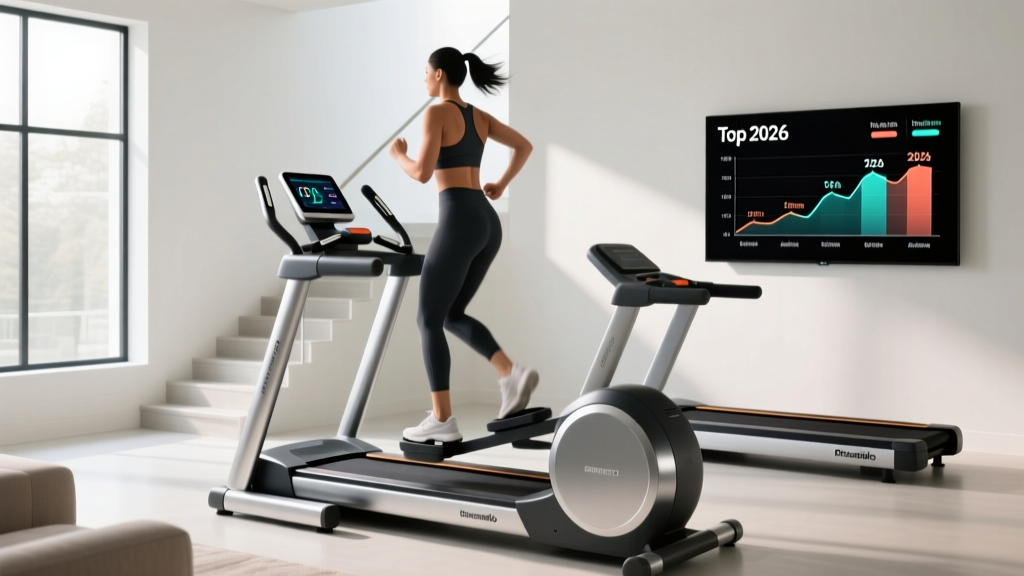
ProForm 860 Quiet Treadmill vs Curved Manual: 2026 Guide
We compare the ProForm 860 Quiet Treadmill against top curved manual treadmills. Discover which motorized or self-powered deck fits your 2026 home gym.

The Great Home Gym Debate: Motorized Convenience vs. Manual Power
As home fitness technology evolves in 2026, buyers are increasingly torn between two distinct philosophies of indoor running. On one side, we have the engineering marvels of acoustic dampening and automated pacing, best exemplified by the ProForm 860 Quiet Treadmill. On the other side, we have the raw, biomechanically demanding world of curved manual treadmills, which rely entirely on human output to drive the belt. Choosing between a motorized flat deck and a self-powered curved deck is not merely a matter of budget; it is a fundamental decision about your training style, joint health, and spatial constraints.
In this comprehensive head-to-head comparison, we will dissect the mechanical realities, long-term maintenance costs, and physiological outputs of the ProForm 860 Quiet Treadmill against premium curved manual alternatives like the AssaultRunner Elite and TrueForm Runner. Whether you are an apartment dweller prioritizing low decibel output or a CrossFit athlete seeking maximum VO2 max stimulation, this guide provides the exact data you need to make an informed purchase.
Specification Breakdown: The Contenders at a Glance
Before diving into the biomechanics, it is crucial to understand the baseline hardware differences. The table below contrasts the mid-tier motorized ProForm 860 against the industry-standard premium curved manual benchmarks.
| Feature | ProForm 860 Quiet Treadmill | Premium Curved Manual (e.g., AssaultRunner) |
|---|---|---|
| Drive System | 2.5 CHP Mach Z Brushless Motor | Self-powered curved slat belt (No motor) |
| Top Speed | 10 MPH (Motor-limited) | Unlimited (User-driven) |
| Incline/Grade | 0-10% Motorized Incline | Fixed curve geometry (Simulates 8-10% grade) |
| Acoustic Profile | ~55-60 dB (Whisper-quiet motor tech) | ~45-50 dB (Dependent on footstrike force) |
| Belt/Slat Material | 1-Ply Silicone-Lubricated PVC | 3.8-inch Polyurethane Rubber Slats |
| 2026 Price Range | $699 - $899 | $2,999 - $3,499 |
Motorized Mechanics: Deep Dive into the ProForm 860 Quiet Treadmill
The ProForm 860 Quiet Treadmill has carved out a highly specific niche in the 2026 market: delivering motorized consistency without the acoustic footprint that typically plagues budget treadmills. The 'Quiet' moniker is achieved through a combination of a brushless DC motor and an acoustic-dampening composite deck.
Acoustic Dampening and Motor Efficiency
Traditional brushed motors create friction and electromagnetic noise, often pushing decibel levels above 70 dB at high speeds. The ProForm 860 utilizes a 2.5 Continuous Horsepower (CHP) brushless system that operates smoothly in the 55-60 dB range at 6 MPH. For context, this is roughly the volume of a normal conversation or a running refrigerator, making it highly viable for multi-family housing or early-morning workouts while family members sleep in adjacent rooms.
Edge Cases and Failure Modes
Despite its acoustic advantages, motorized treadmills possess inherent mechanical vulnerabilities. The most common failure mode for the ProForm 860 is controller board burnout. If a user frequently exceeds the recommended weight capacity (typically 250 lbs for this tier), the motor draws excessive amperage to maintain belt speed. Over time, this heat degrades the Pulse Width Modulation (PWM) controller. Additionally, users who neglect the mandatory 90-day silicone lubrication schedule will experience belt delamination and increased friction, which forces the motor to work harder, ultimately negating the 'quiet' engineering by introducing loud, rhythmic thumping sounds.
The Biomechanics of Curved Manual Treadmills
Curved manual treadmills strip away the motor, screen, and incline mechanics, replacing them with a concave running surface composed of individual rubber slats. This design fundamentally alters human running mechanics.
Caloric Expenditure and VO2 Max
The primary argument for investing $3,000+ in a curved manual treadmill is physiological output. Because the user must physically pull the belt backward with every footstrike, the posterior chain (glutes, hamstrings, and calves) is heavily recruited. According to research highlighted by the American College of Sports Medicine, non-motorized curved treadmills elicit a significantly higher heart rate and oxygen consumption compared to flat motorized treadmills at the exact same perceived pace. Studies indicate a caloric burn increase of up to 30% on curved decks, making them highly efficient for time-crunched HIIT (High-Intensity Interval Training) protocols.
The Learning Curve and Joint Impact
Transitioning to a curved treadmill is not seamless. The 16-degree catch zone at the front of the curve forces a midfoot or forefoot strike. Heel-strikers often report a jarring sensation and a feeling of 'falling backward' during their first few sessions. However, once the neuromuscular adaptation occurs, the impact forces on the knees and lower back are drastically reduced. For joint health and impact absorption, Mayo Clinic guidelines suggest that reducing repetitive high-impact heel striking can mitigate long-term patellofemoral pain, a benefit inherently built into the curved slat design.
Expert Insight: The Sprint Limitation
If your training involves elite-level sprinting (15+ MPH), curved treadmills offer unlimited top speeds. However, biomechanical analyses published via the Journal of Strength and Conditioning Research demonstrate that the fixed curve geometry can slightly alter maximum velocity sprint mechanics compared to overground running, as the user must constantly fight the upward slope of the rear deck to maintain top speed.
Head-to-Head Performance Matrix
To help you visualize how these two machines handle specific workout modalities, refer to the performance matrix below:
- Steady-State LISS (Low-Intensity Steady State): Winner - ProForm 860. The motorized belt allows you to zone out, watch a screen, and maintain an exact heart rate zone without the muscular fatigue required to drive a manual belt.
- HIIT and Tabata Sprints: Winner - Curved Manual. Curved decks allow for instantaneous acceleration and deceleration. There is no waiting for a motor to spool up or slow down, eliminating the dangerous 'jumping on the side rails' maneuver required on motorized treadmills.
- Walking and Incline Hiking: Winner - ProForm 860. Curved treadmills are notoriously awkward for walking. The curve requires a certain momentum to keep the belt moving smoothly. For a 3-mile daily walk, the ProForm 860's motorized 10% incline is vastly superior and more comfortable.
Space, Maintenance, and Longevity
The total cost of ownership extends far beyond the initial purchase price. The ProForm 860 Quiet Treadmill requires a standard 120V grounded outlet and consumes roughly 600-800 watts during active use. Maintenance involves vacuuming dust from the motor hood bi-annually and applying 100% silicone lubricant to the deck every 3 to 6 months. If the electronic console fails out of warranty, replacement PCB boards typically cost between $150 and $250.
Conversely, a curved manual treadmill requires zero electricity, making it completely immune to power surges and electronic component failure. However, the mechanical maintenance is more labor-intensive. The polyurethane slats are held in place by bearings and tension rods. Over a 3-to-5-year period of heavy use, individual slat bearings may seize, requiring you to pop out the retaining clips and replace specific slats (usually $15-$25 per slat). Furthermore, the entire belt tension must be manually adjusted via rear-axle bolts if the belt begins to slip or track to one side.
"The beauty of a manual treadmill is its mechanical simplicity. There are no circuit boards to fry during a thunderstorm and no software updates to bricker your machine. You are the motor, and the machine simply translates your kinetic energy into rotation." — Home Gym Engineering Analyst, 2025 Fitness Tech Report
Real-World Troubleshooting & Edge Cases
When evaluating these machines for a 2026 home gym build, consider the physical environment. The ProForm 860 features a folding hinge mechanism, allowing the deck to lift vertically. This is a massive advantage for multi-purpose rooms or small apartments. Curved manual treadmills, due to their heavy steel frames and fixed curve geometry, do not fold. An AssaultRunner Elite weighs nearly 300 lbs and requires a permanent dedicated footprint of roughly 33 x 67 inches, plus an additional 2 feet of clearance behind the machine for safe mounting and dismounting.
Another edge case involves household flooring. The concentrated downward force of the curved treadmill's heavy frame can dent luxury vinyl plank (LVP) or soft hardwood floors. Users must invest in high-density EVA foam equipment mats. The ProForm 860 distributes weight more evenly across a larger motorized deck footprint, though a mat is still recommended for vibration dampening.
The Final Verdict: Which Should You Buy?
The choice between the ProForm 860 Quiet Treadmill and a curved manual treadmill ultimately boils down to your primary training modality and budget constraints.
Choose the ProForm 860 Quiet Treadmill If:
- Your budget is strictly under $1,000.
- Your primary routine consists of walking, light jogging, and steady-state cardio.
- You live in an apartment or shared space where motor noise and acoustic dampening are top priorities.
- You need a folding machine to conserve floor space.
Choose a Curved Manual Treadmill If:
- You are an athlete focused on HIIT, sprint intervals, and maximum caloric expenditure.
- You want a zero-electricity, zero-software machine with a 10+ year mechanical lifespan.
- You are willing to spend $3,000+ for premium biomechanical feedback and joint-friendly midfoot striking.
- You have a dedicated, permanent space for a heavy, non-folding piece of equipment.
Both machines represent the pinnacle of their respective categories in 2026. By aligning your purchase with your specific physiological goals and spatial realities, you will secure a cardio machine that delivers consistent results for years to come.
More gear to consider
All reviews
Aviron Victory Treadmill Reviews & Stair Climber Troubleshooting Guide
Compact Portable Cardio 2026: Preventing Treadmill Abuse and Motor Murder

Is the WellFit Treadmill Legit? 2026 Portable Cardio Analysis
360 Treadmill VR vs Under Desk Treadmills: 2026 Office Review

Beyond Denise Austin Treadmill Reviews: Elliptical vs Treadmill Space Guide