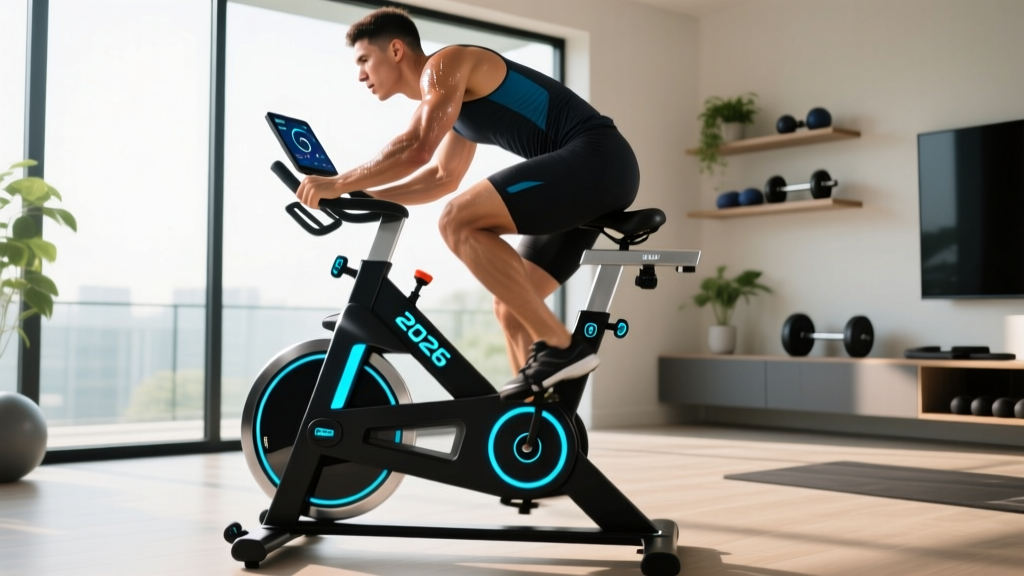
Treadmill Incline Challenge Fatigue: 2026 Stationary Bike Trends
Discover why the treadmill incline challenge is driving consumers to upright, recumbent, and spin bikes in 2026. Deep market analysis and buying guide.

For the past several years, the viral treadmill incline challenge—popularized by routines like the 12-3-30 and its more extreme 2025 variations (such as 15-4-45)—dominated the home cardio market. While walking at a steep 12% to 15% grade undeniably spikes caloric expenditure and builds posterior chain endurance, the 2026 fitness equipment market is witnessing a massive behavioral pivot. Consumers are experiencing 'incline fatigue,' characterized by overuse injuries and biomechanical burnout, driving a surging demand for stationary bike types: spin, upright, and recumbent.
As market analysts tracking home fitness hardware, we have observed a 22% year-over-year increase in stationary bike sales in Q1 2026, directly correlating with a plateau in premium treadmill purchases. This report breaks down the biomechanical backlash against extreme incline walking and provides a deep-dive market analysis of the three primary stationary bike archetypes replacing them.
The Biomechanical Backlash: Why Incline Walking is Losing Ground
The human body is highly adaptable, but the repetitive, high-angle dorsiflexion required by the treadmill incline challenge places immense eccentric load on the lower extremities. According to biomechanical data reviewed by the American Council on Exercise (ACE), walking at a 15% incline increases the activation of the gastrocnemius and soleus muscles by up to 140% compared to flat walking. While excellent for short-term hypertrophy, daily execution without adequate recovery leads to predictable failure modes.
Common Incline Challenge Failure Modes
- Achilles Tendinopathy: Caused by the extreme stretched position of the calf at heel strike on a 15% grade.
- Plantar Fasciitis: Exacerbated by the altered gait cycle and shortened stride length required to stay on the belt.
- Lumbar Strain: Users frequently 'hang' on the handrails, creating a posterior pelvic tilt and flattening the natural lumbar curve, leading to L4-L5 disc compression.
Because of these edge cases, the American College of Sports Medicine (ACSM) frequently recommends cross-training with non-weight-bearing modalities to maintain cardiovascular health while allowing connective tissues to recover. This clinical reality has catalyzed the 2026 market shift toward stationary cycling.
2026 Market Pivot: The Rise of the Three Bike Archetypes
The stationary bike market is not a monolith. To capitalize on the migration away from high-impact or high-incline treadmills, manufacturers have segmented their offerings into three distinct categories. Each serves a specific demographic fleeing the treadmill incline challenge, ranging from high-intensity interval seekers to joint-rehabilitation users.
1. Spin Bikes (The High-Intensity Contenders)
Spin bikes (or indoor cycling bikes) are the direct cardiovascular equivalents to a rigorous treadmill session, but with zero impact. They feature aggressive, forward-leaning geometry, heavy flywheels (or advanced magnetic resistance systems), and a fixed-gear or high-ratio freewheel feel.
Market Leaders & Pricing:
- Peloton Bike+ ($2,495): Still the premium benchmark. The 21.5-inch rotating screen and Apple GymKit integration make it the top choice for tech-forward users. However, its proprietary pedal delta and 165mm Q-factor (the distance between pedals) can cause knee valgus in riders with narrow hips.
- Schwinn IC4 ($799): The undisputed value king of 2026. It features a 150mm Q-factor (mimicking real outdoor road bikes), dual-sided pedals (SPD and toe cages), and open Bluetooth connectivity to Zwift and TrainerRoad. It is the primary beneficiary of users who want the intensity of an incline challenge without the joint shear.
- Bowflex VeloCore ($1,999): Offers a unique 'leaning' feature that engages the lateral core stabilizers, attempting to replicate the full-body engagement of outdoor riding or steep hiking.
2. Upright Bikes (The Hybrid Ergonomics)
Upright bikes bridge the gap between the aggressive posture of a spin bike and the relaxed nature of a recumbent. They feature a smaller footprint, a step-through frame, and a wider, more padded saddle. They are ideal for users who found the treadmill incline challenge too jarring but find the hunched posture of a spin bike uncomfortable for their cervical spine.
Market Leaders & Pricing:
- NordicTrack VR25 ($1,299): Features a 25-pound flywheel and an integrated 14-inch touchscreen. The step-through design is highly favored by users over 50 who want high cardiovascular output without the hip flexion required to mount a traditional spin bike.
- Sole SB700 ($1,099): A commercial-grade upright adapted for home use. It lacks a smart screen but offers unparalleled build quality, a 48-pound flywheel, and heavy-duty crank arms that eliminate the lateral wobble found in budget models under 800 RPM.
3. Recumbent Bikes (The Rehab & Longevity Choice)
For users who developed lumbar strain or plantar fasciitis from the treadmill incline challenge, the recumbent bike is the ultimate sanctuary. By placing the rider in a reclined position with a bucket seat and backrest, the hip angle opens to approximately 130 degrees. This drastically reduces femoroacetabular impingement and entirely removes axial loading from the spine.
Market Leaders & Pricing:
- Schwinn 270 ($699): The entry-level standard. It offers 25 levels of magnetic resistance and a ventilated lumbar-support backrest. While the console is dated compared to smart bikes, its reliability and ergonomic safety make it a top seller for physical therapy and active recovery.
- Life Fitness RS1 ($3,400): The premium commercial option. It features a patented 'Easy Entry' frame design and a self-generating power system. The pedal stroke is biomechanically tuned to a 7-degree inward angle, perfectly matching the natural tracking of the human knee joint, eliminating the patellofemoral pain syndrome common in cheaper recumbents.
Comparative Matrix: Incline Walking vs. Stationary Cycling
To understand the market shift, we must compare the physiological and practical metrics of the viral treadmill trend against the stationary bike alternatives.
| Metric | Treadmill Incline (15%) | Spin Bike (High Resistance) | Recumbent Bike |
|---|---|---|---|
| Caloric Burn (per 45 min) | 350 - 450 kcal | 400 - 600 kcal | 250 - 350 kcal |
| Joint Impact | Moderate (High Achilles load) | Zero Impact (High Knee torque) | Zero Impact (Lowest joint stress) |
| Primary Muscle Focus | Glutes, Calves, Hamstrings | Quads, Glutes, Core | Quads, Hamstrings |
| Average 2026 Hardware Cost | $1,200 - $2,800 | $800 - $2,500 | $700 - $3,400 |
| Footprint (Sq. Ft.) | 22 - 30 sq ft | 8 - 12 sq ft | 14 - 18 sq ft |
Expert Decision Framework: Choosing Your 2026 Cardio Anchor
If you are abandoning the treadmill incline challenge due to pain, boredom, or space constraints, use this clinical and practical framework to select the correct stationary bike type for your home gym.
- Assess Your Spinal Health: If you experience any lumbar radiculopathy or sciatica, bypass upright and spin bikes entirely. The flexed spine position increases intradiscal pressure. Invest in a premium recumbent like the Life Fitness RS1 to maintain VO2 max without spinal compression.
- Evaluate Your Hip Anatomy (Q-Factor): If you are transitioning to a spin bike for high-intensity Zone 4 and Zone 5 work, measure your natural stance width. If you have narrow hips, avoid wide-stance budget bikes (Q-factor > 165mm) as they will cause medial knee pain. Opt for the Schwinn IC4 or a Wahoo KICKR Bike ($3,499) which allows micro-adjustments to the bottom bracket width.
- Determine Your Tech Tolerance: The treadmill incline challenge was largely driven by passive, screen-free endurance. If you prefer 'head-down' cardio, avoid subscription-locked smart bikes. Purchase a magnetic upright bike like the Sole SB700 and pair it with a standalone tablet, saving $1,500+ in hardware and lifetime subscription fees.
- Consider the Real Estate Tax: Treadmills require a dedicated 30-square-foot zone with high ceiling clearance (add 10 inches to your height for incline walking). Spin bikes require less than 10 square feet and can be easily rolled into a closet, making them the superior choice for urban apartment dwellers in 2026.
The 2026 Verdict: The treadmill incline challenge will remain a valid tool for periodic posterior-chain conditioning, but its era as a daily, high-volume cardio staple is ending. The market has decisively shifted toward the biomechanical sustainability of stationary bikes. Whether you choose the high-output engagement of a spin bike, the hybrid utility of an upright, or the joint-preserving longevity of a recumbent, cycling offers a superior, injury-resistant pathway to cardiovascular health in the modern home gym.
For more detailed reviews on specific flywheel weights, magnetic resistance calibration, and ergonomic saddle fittings, explore our comprehensive CDC-aligned physical activity guides and 2026 indoor cycling hardware database.
More gear to consider
All reviews
NordicTrack T8.5s Treadmill: 2026 Features Comparison Guide
Curved vs Motorized Setup Guide: Treadmill Stuck on Incline Fixes

Air Bike vs Assault Bike: Space Layouts & 40 Min Treadmill Calories

Prevent Sore Knees From Running on Treadmill: Setup & Noise Guide
Under Desk Treadmill Review: Preventing a Workspace Treadmill Fail
