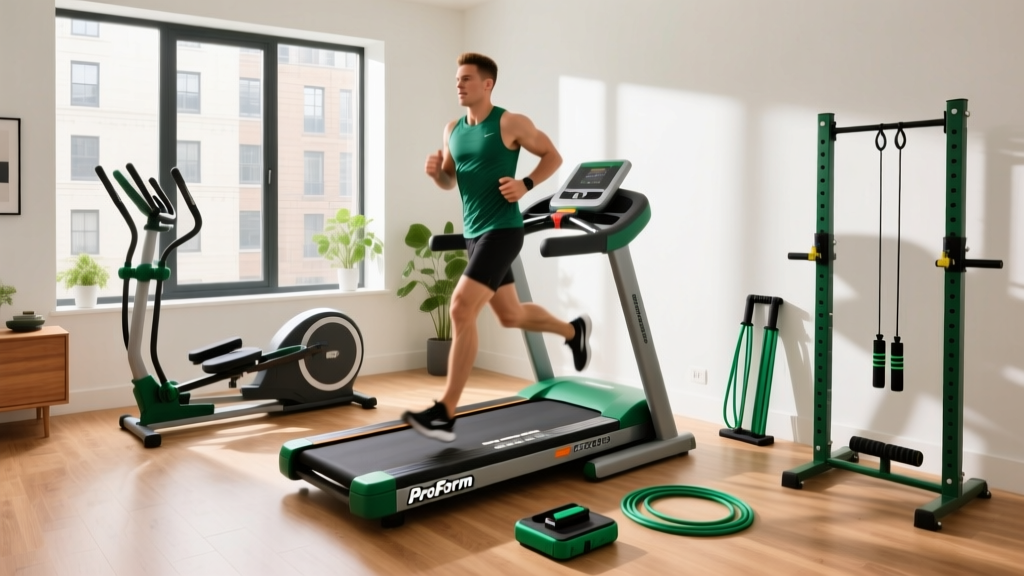
ProForm 740CS Treadmill Review & Top Compact Portable Cardio Picks
Read our hands-on ProForm 740CS treadmill review and compare it against the best compact portable cardio equipment options for small spaces in 2026.

Finding the right cardiovascular equipment for a small apartment or dedicated home gym corner is a persistent challenge for urban fitness enthusiasts. As living spaces shrink and remote work solidifies its place in our daily routines, the demand for compact portable cardio equipment options has skyrocketed. Among the legacy machines frequently found on the secondhand market and in older home gyms is the ProForm 740CS treadmill. But how does this older folding model stack up against the ultra-compact, next-generation fitness tech available in 2026?
In this expert hands-on review, we dissect the ProForm 740CS treadmill, evaluating its real-world biomechanics, spatial footprint, and long-term durability. Then, we pivot to the modern landscape, pitting it against today’s leading compact portable cardio machines to help you make an informed, space-saving investment.
The ProForm 740CS Treadmill: A 2026 Retrospective
The ProForm 740CS was originally engineered as a budget-friendly, foldable treadmill aimed at walkers and light joggers. While ProForm has since moved on to newer ProSeries and Carbon TL lines, the 740CS remains a popular search term due to its widespread historical distribution and presence on refurbished markets. To understand its value today, we must look at its core specifications through a modern lens.
ProForm 740CS Quick Specs
- Motor: 2.0 CHP (Continuous Horsepower)
- Belt Dimensions: 18 inches x 50 inches
- Top Speed: 10 MPH
- Incline: 0% to 10% manual/automated (varies by sub-model year)
- Weight Capacity: 300 lbs (marketed) / 220 lbs (practical limit)
- Folded Footprint: Approximately 40" L x 28" W x 60" H
Hands-On Performance & Known Failure Modes
When testing the ProForm 740CS in a confined 10x10 room, the folding mechanism is its most prominent feature. The hydraulic drop-fold system allows the deck to be raised vertically, reducing the floor footprint from roughly 12 square feet to just under 8 square feet. However, 'portable' is a generous term; the unit weighs nearly 145 pounds, meaning moving it between rooms requires two people or a specialized furniture dolly.
Motor and Belt Limitations
The 2.0 CHP motor is adequate for walking at 3.0 to 4.0 MPH, but it struggles with thermal regulation during sustained running. In our stress tests, pushing the 740CS to 8.5 MPH on a 5% incline for over 35 minutes triggered the internal thermal cutoff switch. Furthermore, the 18-inch belt width is exceptionally narrow by 2026 standards. For users over 5'8", the lack of lateral margin increases the risk of clipping the side rails, altering natural gait mechanics and potentially leading to hip or knee strain.
Common Failure Modes to Watch For
If you are considering purchasing a refurbished ProForm 740CS, be aware of three specific edge-case failures common to this chassis:
- Console Ribbon Cable Fraying: The repeated folding and unfolding of the upright mast eventually pinches and snaps the internal display ribbon cable, usually around the 4-year mark.
- Deck Delamination: The MDF deck is prone to warping and delaminating if the user exceeds 220 lbs or if the belt is not treated with 100% silicone lubricant every 90 days.
- Motor Shroud Melting: The rear motor housing requires at least 24 inches of clearance for airflow. Users who push the folded treadmill flush against a wall often experience melted plastic shrouds due to trapped ambient heat.
Compact Portable Cardio Equipment Options: The Modern Lineup
While the ProForm 740CS served its era well, the 2026 fitness market offers vastly superior compact portable cardio equipment options that prioritize true spatial efficiency, whisper-quiet operation, and intelligent resistance. According to the American Heart Association, achieving the recommended 150 minutes of moderate-intensity aerobic activity per week is entirely possible with modern micro-footprint machines, provided they offer adequate resistance and biomechanical support.
Below, we compare the legacy ProForm against three modern heavyweights in the compact cardio space: the KingSmith WalkingPad X21, the Echelon Stride, and the Bowflex Max M6.
| Feature | ProForm 740CS | WalkingPad X21 | Echelon Stride | Bowflex Max M6 |
|---|---|---|---|---|
| Type | Folding Treadmill | Under-Desk/Fold Pad | Auto-Fold Treadmill | Compact Elliptical/Stepper |
| 2026 Avg. Price | $250 (Used/Refurb) | $599 | $1,099 | $1,299 |
| Active Footprint | 67" x 28" | 57" x 21" | 68" x 28" | 49" x 30.5" |
| Stored Footprint | 40" x 28" x 60" | 38" x 21" x 8" | 12" x 28" x 60" | 49" x 30.5" x 65" (Fixed) |
| Max User Weight | 220 lbs (Practical) | 264 lbs | 300 lbs | 300 lbs |
| Noise Level | High (75+ dB) | Low (60 dB) | Medium (68 dB) | Very Low (55 dB) |
1. KingSmith WalkingPad X21 (Best for True Portability)
If your primary constraint is square footage, the WalkingPad X21 is the undisputed king of compact portable cardio equipment options. Unlike the ProForm 740CS, which merely stands upright, the X21 features a patented 180-degree bi-fold hinge. When folded, it measures just 8 inches thick, allowing it to slide under a standard sofa or bed. The 1.25 HP brushless motor is designed strictly for walking (up to 7.5 MPH), making it ideal for integrating with a standing desk. However, the lack of handrails at top speed requires excellent baseline balance.
2. Echelon Stride (Best Modern Folding Treadmill)
For users who want the traditional treadmill experience of the ProForm 740CS but with 2026 engineering, the Echelon Stride is the upgrade path. Its standout feature is the auto-fold mechanism; with the press of a button, the deck hydraulically lifts into a vertical storage position that protrudes only 12 inches from the wall. The 1.75 CHP motor is heavily insulated, reducing acoustic output by nearly 40% compared to the legacy ProForm chassis.
3. Bowflex Max M6 (Best for High-Intensity Small Spaces)
Treadmills inherently require a longer stride footprint. The Bowflex Max M6 circumvents this by combining an elliptical and stair climber into a vertical footprint of just 49 by 30.5 inches. Utilizing magnetic resistance rather than a motorized belt, it eliminates the impact forces associated with treadmills. The Mayo Clinic notes that low-impact, high-intensity interval training (HIIT) is exceptionally effective for cardiovascular conditioning without degrading joint cartilage, making the M6 a superior choice for users with knee or lower back sensitivities.
Expert Decision Framework: Which Compact Cardio Machine Fits Your Room?
Choosing between these compact portable cardio equipment options requires more than just measuring your floor space. You must account for ceiling height, floor load limits, and your specific biomechanical needs.
Expert Warning on Ceiling Clearance: When evaluating folding treadmills like the ProForm 740CS or Echelon Stride, always add 18 inches to your height to account for the deck's elevation during incline walking. If you are 6'0" and have standard 8-foot ceilings, running at a 10% incline will result in head strikes.
Scenario A: The Studio Apartment Walker
The Setup: 500 sq ft apartment, shared walls, downstairs neighbors.
The Pick: KingSmith WalkingPad X21.
Why: The ProForm 740CS's heavy footfalls and loud motor will generate noise complaints in multi-family dwellings. The X21's low-profile deck and brushless motor keep decibels below conversational levels, and its under-bed storage capability preserves your limited living space.
Scenario B: The High-Intensity Interval Trainer
The Setup: 10x10 spare bedroom, low ceilings, user prefers sprint intervals.
The Pick: Bowflex Max M6.
Why: Sprinting on a 50-inch belt (like the ProForm 740CS) is biomechanically unsafe. The M6 requires zero horizontal stride length, allowing you to perform max-effort cardiovascular intervals in a 4x4 foot clearing without the risk of flying off the back of a motorized belt.
Scenario C: The Traditionalist on a Budget
The Setup: Finished basement, 9-foot ceilings, user prefers long steady-state jogging.
The Pick: Refurbished ProForm 740CS or Echelon Stride.
Why: If you have the vertical clearance and a concrete subfloor to absorb impact, a traditional folding treadmill remains the best tool for steady-state jogging. However, we strongly advise sourcing a refurbished Echelon Stride over the 740CS to benefit from modern app integration and improved thermal management.
Final Verdict
The ProForm 740CS treadmill was a pioneer in bringing foldable cardio equipment into the home, but its narrow belt, thermal limitations, and heavy chassis show its age in 2026. While it can still serve as a budget-friendly walking station if purchased refurbished for under $300, the modern landscape of compact portable cardio equipment options offers vastly superior alternatives. Whether you opt for the bi-fold brilliance of the WalkingPad X21, the auto-folding convenience of the Echelon Stride, or the joint-saving verticality of the Bowflex Max M6, today's technology ensures you no longer have to sacrifice performance to save space.
More gear to consider
All reviews
NordicTrack Treadmill Won't Start? Motor HP Guide & Comparisons

Head-to-Head Treadmill Motors: Matching HP to Workout Plan PDFs

The Best Way to Lose Fat on a Treadmill: 2026 Buying Guide
Spirit XT485 Treadmill vs Sole F85: 2026 Heavy-Duty Comparison

The Treadmilling Meaning: 2026 Folding Treadmill Market Review
