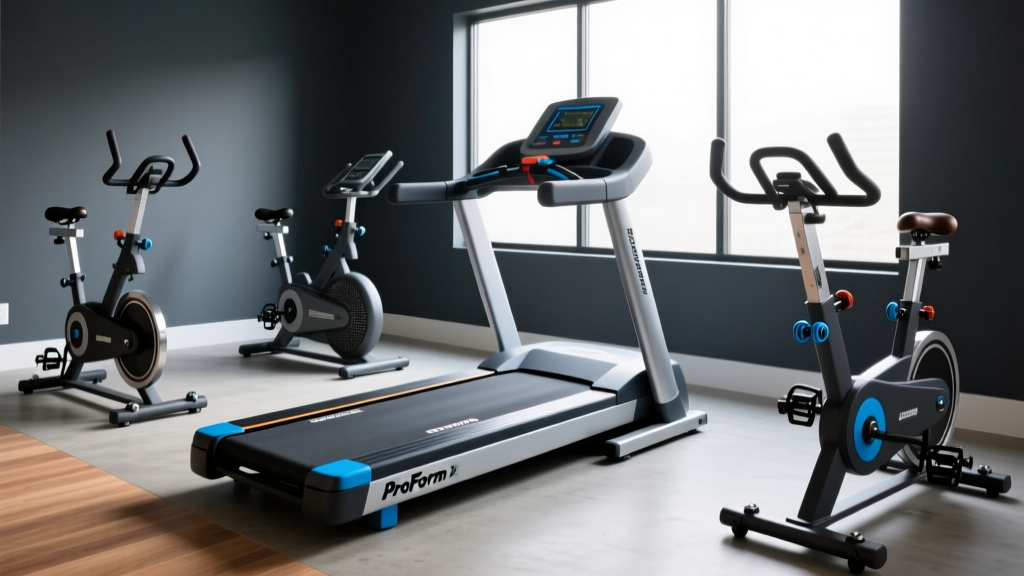
ProForm 12 Treadmill vs Stationary Bike Types: Maintenance Guide
Master home gym longevity. Compare maintenance needs of the ProForm 12 treadmill against upright, recumbent, and spin bikes with expert care schedules.

The 2026 Home Gym Reality: Treadmills vs. Stationary Bikes
Building a comprehensive home cardio fleet requires more than just matching aesthetics or subscribing to interactive fitness apps; it demands a rigorous understanding of long-term mechanical care. When comparing the high-impact, motor-driven mechanics of a ProForm 12 treadmill against the diverse biomechanics of stationary bike types—upright, recumbent, and spin—the maintenance paradigms shift dramatically. While treadmills battle continuous friction, gravitational force, and motor heat, stationary bikes fight sweat corrosion, bearing fatigue, and drive-belt tension loss.
As we navigate the 2026 home fitness landscape, equipment prices have stabilized, but replacement part costs and technician call-out fees have surged. A single neglected maintenance step on a ProForm 12 series treadmill can result in a burned-out drive motor, while ignoring the bottom bracket on an indoor spin bike can ruin the crankset. This guide breaks down the exact maintenance protocols, failure modes, and longevity strategies for the most popular cardio machines on the market.
Fleet Maintenance Mindset: Treat your cardio equipment like a vehicle. Treadmills require 'oil changes' (silicone belt lubrication) and 'tire rotations' (belt tracking), while bikes require 'suspension checks' (seat rails) and 'drivetrain care' (pedal bearings).Decoding Stationary Bike Types: Upright, Recumbent, and Spin
Stationary bikes are often mistakenly categorized as 'zero-maintenance' because they lack the massive continuous-duty motors and high-friction walking belts found in treadmills. However, each bike subtype presents unique mechanical vulnerabilities.
Upright Bikes (e.g., Schwinn 170, Nautilus U618)
Upright bikes mimic the geometry of a traditional road bike but utilize heavy flywheels and magnetic resistance. The primary failure point on upright bikes is the pedal crank arm assembly. Due to the lateral torque applied during standing climbs or high-resistance intervals, pedal threads can strip if not properly maintained.
- Crucial Detail: The left pedal is reverse-threaded. Tightening it clockwise will destroy the crank arm. Always tighten the right pedal clockwise and the left pedal counter-clockwise to a torque spec of 35-40 Nm.
- Seat Post Slippage: Over time, the micro-adjustments in the seat post collar wear down. Clean the seat post with isopropyl alcohol and apply a thin layer of carbon assembly paste (not grease) to increase friction without seizing the metal.
Recumbent Bikes (e.g., Nautilus R618, ProForm Recumbent Series)
According to the Mayo Clinic, recumbent bikes significantly reduce joint stress and lumbar strain, making them ideal for rehabilitation and older adults. However, their mechanical complexity is higher due to the step-through frame and the extended seat rail system.
The seat adjustment mechanism relies on a spring-loaded pop-pin gliding along a steel or aluminum rail. If this rail is neglected, it accumulates dust and skin cells, forming an abrasive paste that degrades the glide bearings. Longevity Tip: Wipe the seat rails weekly and apply a PTFE-based dry lubricant every three months. Avoid wet silicone sprays, which act as magnets for household dust and pet hair.
Spin and Indoor Cycles (e.g., Schwinn IC4, Peloton Bike+)
Spin bikes are the high-performance sports cars of the cardio world. They endure the highest RPMs, the most aggressive out-of-the-saddle riding, and the heaviest sweat loads. The number one killer of indoor cycles in 2026 is not mechanical wear—it is sweat corrosion.
Expert Warning: Human sweat is highly acidic and corrosive. When it drips onto the exposed aluminum handlebars or seeps under the plastic shrouds of the magnetic resistance caliper, it causes galvanic corrosion. This leads to snapped handlebars and seized adjustment knobs. Always use a sweat guard and wipe down the frame with a pH-neutral cleaner after every ride.
Furthermore, if your spin bike utilizes a friction pad (common in older or budget models), the pad will compress and glaze over time, leading to slipping and squeaking. Magnetic resistance models (like the Schwinn IC4) bypass this issue but require occasional calibration of the internal servo motor if the resistance levels displayed on the console no longer match the physical output.
The ProForm 12 Treadmill: High-Friction Maintenance Realities
The ProForm 12 series (encompassing models like the ProForm Pro 12 and Performance 12.0) features robust 2.75 to 3.0 Continuous Horsepower (CHP) motors and 20x55-inch tread belts. Unlike bikes, treadmills are open-loop friction systems. The user's body weight presses the belt into the wooden/MDF deck, generating immense heat and drag.
Belt Lubrication and Tensioning
Manufacturer guidelines from ProForm Support dictate the exclusive use of 100% silicone liquid lubricant. Petroleum-based products like WD-40 will instantly melt the urethane backing of the belt and destroy the deck.
The Lift Test: To check belt tension, reach under the center of the belt and lift. It should raise exactly 2 to 3 inches off the deck. If it lifts higher, the belt will slip during heavy incline sprints. If it lifts less, the excessive friction will overheat the motor control board (MCB) and blow the motor. To adjust, turn the rear roller adjustment bolts exactly one-quarter turn clockwise on both sides. Never overtighten, or you will crush the front roller bearings, resulting in a $120 replacement bill.
Motor Hood and Carbon Dust
The ProForm 12's DC motor utilizes carbon brushes that slowly wear down against the commutator. This creates a fine, highly conductive carbon dust. Every 90 days, unplug the treadmill, remove the motor hood screws, and use a vacuum with a soft brush attachment to remove this dust. If left alone, the carbon dust can bridge the gap on the MCB circuitry, causing a catastrophic short circuit.
Comparative Maintenance Matrix: Bikes vs. ProForm 12
Understanding the cost and time investment of your equipment helps in planning your 2026 home gym budget. Below is a comparative breakdown of annual maintenance requirements.
| Equipment Type | Primary Wear Component | Maintenance Frequency | Estimated Annual Cost | DIY Difficulty |
|---|---|---|---|---|
| ProForm 12 Treadmill | Walking Belt & Deck | Every 130 miles / 3 months | $20 (Silicone) + $60 (Deck flip) | Moderate |
| Upright Bike | Pedal Cranks & Seat Post | Every 6 months | $10 (Assembly paste) | Easy |
| Recumbent Bike | Seat Guide Rails | Every 3 months | $12 (PTFE Dry Lube) | Easy |
| Spin / Indoor Cycle | Bottom Bracket & Sweat Guards | Every 12 months | $40 (Bearing replacement) | Advanced |
Advanced Longevity Protocols for 2026
To maximize the lifespan of your cardio fleet, implement these advanced protocols based on current biomechanical engineering standards and Schwinn Fitness technical bulletins.
- The Subfloor Mat Imperative: Never place a ProForm 12 treadmill or a heavy recumbent bike directly on carpet or bare hardwood. Carpets restrict motor airflow, causing thermal shutdowns, while hardwood amplifies micro-vibrations that loosen internal console wiring. Invest in a high-density, 3/8-inch thick vulcanized rubber equipment mat. This dampens acoustic vibration and provides a level, load-bearing surface.
- Incline Motor Calibration: On the ProForm 12 series, the incline motor operates independently of the drive motor. Once a year, run the treadmill's built-in calibration mode (usually accessed by holding the 'Stop' and 'Speed Up' buttons simultaneously while inserting the safety key). This recalibrates the potentiometer, ensuring the physical deck angle matches the digital console readout, preventing uneven deck wear.
- Drive Belt Inspection (Bikes): For belt-driven upright and recumbent bikes, remove the side shroud annually. Press the poly-V drive belt. It should have about 1/2 inch of deflection. If it's loose, it will slip and squeak; if it's too tight, it will prematurely wear out the alternator or magnetic flywheel bearings.
Environmental Threats: Humidity and HVAC Placement
The physical location of your cardio machines dictates their lifespan just as much as your lubrication schedule. Treadmills like the ProForm 12 draw massive amounts of ambient air through the motor hood to cool the electronics. If your treadmill is placed directly under an HVAC vent, or in a dusty garage, the motor fan acts as a vacuum, pulling dust, pet dander, and humidity directly onto the circuit boards.
Similarly, spin bikes placed in rooms with high humidity (above 60%) are prone to rapid oxidation on exposed steel components, such as the seat post and handlebar stems. Maintain your home gym environment at a stable 40-50% relative humidity using a smart dehumidifier, and ensure all equipment is positioned at least two feet away from direct HVAC airflow and exterior doors.
Final Verdict: Balancing the Fleet
Maintaining a mixed cardio fleet requires adapting your mindset to the specific engineering of each machine. The ProForm 12 treadmill demands rigorous, scheduled friction management and electrical hygiene to protect its high-torque motor and walking deck. In contrast, stationary bike types—whether the joint-friendly recumbent, the traditional upright, or the high-intensity spin bike—require a hyper-focus on sweat mitigation, thread torque, and bearing care. By adhering to these targeted, model-specific maintenance protocols, you will easily push your equipment past its standard 5-year warranty, securing a decade of reliable, high-performance cardio training in your home gym.
More gear to consider
All reviews
Top Compact Treadmills for Walking Backwards on Treadmill Incline
NordicTrack 6.5S Treadmill vs Under Desk Treadmills: Office Value
Home Stair Climber Guide: Avoid Sole F80 Treadmill Lube Mistakes

HIIT Cardio Treadmill Motor Guide & Setup Walkthrough

Gym Layouts: Stationary Bike Types & 9 Min Mile Treadmill Speed
