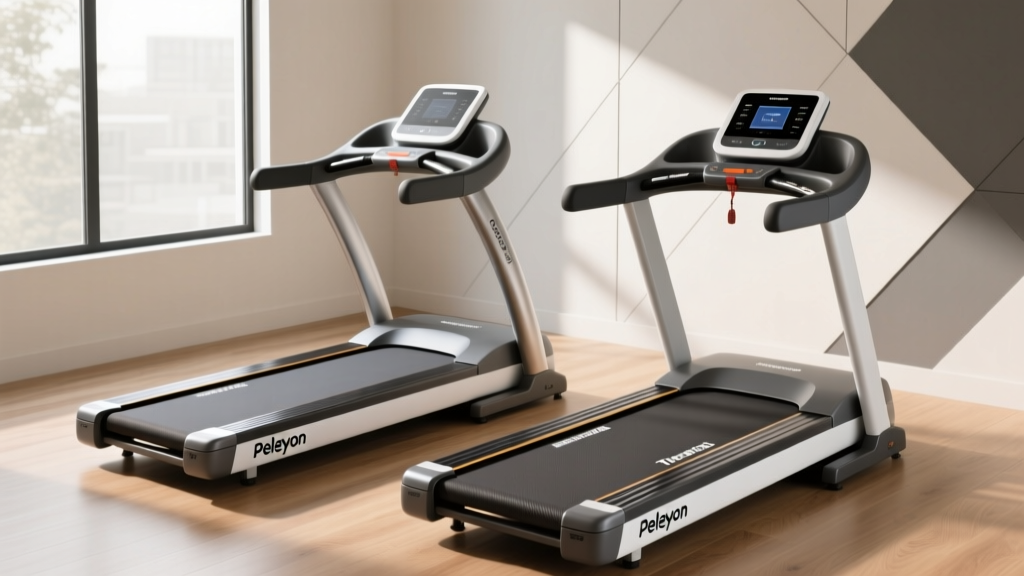
Peleyon Treadmill: Curved Manual vs Motorized 2026 Guide
Compare the Peleyon treadmill curved manual design against standard motorized models. Expert 2026 buying guide with specs, biomechanics, and cost data.

The Paradigm Shift: Peleyon Treadmill and the Manual Revolution
When outfitting a home gym in 2026, the debate between curved manual treadmills and traditional motorized models remains one of the most critical decisions for cardio enthusiasts. The Peleyon treadmill has recently emerged as a formidable contender in the non-motorized space, challenging legacy brands with its precision-engineered 12-degree curve and high-density vulcanized rubber slat belt. But does a self-powered, gravity-driven machine genuinely outperform a 3.0 CHP motorized workhorse like the Sole F80 or NordicTrack T Series?
This in-depth buying guide dissects the biomechanics, long-term failure modes, caloric expenditure, and spatial requirements of the Peleyon curved manual treadmill versus standard motorized alternatives. Whether you are a sprint-interval athlete or a steady-state endurance runner, understanding the mechanical realities of these machines is essential before dropping $1,500 to $3,000 on your next cardio investment.
Key Takeaway: The Peleyon manual treadmill eliminates motor and control board failures entirely, trading electrical maintenance for mechanical bearing and slat-belt upkeep, while simultaneously increasing caloric burn by up to 30% per session.Head-to-Head Matrix: Peleyon Curved vs. Standard Motorized
Before diving into the physiological data, it is crucial to understand the baseline hardware differences. The table below contrasts the mid-tier Peleyon curved manual treadmill with a benchmark 3.0 CHP motorized treadmill (representative of popular 2026 models in the $1,200–$1,500 range).
| Specification | Peleyon Curved Manual Treadmill | Standard Motorized Treadmill (3.0 CHP) |
|---|---|---|
| Power Source | 100% Self-Powered (Human Kinetic) | 120V Dedicated Outlet Required |
| Top Speed | Unlimited (User-Dependent, tested to 22+ mph) | Capped at 12.0 mph (Software Limited) |
| Running Surface | 17' x 62' Vulcanized Rubber Slat Belt | 20' x 60' Multi-Ply PVC/Nylon Belt |
| Unit Weight | 155 lbs (Highly Stable, No Anchoring Needed) | 185 - 210 lbs (Requires stabilization at high speeds) |
| User Weight Capacity | 300 lbs (Distributed across slats) | 325 - 350 lbs (Dependent on deck flex) |
| Average Price (2026) | $1,899 - $2,299 | $1,199 - $1,699 |
| Deck Lubrication | None (Urethane guide tracks) | 100% Silicone Spray (Every 3-6 months) |
Biomechanics and Caloric Expenditure: The Data
The primary argument for purchasing the Peleyon treadmill over a motorized alternative lies in human biomechanics. On a motorized treadmill, the belt pulls your foot backward, which artificially assists in the hip extension phase of the running gait. Conversely, the Peleyon's curved deck requires the user to actively pull the belt backward using their hamstrings and glutes, engaging the entire posterior chain.
What the Research Says
According to studies published in the Journal of Strength and Conditioning Research, running on a curved manual treadmill increases energy expenditure by approximately 30% compared to running at the exact same speed on a motorized treadmill. The 12-degree curve of the Peleyon forces a more natural mid-foot or forefoot strike, drastically reducing the braking forces typically associated with heel-striking on flat, motorized decks.
- Heart Rate Response: Users typically see a 10 to 15 BPM higher heart rate on the Peleyon at sub-maximal speeds compared to motorized equivalents.
- Muscle Activation: Electromyography (EMG) data shows significantly higher activation in the biceps femoris (hamstring) and gastrocnemius (calf) when propelling a manual slat belt.
- Joint Impact: The thick rubber slats of the Peleyon absorb up to 40% more shock than standard phenolic wood decks found on budget motorized models, reducing tibial stress.
Long-Term Ownership: Failure Modes and Maintenance
One of the most overlooked aspects of buying cardio equipment is the 5-year failure trajectory. Motorized and manual treadmills fail in fundamentally different ways. Understanding these edge cases will dictate which machine is right for your specific environment.
Motorized Treadmill Vulnerabilities: The most common catastrophic failure in motorized treadmills is the Motor Control Board (MCB). Dust ingress, power surges, and excessive friction from under-lubricated belts cause the MCB to overheat and fry. Replacing an MCB typically costs between $250 and $400, plus labor. Drive belts and roller bearings are secondary failure points.The Peleyon Manual: Mechanical Wear and Tear
Because the Peleyon treadmill lacks a motor, MCB, and power cord, its failure modes are entirely mechanical.
- Guide Wheel Degradation: The slat belt glides on UHMWPE (Ultra-High-Molecular-Weight Polyethylene) guide wheels. After approximately 3,000 to 4,000 miles of heavy use, these wheels can develop flat spots or wear down, causing a 'bumping' sensation. Replacement is straightforward and costs under $80 for a full set.
- Main Axle Bearings: The front and rear axles rely on sealed cartridge bearings. If exposed to high humidity or sweat corrosion without periodic wiping, these bearings can seize. Unlike motorized belts, you cannot simply spray silicone to fix a seized bearing; it requires a press-removal and replacement.
- Slat Belt Stretch: While vulcanized rubber is incredibly durable, the Kevlar-reinforced core can experience minor tension loss over 5+ years. The Peleyon features manual rear-axle tensioning bolts to correct this, a 5-minute fix requiring only a 15mm wrench.
Spatial Footprint and Home Gym Integration
Curved manual treadmills possess a distinct spatial advantage. Motorized treadmills require a 3-foot clearance behind the deck for safety (to prevent users from being thrown into a wall if they fall) and proximity to a dedicated 120V, 15-amp circuit. The Peleyon treadmill, measuring roughly 68 inches long by 33 inches wide, can be placed flush against a wall or in the corner of a room.
'Because there is no motorized belt accelerating to 10 mph, if a user steps off or falls on a curved manual treadmill, the belt stops almost instantly. This eliminates the need for rear-clearance safety zones, saving up to 9 square feet of valuable home gym real estate.'
Flooring Requirements: The Peleyon weighs 155 lbs, but the dynamic point-load of a 200 lb runner striking the curve can exceed 800 lbs of force per square inch. Do not place this machine directly on hardwood or luxury vinyl plank (LVP) flooring. A minimum 3/8-inch thick, high-density vulcanized rubber horse-stall mat is mandatory to prevent subfloor indentation and dampen acoustic resonance.
Decision Framework: Which Machine Should You Buy?
Use the following practical framework to make your final purchasing decision in 2026.
Choose the Peleyon Curved Manual Treadmill If:
- You prioritize HIIT and Sprint Intervals: The ability to jump on the rails, sprint at maximum effort, and safely step back on without waiting for a motor to accelerate makes the Peleyon superior for CrossFit-style EMOMs and Tabata protocols.
- You want zero electrical dependency: Ideal for garage gyms without dedicated 20-amp circuits, off-grid homes, or users who want to reduce their household energy footprint.
- You suffer from patellofemoral pain: The forced forefoot strike and shock-absorbing slat belt significantly reduce the knee-extension torque that aggravates runner's knee.
Choose a Standard Motorized Treadmill If:
- You are strictly a steady-state walker or jogger: If your primary exercise is walking at 3.0 mph while watching television, the manual resistance of a curved deck will feel unnecessarily taxing and alter your natural walking posture.
- You rely on automated programming: If you prefer 'set it and forget it' heart-rate-controlled incline/decline programs (like iFIT or Peloton guided routes), motorized machines with automated screens remain the undisputed champions of passive engagement.
- You have strict budget constraints: A reliable motorized treadmill like the Sole F63 can be acquired for under $1,000, whereas the entry-level Peleyon curved models start closer to $1,899.
Frequently Asked Questions
Is the Peleyon treadmill difficult to assemble?
Unlike motorized treadmills that require complex console wiring and motor hood alignment, the Peleyon arrives roughly 80% pre-assembled. The primary task involves bolting the upright handrails to the main deck chassis and tightening the rear axle tensioners. Two people can complete the assembly in under 45 minutes using standard metric hex keys.
Can I walk backwards on the Peleyon for physical therapy?
Yes. Walking backwards on a curved manual treadmill is highly effective for targeting the VMO (vastus medialis oblique) and aiding in ACL rehabilitation. Because the belt only moves when you push it, backward walking is exceptionally safe on the Peleyon, provided you maintain a firm grip on the side rails.
How does the noise level compare to a motorized treadmill?
The Peleyon is significantly louder in terms of 'impact' noise (footfalls on the rubber slats) but completely silent in terms of 'mechanical' noise (no motor whine or belt friction hum). If you live in a multi-story apartment, the impact noise will require heavy acoustic dampening mats, whereas a motorized treadmill's hum might be more disruptive to a sleeping partner in the same room.
More gear to consider
All reviews
Elliptical vs Treadmill: Apple Watch Accuracy & Budget Guide

Horizon Fitness 7.0AT Studio Series Treadmill vs Walking Pads

Bowflex BXT6 Treadmill Review vs Home Stair Climber Troubleshooting

Pad vs Treadmill: Running on a Treadmill to Lose Weight How Long?
Manual vs Motorized: WalkingPad X25 Double Fold Running Treadmill Review
