
Orange Theory Treadmill Workout at Home: Bike Types & Budget Breakdown
Compare the cost of an Orange Theory treadmill workout to buying upright, recumbent, or spin bikes. Discover the best budget value for home heart-zone training.

The Heart-Zone Dilemma: Studio vs. Home Cardio ROI
If you are chasing the endorphin rush and 'Splat points' of an orange theory treadmill workout, you already know the addictive appeal of heart-rate zone training. The signature combination of 12-15% incline pushes and flat-out sprints delivers elite cardiovascular conditioning. However, as of 2026, the financial reality of boutique fitness is staggering. With unlimited studio memberships averaging $189 per month, plus commuting time and parking fees, the annual cost easily eclipses $2,500.
This brings us to a critical budget and value analysis: Can you replicate the physiological intensity of an Orange Theory treadmill workout at home using a stationary bike? More importantly, which stationary bike type—spin, upright, or recumbent—offers the highest return on investment for high-intensity interval training (HIIT)? Let us break down the biomechanics, the exact 2026 pricing, and the long-term value of each machine category.
Decoding the Treadmill Cues for Cyclists
Before evaluating equipment, we must translate treadmill biomechanics to the bike. According to the American Heart Association, maximizing cardiovascular benefit requires spending time in specific target heart rate zones. The Orange Theory model relies heavily on pushing into the Orange (84-91% of max HR) and Red (92-100%) zones.
- Base Pace (Treadmill): 3.0 - 4.5 mph at 1-5% incline. Bike Translation: 80-90 RPM at light-to-moderate resistance (Zone 2/3).
- Push Pace (Treadmill): 3.0 - 4.5 mph at 8-15% incline. Bike Translation: 60-75 RPM at heavy resistance, simulating a steep hill climb (Zone 4).
- All Out (Treadmill): 8.0 - 12.0+ mph flat. Bike Translation: 95-115 RPM at moderate resistance, focusing on explosive leg turnover (Zone 5).
Stationary Bike Types: Upright vs. Recumbent vs. Spin
Not all stationary bikes are engineered to handle the explosive torque and rapid cadence shifts required for HIIT. Here is how the three main categories stack up for replicating studio-level intensity.
1. Spin Bikes (Indoor Cycles): The Direct Splat-Point Competitor
Spin bikes are the only true 1:1 replacement for the high-intensity demands of an orange theory treadmill workout. They feature a heavy flywheel (or advanced magnetic eddy-current resistance) and a geometry that allows for out-of-the-saddle climbing, which mimics the glute and hamstring engagement of a 15% treadmill incline.
Top 2026 Value Picks:- Schwinn IC4 ($799): Features 100 levels of magnetic resistance and a 40lb equivalent flywheel. The 168mm Q-factor closely mirrors outdoor road bikes, protecting your knees during high-cadence 'All Out' sprints.
- Echelon EX3 ($599): A budget-friendly alternative with 32 resistance levels, though the lighter flywheel can feel slightly 'jerky' during rapid accelerations.
Value Verdict: Spin bikes offer the highest ROI for HIIT enthusiasts. They safely accommodate 110+ RPM sprints and heavy standing climbs, making them the undisputed champion for heart-rate zone training.
2. Upright Bikes: The Mid-Tier Compromise
Upright bikes feature a smaller footprint, a step-through frame, and a seated position that places the pedals slightly ahead of the body. They are excellent for steady-state cardio but struggle with the explosive dynamics of studio-style intervals.
- Nautilus U618 ($799): Offers 25 levels of resistance and a fan-cooled console.
- Sole B94 ($1,299): Features a heavier 48lb flywheel, which provides smoother momentum than cheaper uprights.
The Edge Case: You cannot safely stand and climb on a standard upright bike. Therefore, simulating a 15% incline 'Push Pace' requires grinding at very low RPMs with max resistance, which places excessive shear force on the patellar tendon. Upright bikes are better suited for LISS (Low-Intensity Steady State) than Orange Theory-style HIIT.
3. Recumbent Bikes: Active Recovery and Rehab
Recumbent bikes position the rider in a laid-back posture with a full backrest and pedals extending forward. Models like the Schwinn 270 ($1,099) or Horizon Comfort R ($1,199) are engineering marvels for joint preservation.
"While recumbent bikes reduce lumbar spine loading by up to 40% compared to upright cycling, their biomechanical leverage limits maximum power output, making it nearly impossible to reach the Zone 5 heart rate spikes required for true HIIT."
Value Verdict: If your primary goal is replicating the 'All Out' sprints of an orange theory treadmill workout, a recumbent bike is a poor investment. However, if you are using the bike strictly for active recovery days between heavy studio sessions, it holds immense value.
The Splat-Point Translation Matrix
To successfully transition your routine, use this matrix to map your treadmill cues to a magnetic resistance spin bike (calibrated to a 1-100 resistance scale).
| OTF Treadmill Cue | Treadmill Metrics | Spin Bike Translation | Target HR Zone |
|---|---|---|---|
| Base Pace | 3.5 mph / 2% Incline | 85 RPM / Resistance 35-45 | Green (71-83%) |
| Push Pace | 3.2 mph / 12% Incline | 65 RPM / Resistance 70-85 (Seated Climb) | Orange (84-91%) |
| All Out Sprint | 10.0 mph / 1% Incline | 105 RPM / Resistance 40-50 (Fast Pedal) | Red (92-100%) |
3-Year Budget Breakdown: Memberships vs. Equipment
Let us look at the hard data. According to Harvard Health Publishing, vigorous stationary cycling burns a comparable amount of calories to running at a 6 mph pace (roughly 315-441 calories per 30 minutes depending on body weight). The physiological ROI is identical; the financial ROI is where home equipment wins.
| Investment Path | Upfront Cost | Monthly Recurring | 3-Year Total Cost |
|---|---|---|---|
| OTF Unlimited Membership | $0 | $189 / mo | $6,804 |
| Schwinn IC4 + JRNY App | $799 | $14.99 / mo | $1,338 |
| Peloton Bike+ + All-Access | $2,495 | $44 / mo | $4,079 |
By purchasing a mid-tier spin bike and utilizing a connected fitness app to guide your heart-rate zones, you save over $5,400 across a 36-month period compared to studio memberships.
Hidden Costs and Edge Cases in Home Cardio
When budgeting for a home spin bike to replace your treadmill workouts, do not ignore the peripheral costs that catch beginners off guard:
- Footwear & Cleats ($120 - $180): Most studio-quality spin bikes use SPD or Delta cleat systems. Running shoes will cause foot numbness and power leakage during heavy 'Push Pace' climbs. Budget for stiff-soled cycling shoes.
- Equipment Mats ($40 - $60): HIIT cycling generates significant lateral sway and sweat. A high-density PVC mat is mandatory to protect hardwood floors from sweat corrosion and dampen the acoustic vibration of a 100 RPM sprint.
- Heart Rate Monitors ($80 - $130): To accurately track your 'Splat points' at home, a chest strap (like the Polar H10 or Garmin HRM-Pro) is vastly superior to the optical sensors built into bike handlebars, which fail during high-vibration out-of-the-saddle climbs.
Final Verdict: Which Bike Type Delivers the Best Value?
If your ultimate goal is to replicate the explosive, heart-rate-spiking nature of an orange theory treadmill workout without the $2,500+ annual studio fee, the Spin Bike is the only logical choice. Upright bikes lack the biomechanical geometry for standing climbs, and recumbent bikes cannot facilitate Zone 5 power outputs.
For the ultimate budget-to-performance ratio in 2026, a magnetic resistance spin bike in the $700–$900 range (such as the Schwinn IC4 or Bowflex C6), paired with a third-party heart rate monitor and a guided HIIT app subscription, delivers 95% of the studio experience for less than 20% of the three-year cost.
More gear to consider
All reviews
Treadmill Incline Showdown: 2026 Motor Horsepower Guide

ProForm 540S Treadmill: Feature Comparison & Buying Guide
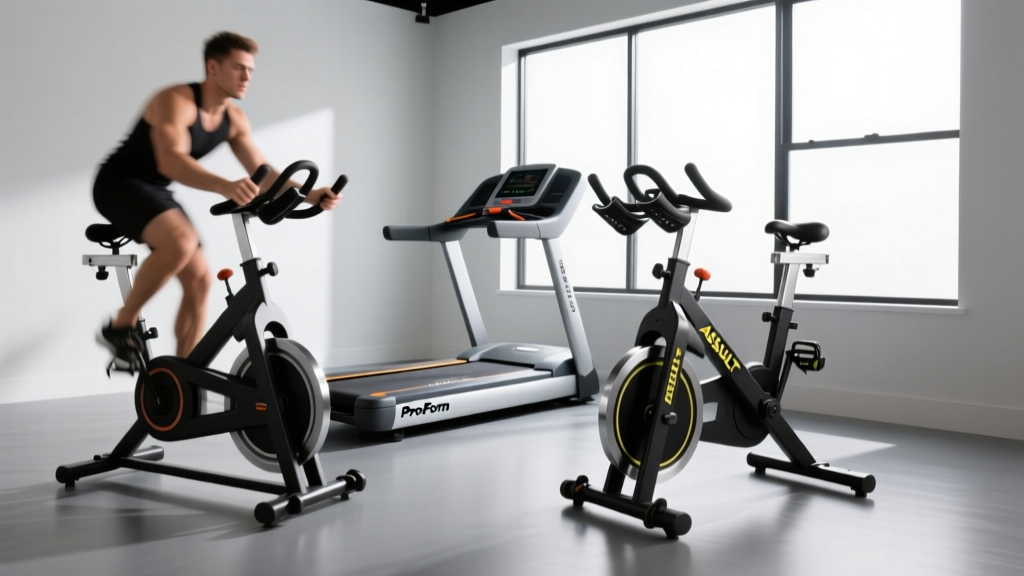
Air Bike vs Assault Bike Care: ProForm 745CS Treadmill Comparisons

Best In Place Treadmill Models for Office Use: 2026 Market Review
Treadmill Smells Like Burning Rubber? Best Folding Picks Reviewed
