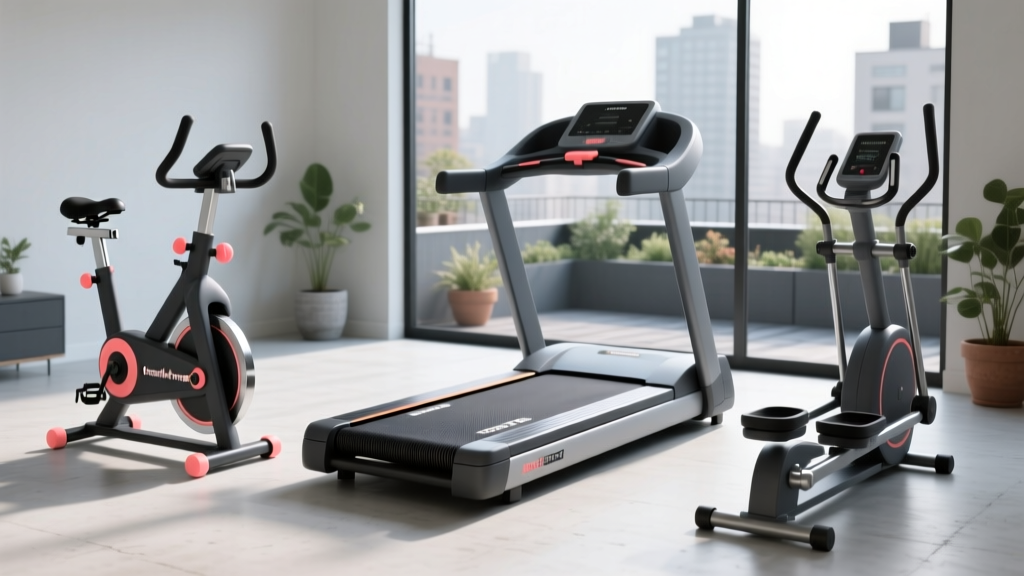
Under Desk Treadmill for Office Use Review: Bowflex vs Sole Treadmill
Optimize your 2026 home office layout. Read our under desk treadmill for office use review, comparing walking pads to the Bowflex vs Sole treadmill footprint.

The 2026 Home Office Dilemma: Gym Space vs. Workspace
As hybrid work models solidify into permanent lifestyle standards in 2026, the architectural lines between the home gym and the home office have blurred. When homeowners begin researching cardio equipment, the search almost inevitably leads to the classic Bowflex vs Sole treadmill debate. Sole remains a dominant force with robust warranty support and heavy-duty frames, while Bowflex units—navigating a post-restructuring market—are often sought after for their integrated digital ecosystems. However, when the primary goal is outfitting a dedicated workspace rather than a two-car garage gym, comparing these full-size behemoths misses the mark entirely.
Full-size treadmills demand massive spatial commitments, generate significant acoustic pollution, and disrupt the ergonomic flow of a professional environment. For the modern remote worker, the solution lies in specialized spatial optimization. In this comprehensive under desk treadmill for office use review, we will dissect the spatial, acoustic, and ergonomic realities of integrating walking pads into your office layout, contrasting their practical utility against the traditional footprint of full-size gym equipment.
Footprint Analysis: Full-Size vs. Under-Desk Reality
To understand why space optimization dictates a departure from traditional cardio machines, we must look at the raw geometry of the equipment. A standard home office ranges from 80 to 120 square feet. Dedicating 20% of that space to a single piece of stationary equipment is a poor layout decision.
| Equipment Model | Dimensions (L x W) | Total Footprint | Weight | Primary Use Case |
|---|---|---|---|---|
| Sole F80 | 82' x 37' | 20.9 sq ft | 280 lbs | Dedicated Gym Room |
| Bowflex Treadmill 10 | 86.5' x 39.6' | 23.7 sq ft | 323 lbs | Dedicated Gym Room |
| LifeSpan TR1200-Glow | 63' x 28.5' | 12.4 sq ft | 114 lbs | Under-Desk Office |
| WalkingPad R2 | 56.5' x 21.5' | 8.4 sq ft | 62 lbs | Compact / Stowable |
As the data illustrates, the Sole F80 and Bowflex Treadmill 10 require nearly triple the floor space of a dedicated under-desk model. Furthermore, full-size treadmills feature aggressive incline motors and extended belt lengths that dictate a permanent, immovable placement in a room. Under-desk treadmills, conversely, are designed for dynamic spatial fluidity—allowing you to slide them beneath a workstation when active, and tuck them into a closet or beneath a sofa when the workday ends.
Under Desk Treadmill for Office Use Review: Top 2026 Models
When selecting a treadmill for an enclosed office environment, motor duty cycle, deck height, and console integration are vastly more important than top speed or incline capabilities. Here is how the top contenders perform in a real-world office layout.
LifeSpan TR1200-Glow: The Heavy-Duty Office Workhorse
Retailing around $1,199, the LifeSpan TR1200-Glow is engineered specifically for the biomechanics of slow, sustained walking. Unlike adapted gym treadmills, it features a 2.0 HP continuous-duty motor optimized for low-RPM, high-torque output. This means it can handle a 250 lb user walking at 2.5 mph for four hours without triggering thermal throttling.
- Deck Height: 5.25 inches (Requires a high-clearance standing desk)
- Belt Width: 20 inches (Sufficient for walking stride, inadequate for running)
- Layout Advantage: The console is a separate, compact unit that mounts directly to your desktop or wall, eliminating the need to reach down to a floor-level display.
WalkingPad R2: The Foldable Space-Saver
For users operating in multi-purpose rooms (e.g., a home office that doubles as a guest bedroom), the $599 WalkingPad R2 is the undisputed champion of spatial efficiency. Its patented 180-degree folding hinge allows the 56-inch track to fold down to a mere 28 inches, sliding easily under a standard bed or behind a bookshelf.
- Deck Height: 4.5 inches (Lower profile suits more desk configurations)
- Motor: 1.25 HP (Strictly limited to users under 220 lbs and sessions under 2 hours)
- Layout Advantage: Zero permanent footprint. The handlebar folds flat, and the integrated transport wheels allow for one-handed relocation.
Never use a WalkingPad or similar 1.25 HP under-desk treadmill for jogging. The lack of active cooling fans and small motor housing will cause the internal temperature to exceed 140°F within 20 minutes of high-impact use, permanently degrading the belt lubricant and voiding the warranty.
Ergonomic Math: The Hidden Desk Clearance Constraint
The most common failure mode in home office layout design is ignoring the vertical displacement caused by the treadmill deck. According to Cornell University Ergonomics Web, maintaining a neutral 90-degree elbow angle is critical for preventing repetitive strain injuries during keyboard work.
Here is the spatial math most buyers overlook:
- A standard seated desk height is 29.5 inches.
- An under-desk treadmill deck adds 4.5 to 5.5 inches of height beneath your feet.
- To maintain proper typing ergonomics while standing on the treadmill, your desk surface must be raised to approximately 44 to 47 inches (depending on your exact height).
Many budget motorized standing desks max out at 42 inches. If your desk cannot reach 46 inches, you will be forced to type with elevated shoulders, leading to severe trapezius fatigue within 45 minutes.
Layout Solution: When designing your office space, you must pair your under-desk treadmill with a premium dual-motor standing desk (such as the Uplift V2-Commercial or Fully Jarvis) that guarantees a maximum height of at least 48 inches. Furthermore, ensure your desk has a minimum depth of 30 inches; the forward stance required to reach a keyboard while balancing on a moving belt requires deeper desk clearance than seated work.
Thermal and Acoustic Constraints in Enclosed Offices
When comparing the Bowflex vs Sole treadmill for a dedicated gym, acoustics are rarely the primary concern. In an office environment, they are dealbreakers. The CDC recommends integrating consistent physical activity into daily routines, but not at the expense of professional communication.
Acoustic Profiling
Full-size treadmills generate between 70 and 85 decibels (dB) of operational noise, driven by belt friction, heavy impact, and large cooling fans. This easily bleeds through standard drywall and disrupts virtual meetings. Premium under-desk treadmills like the LifeSpan TR1200 operate at roughly 50-55 dB—equivalent to a quiet conversation or a humming refrigerator. This allows you to take Zoom calls with the microphone unmuted while walking at 1.5 mph.
Thermal Output and HVAC Load
A 3.0 HP motor on a full-size treadmill acts as a localized space heater, raising the ambient temperature of a small 10x10 office by 3 to 5 degrees during a one-hour run. Under-desk treadmills generate significantly less ambient heat, but their enclosed motor housings require strategic placement. Never push an under-desk treadmill flush against a wall or baseboard heater; the rear motor housing requires at least 12 inches of clearance for passive heat dissipation.
Biomechanical Limitations: Stride and Speed
Space optimization requires compromise. By reducing the treadmill footprint from 82 inches to 56 inches, you are fundamentally altering the biomechanical utility of the machine. According to the Mayo Clinic, the primary benefit of standing and light movement at work is metabolic activation and blood flow, not cardiovascular conditioning.
Under-desk treadmills feature belt lengths of 40 to 45 inches. If you attempt to walk faster than 3.5 mph, your natural stride length will exceed the belt's physical boundaries, causing you to consciously shorten your gait. This altered gait can lead to hip flexor tightness and lower back compensation over prolonged periods. Therefore, the layout of your office treadmill should be viewed as a 'Zone 1' active recovery and circulation tool, while your full-size Sole or Bowflex treadmill (if space permits in another room) remains the tool for Zone 2+ cardiovascular training.
Final Verdict: Designing Your Hybrid Room
If your 2026 spatial layout forces a choice between a dedicated gym zone and a professional workspace, do not attempt to force a full-size Bowflex or Sole treadmill into your office. The acoustic disruption, massive spatial footprint, and ergonomic incompatibilities make them fundamentally unsuited for desk-bound work.
Instead, invest in a purpose-built under-desk treadmill like the LifeSpan TR1200-Glow for sustained, low-decibel metabolic engagement during the workday. Pair it with a high-clearance, dual-motor standing desk, respect the thermal clearance requirements, and reserve the heavy-duty cardio sessions for a properly ventilated, acoustically isolated space. True space optimization is not about cramming a massive machine into a small room; it is about selecting the exact tool that aligns with the specific biomechanical and architectural constraints of your environment.
More gear to consider
All reviews
Gold's Gym Trainer 720 Treadmill: Small Space Review & Maintenance
Treadmill Motor HP Guide: NordicTrack Series 8 Treadmill & Beyond

Rowing Machine Guide: Technique & How to Work a Treadmill

NordicTrack Treadmill Won't Start? Motor HP Guide & Comparisons

Stair Climber Guide: Mistakes, Troubleshooting & Tony Little Treadmill