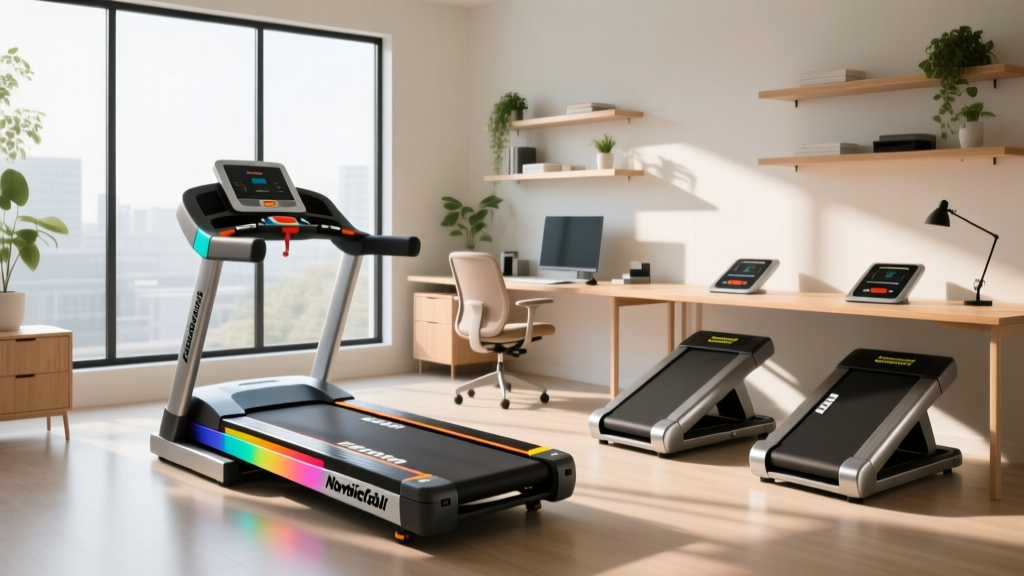
NordicTrack T Series 9 vs Under Desk Treadmills: Office Space Guide
Optimize your home office layout. We compare the NordicTrack T Series 9 treadmill against top under-desk treadmills for space, noise, and workflow.

The Spatial Reality of Home Office Cardio in 2026
As remote and hybrid work models have permanently reshaped our living spaces in 2026, the home office has evolved from a simple desk-and-chair setup into a multi-functional wellness hub. Maximizing Non-Exercise Activity Thermogenesis (NEAT) through daily movement is no longer a luxury; it is a physiological necessity. According to the Mayo Clinic, prolonged sitting is linked to severe metabolic consequences, making active workstations highly recommended. However, integrating fitness equipment into a standard 10x12 or 12x14 bedroom office presents a significant spatial design challenge.
In this comprehensive under desk treadmill for office use review and spatial analysis, we are tackling a common layout dilemma. Many remote workers want the versatility of a traditional folding running machine but are constrained by square footage. To solve this, we are comparing the footprint, acoustic profile, and layout requirements of a traditional folding model—specifically the NordicTrack T Series 9 treadmill—against dedicated low-profile under-desk alternatives like the WalkingPad R2 and UREVO Strol 2E. By analyzing exact dimensions, clearance zones, and ergonomic workflows, you can design an office layout that supports both deep work and cardiovascular health without sacrificing your floorplan.
Evaluating the NordicTrack T Series 9 Treadmill for Office Zones
The NordicTrack T Series 9 treadmill is a staple in the budget-friendly home cardio market, typically retailing between $499 and $549. It is engineered for dedicated running and walking sessions, featuring a 2.75 CHP motor, a 20-inch by 55-inch running belt, and a robust steel frame. But how does it translate to a home office environment?
Dimensional Footprint and the 39-Inch Rule
When unfolded, the T Series 9 measures 73.5 inches long, 29 inches wide, and 48.5 inches high. This requires an operational footprint of roughly 14.8 square feet. However, spatial planning for traditional treadmills requires adherence to strict safety clearance zones. The Consumer Product Safety Commission and manufacturer guidelines mandate a minimum 39-inch clearance zone behind the machine to prevent injury in the event of a fall. This pushes the total required linear floor space to nearly 113 inches (over 9 feet) in length.
When folded, the T Series 9 utilizes a hydraulic EasyLift system, reducing its footprint to 29 inches by 29 inches (roughly 5.8 square feet). While this vertical storage saves floor space, the 48.5-inch height means it cannot be stored under standard office desks or in low-profile shelving units, forcing it to occupy a permanent visual corner of the room.
Acoustic Profile in Shared Spaces
The 2.75 CHP motor generates approximately 65 to 70 decibels (dB) at walking speeds (3.0 mph) and can peak near 78 dB during a 7.0 mph run. In a shared home or an office with thin drywall, this low-frequency rumble and belt-slapping noise will easily bleed into adjacent rooms or disrupt virtual meetings.
Under Desk Treadmill for Office Use Review: The Low-Profile Contenders
If the spatial and acoustic demands of a traditional machine are too high, under-desk treadmills offer a radically different layout paradigm. These machines sacrifice top speed and incline for seamless integration into active workstations.
WalkingPad R2: The Fold-in-Half Innovator
Retailing around $499, the WalkingPad R2 features a unique 180-degree fold. Unfolded, it measures 60 inches by 22.5 inches, offering a 43.3-inch by 17.3-inch belt. Its standout spatial feature is its folded state: just 38 inches by 22.5 inches by 6 inches high. This 6-inch profile allows it to slide completely under a standard 28-inch high bed, sofa, or even a low-profile office filing cabinet, effectively reducing its daily spatial footprint to zero.
UREVO Strol 2E: The Hybrid Stand-and-Walk
Priced closer to $279, the UREVO Strol 2E features a built-in telescoping handrail and a 2.25 HP motor. It measures 51.2 inches by 21.5 inches. While it does not fold in half, its lack of a bulky front motor shroud allows it to be pushed flush against a wall or under a raised standing desk. Its smaller 1.25 HP continuous motor operates at a whisper-quiet 55 to 60 dB, making it virtually silent during Zoom calls.
Spatial & Acoustic Comparison Matrix
When designing your office layout, raw specifications dictate the flow of the room. Use the matrix below to compare the spatial realities of these cardio machines.
| Feature | NordicTrack T Series 9 | WalkingPad R2 | UREVO Strol 2E |
|---|---|---|---|
| Primary Use Case | Dedicated Running / HIIT | Active Walking / Storage | Standing Desk Integration |
| Unfolded Footprint | 73.5" x 29" (14.8 sq ft) | 60" x 22.5" (9.4 sq ft) | 51.2" x 21.5" (7.6 sq ft) |
| Stored / Folded Profile | 29" x 29" x 48.5" H | 38" x 22.5" x 6" H | 51.2" x 21.5" x 6.3" H |
| Required Rear Clearance | 39 Inches (Mandatory) | 12 Inches (Recommended) | 12 Inches (Recommended) |
| Noise Level (at 3 mph) | 65 - 70 dB | 58 - 62 dB | 55 - 60 dB |
| Desk Compatibility | None (Standalone) | Excellent (Low profile) | Good (Handrail may interfere) |
| Average Price (2026) | $549 | $499 | $279 |
Designing the Layout: Clearance, Power, and Ergonomics
Integrating cardio into an office requires more than just measuring floor space; it demands an understanding of human ergonomics and electrical load management. The Occupational Safety and Health Administration (OSHA) emphasizes that proper workstation layout must account for posture, reach zones, and unobstructed movement paths. Here is a step-by-step framework for optimizing your office layout.
Step 1: Map the Ergonomic Drop Zones
If you choose the NordicTrack T Series 9 treadmill, you must map a 39-inch rear drop zone. In a 10x12 room, placing the machine against a short wall means the clearance zone will consume nearly a third of the room's total length. Design Tip: Never place a traditional treadmill facing a solid wall where the rear clearance overlaps with a high-traffic doorway or a rolling office chair path.
For under-desk models, the drop zone is minimal. However, you must account for the vertical clearance of your standing desk. Ensure your desk can lower to at least 28 inches to accommodate the 4-to-5-inch deck height of the treadmill plus the user's footwear.
Step 2: Electrical Circuit Mapping
Motorized treadmills draw significant current, especially upon startup. The NordicTrack T Series 9 requires a dedicated 15-amp, 120-volt grounded outlet. Plugging this into a shared power strip alongside a high-wattage gaming PC, dual monitors, and a space heater will trip the breaker and potentially damage the treadmill's control board. Under-desk treadmills, drawing less than 3 amps under normal walking loads, can safely share a standard office surge protector.
⚠️ Layout Warning: Cable Management and Trip Hazards
According to the CDC's workplace health guidelines, physical activity environments must be free of fall hazards. In a home office, the power cord of a folding treadmill creates a severe trip hazard when the machine is deployed and retracted daily. Invest in a flat, low-profile cable management channel (like the J-Channel raceway) adhered directly to the baseboards to route power safely away from the 39-inch rear clearance zone.
Step 3: Acoustic Dampening for Multi-Use Rooms
If your office doubles as a guest room or shares a wall with a nursery, acoustic layout planning is critical. Place a high-density EVA foam treadmill mat (at least 3/8-inch thick) beneath any of these machines. This not only protects hardwood floors from the T Series 9's 130-pound frame but also decouples the motor vibration from the floor joists, reducing structural noise transfer by up to 40%.
'The most successful home office layouts in 2026 treat fitness equipment not as an afterthought, but as primary architectural anchors. The machine dictates the flow of the room, the placement of the desk, and the management of natural light.' — FitGearPulse Spatial Design Desk
Final Verdict: Matching the Machine to Your Floorplan
Choosing between a traditional folding model and an under-desk alternative ultimately depends on your spatial constraints and your cardiovascular goals.
- Choose the NordicTrack T Series 9 treadmill if: You have a dedicated office space larger than 12x14 feet, you require a 55-inch belt for actual running (over 4.5 mph), and you can dedicate a permanent 9-foot linear wall space to accommodate the machine and its mandatory safety clearance.
- Choose the WalkingPad R2 if: You are working in a small apartment, a bedroom nook, or a shared living space. Its 6-inch folded height allows it to vanish under furniture, and its low-decibel motor ensures your daily steps won't interrupt household acoustics or virtual meetings.
- Choose the UREVO Strol 2E if: You are on a strict budget, already own an adjustable standing desk, and want a simple, low-profile walking base that can slide under your workstation without complex folding mechanisms.
By respecting clearance zones, managing electrical loads, and aligning your equipment choice with your actual room dimensions, you can build a 2026 home office that fosters both deep professional focus and long-term cardiovascular health.
More gear to consider
All reviews
2026 Trends: Belt Maintenance for a Treadmill for Knee Problems

NordicTrack T Series 10 Treadmill Review & Compact Cardio Picks 2026
Home Stair Climber Guide 2026: Escape Treadmill Squeaking

Research Treadmill vs Elliptical: 2026 Home Cardio Trends

Rowing Machine Buying Guide for Elite Treadmill NordicTrack Users
