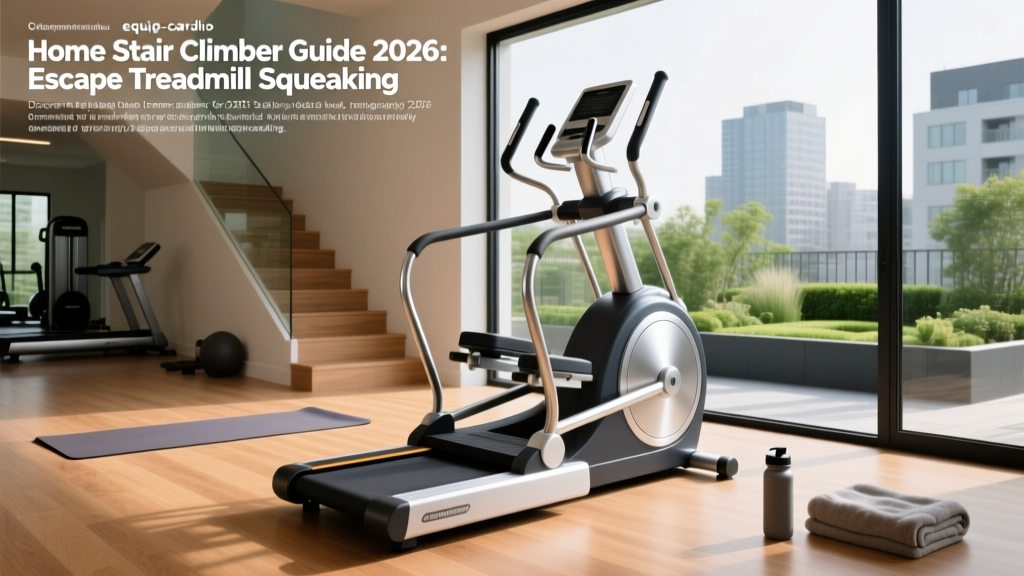
Home Stair Climber Guide 2026: Escape Treadmill Squeaking
Discover the best home stair climbers for 2026. Compare noise levels, maintenance, and models to finally escape treadmill squeaking and upgrade your cardio.

The Great Cardio Shift: Why Home Gyms Are Ditching Squeaky Treadmills
If you are reading this comprehensive stair climber machine for home use guide, you are likely dealing with a frustrating reality of home fitness: chronic treadmill squeaking. It is one of the most common complaints we receive at FitGearPulse. That high-pitched chirp or rhythmic thumping isn't just annoying; it is a mechanical distress signal. Treadmill squeaking typically stems from belt-to-deck friction, degraded sealed roller bearings, or a slipping motor drive belt. Fixing it requires lifting the motor hood, applying 100% silicone lubricants, and constantly realigning the track.
In 2026, a massive shift is occurring in home gym setups. Fitness enthusiasts are abandoning high-maintenance treadmills in favor of modern stair climbers. Not only do stair climbers offer a superior vertical cardiovascular stimulus, but their enclosed magnetic and hydraulic resistance systems are virtually silent. According to the CDC's physical activity guidelines, achieving vigorous-intensity cardio doesn't require a loud, belt-driven machine. This guide breaks down exactly how to choose the right stair climber, escape the treadmill squeaking nightmare, and optimize your home gym footprint.
Treadmill Squeaking vs. Stair Climber Silence: The Mechanical Reality
To understand why a stair climber is the ultimate upgrade, we must look at the mechanical failure modes of traditional cardio equipment. Treadmills rely on friction. A heavy user running at 7 mph generates immense kinetic energy and heat, requiring constant lubrication. When that lubrication dries out, the belt grips the deck, causing the motor to overwork and the roller bearings to whine and squeak.
Stair climbers, conversely, utilize either hydraulic fluid displacement or electromagnetic eddy-current brakes. There is no physical friction track to degrade. Below is a mechanical comparison of why stair climbers dominate in low-maintenance home environments.
| Feature | Traditional Treadmill | Magnetic Stair Climber | Hydraulic Pedal Stepper |
|---|---|---|---|
| Resistance Type | Friction Belt & Motor | Electromagnetic Flywheel | Fluid-Filled Cylinders |
| Noise Profile | 65-85 dB (Prone to squeaking) | 40-50 dB (Near silent) | 45-55 dB (Minor fluid hiss) |
| Maintenance | High (Lubrication, tensioning) | Low (Dusting, firmware) | Medium (Seal inspection) |
| Common Failure | Deck warping, bearing squeak | Console electronics | Cylinder cavitation |
| Avg 2026 Price | $800 - $3,500 | $1,500 - $3,000 | $150 - $500 |
2026 Stair Climber Buying Matrix: Top Models Tested
When selecting a stair climber machine for home use, you must choose between three distinct form factors: the Step Mill (rotating stairs), the Pedal Stepper (hydraulic pistons), and the Hybrid Climber (elliptical-stepper crossover). Here are the top three models we have stress-tested this year.
1. Bowflex Max Trainer M9 (Best Overall Silent Hybrid)
Price: $2,299 | Footprint: 49" L x 30.5" W | Resistance: 20 Levels Electromagnetic
The Bowflex Max Trainer M9 remains the gold standard for home users who want the vertical climb of a stair stepper combined with the upper-body engagement of an elliptical. Because it uses an electromagnetic brake system, there is zero physical friction. You will never experience the treadmill squeaking associated with belt-driven decks. The 2026 model features an upgraded JRNY adaptive fitness display that tracks your exact vertical ascent. The only maintenance required is wiping down the dual-action arm rails every 50 hours to prevent sweat corrosion on the pivot joints.
2. Xiser Commercial Portable Stair Climber (Best Space-Saver)
Price: $439 | Footprint: 14" x 17" | Resistance: Hydraulic Alloy
If you live in an apartment where a squeaky treadmill would result in noise complaints from downstairs neighbors, the Xiser Commercial is your solution. Weighing just 32 pounds, it is milled from aerospace-grade cast aluminum alloy. It uses dual hydraulic cylinders to provide resistance. While hydraulic cylinders can occasionally 'hiss' if the fluid heats up during a 45-minute session, they do not squeak. The Xiser forces a strict vertical posture, engaging the glutes and calves with an intensity that biomechanical analyses supported by the American Council on Exercise (ACE) show to be highly effective for lower-body power development.
3. Sunny Health & Fitness SF-E3912 Air Climber (Best Budget Option)
Price: $149 | Footprint: 26" L x 18" W | Resistance: Hydraulic + Air
For those on a strict budget, the SF-E3912 offers a surprising amount of utility. It combines hydraulic stepping resistance with air-resistance pull cords for the upper body. At this price point, build quality is naturally lighter, and the hydraulic pistons may develop a slight 'spongy' feel after 80+ hours of use due to minor fluid cavitation. However, it completely sidesteps the mechanical complexities of a motorized deck, ensuring a squeak-free, low-impact workout session.
Expert Callout: The Ceiling Height Trap
Before purchasing a traditional rotating Step Mill (like the StairMaster Gauntlet or NordicTrack CL Series), measure your ceiling height. You must add your total height plus 15 inches of step-up clearance to the machine's base height (usually 9 to 12 inches). For a 6-foot user on a 12-inch base Step Mill, you need a minimum ceiling height of 8 feet 3 inches. If your home gym is in a basement with drop ceilings, pivot to a low-profile Pedal Stepper or Hybrid Climber to avoid head-strike injuries.
Biomechanics and Joint Health: Why the Climb Wins
Beyond the noise and maintenance factors, the physiological ROI of a stair climber is exceptional. When dealing with treadmill squeaking, users often subconsciously alter their gait to avoid the 'sticky' spots on a poorly lubricated deck, leading to asymmetrical joint loading. Stair climbers enforce a natural, symmetrical kinetic chain.
According to Mayo Clinic's fitness research, low-impact, weight-bearing exercises like stair climbing are critical for maintaining bone density without the repetitive ground-reaction forces associated with running. A 180-pound individual burning 500 calories on a treadmill requires a 45-minute run at a 6 mph pace, generating thousands of high-impact foot strikes. That same 500-calorie burn can be achieved in roughly 35 minutes on a stair climber at a moderate cadence of 60 steps-per-minute, all while keeping the foot planted on the pedal, eliminating the 'heel-strike' shockwave that travels up the tibia to the lumbar spine.
Space, Power, and Flooring Requirements
Transitioning from a treadmill to a stair climber frees up significant square footage. A standard home treadmill requires a 70" x 30" footprint, plus 2 feet of clearance behind it for safety fall-offs. In contrast, hybrid climbers and pedal steppers require less than half that space.
- Power Delivery: Magnetic hybrid climbers (like the Bowflex M9) require a dedicated 120V/15A outlet. Do not plug them into a shared power strip with space heaters or dehumidifiers, as voltage drops can cause the electromagnetic brake to stutter.
- Flooring: While treadmills require heavy-duty rubber mats to absorb motor vibration and prevent deck-squeak resonance, hydraulic pedal steppers can be placed directly on carpet or hardwood. We recommend a simple 3mm PVC mat purely to catch sweat drips, which can corrode the lower hydraulic mounting brackets over time.
- Weight Capacity: Always check the user weight limit. Budget hydraulic steppers often max out at 220 lbs. Exceeding this causes the hydraulic seals to blow out, resulting in a sudden loss of resistance and a ruined machine.
Expert Troubleshooting: Keeping Your Cardio Machine Silent
While stair climbers avoid the classic treadmill squeaking, they have their own minor maintenance quirks. Here is how to keep your 2026 stair climber running flawlessly:
- Hydraulic Piston Care: If your pedal stepper develops a 'creak' at the pivot point, it is not the cylinder itself, but the metal-on-metal pivot bolt. Apply a single drop of PTFE (Teflon) dry lubricant to the pivot joint. Never use WD-40, as it attracts dust and creates a grinding paste.
- Magnetic Flywheel Dusting: For electromagnetic climbers, dust accumulation on the flywheel can cause a faint 'whirring' sound. Use a can of compressed air to blow out the side vents every three months.
- Pedal Grip Tape: The diamond-tread aluminum pedals on commercial-style steppers can wear smooth after 500 hours. Replace them with standard skateboard grip tape to maintain barefoot or sock-foot traction without altering the pedal weight.
Frequently Asked Questions
Can a stair climber completely replace my treadmill?
For cardiovascular conditioning and lower-body muscular endurance, absolutely. However, if you are training specifically for a marathon or need to practice horizontal running mechanics, you will still need a treadmill or outdoor running. For general health, weight management, and joint-friendly cardio, the stair climber is a superior, quieter alternative.
Why did my old treadmill start squeaking so loudly?
Treadmill squeaking is almost always a friction issue. The walking belt requires 100% silicone lubrication every 150 miles. If neglected, the belt melts slightly against the wooden deck, creating immense friction that transfers stress to the front and rear roller bearings, causing them to whine and eventually seize.
Are hydraulic stair steppers safe for bad knees?
Yes, provided you do not 'lock out' your knees at the bottom of the stepping motion. Maintain a soft bend in the knee to keep the tension on the quadriceps and glutes rather than transferring the load to the patellar tendon. The controlled descent of a hydraulic cylinder is much safer for the meniscus than the uncontrolled impact of a treadmill foot-strike.
More gear to consider
All reviews
Space-Saving Cardio: ProForm Carbon XL Treadmill & Portable Options
Is a Treadmill Good for Losing Weight? 2026 Buying Guide
Elliptical vs Treadmill: Matching Treadmills at Lifetime Fitness

Treadmill Jacuzzi Showdown: Underwater vs Traditional Cardio

Planet Fitness New Treadmill Motors vs Home: A Beginner's HP Guide
