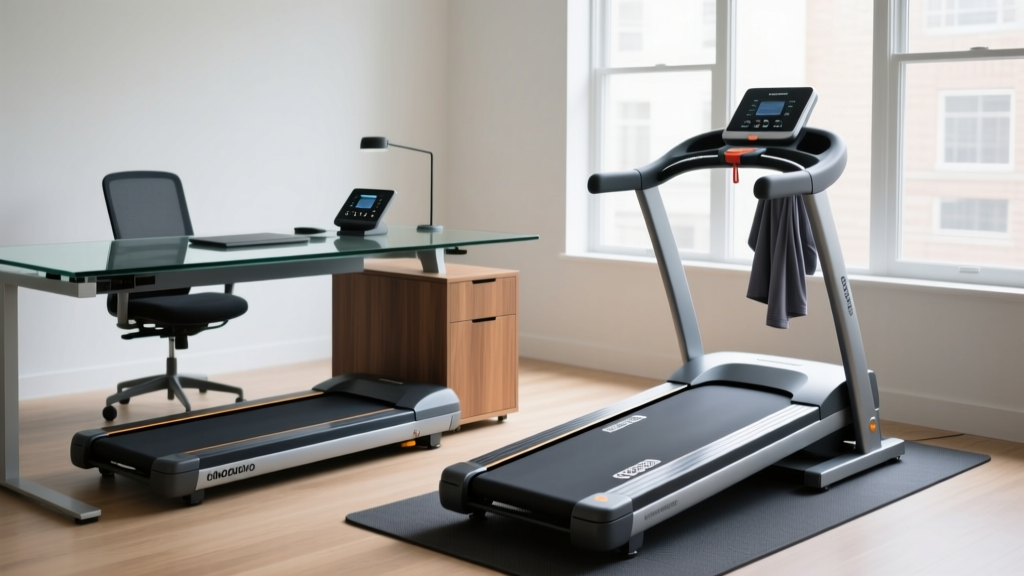
NordicTrack Treadmill Parts Diagram & 2026 Under Desk Office Trends
Explore the 2026 shift from traditional repairable gym gear to sealed under-desk treadmills, analyzing market trends, maintenance, and top office models.

The Evolution of Home Cardio: From Schematics to Sealed Units
For decades, the hallmark of home cardio ownership was the ability to maintain, tinker with, and repair your machine. A quick search for a NordicTrack treadmill parts diagram would yield detailed, multi-page schematics for replacing walking belts, adjusting tension rollers, and swapping out incline motors. Traditional fitness equipment was built like a tank, utilizing modular components that consumers and local technicians could easily diagnose and fix. However, as we navigate the 2026 fitness equipment market, a massive paradigm shift has occurred in the cardio space—specifically regarding how and where we exercise.
The rise of the permanent hybrid work model has catalyzed an explosion in the under-desk treadmill market. Unlike their traditional, full-sized counterparts, modern office treadmills are engineered as sealed, ultra-compact units. This market analysis explores the engineering realities of this shift, reviews the top under-desk treadmills for office use in 2026, and explains why the era of the consumer-repairable home treadmill is rapidly giving way to modular, replaceable office fitness tech.
2026 Market Analysis: The Under-Desk Treadmill Boom
According to recent occupational health data, sedentary behavior remains a primary risk factor for cardiovascular disease, prompting organizations and remote workers to invest heavily in active workstations. The CDC's physical activity guidelines emphasize the necessity of breaking up prolonged sitting, a directive that has made under-desk treadmills a staple of the 2026 home office. But how do these machines compare to traditional treadmills from a market and engineering perspective?
| Metric | Traditional Treadmills (e.g., NordicTrack, Sole) | Under-Desk Office Treadmills (2026 Models) |
|---|---|---|
| Average Price Point | $800 - $3,500+ | $299 - $1,499 |
| Motor Type | Heavy-duty DC / AC (2.5 - 4.0 CHP) | Brushless DC / BLDC (1.0 - 2.5 HP) |
| Repairability Index | High (Modular parts, accessible diagrams) | Low (Sealed decks, potted electronics) |
| Deck Construction | Multi-layer MDF with replaceable wax/silicone | Composite honeycomb / Integrated elastomer |
| Expected Lifespan | 7 - 12 Years (with maintenance) | 3 - 5 Years (heavy use) / 5 - 7 Years (light use) |
Top Under-Desk Treadmills for Office Use: 2026 Review
When outfitting a home or corporate office in 2026, buyers are prioritizing acoustic dampening, spatial footprint, and continuous-duty reliability over top speed or incline capabilities. Below is our expert review of the market leaders.
1. LifeSpan TR1200-DT3: The Corporate Workhorse
Price: $1,299 | Motor: 2.0 HP Continuous Duty | Belt Area: 20" x 50" | Weight Capacity: 350 lbs
The LifeSpan TR1200-DT3 remains the gold standard for dedicated office treadmills. Unlike consumer-grade walking pads, the DT3 is engineered to run for up to 6 hours a day. It features a heavy-duty 2.0 HP continuous-duty motor that operates at a remarkably low 52 decibels at 2.0 mph, ensuring it won't interfere with Zoom calls. The 18-inch step-up height is ergonomically optimized to prevent the neck strain often associated with raising a desk too high to accommodate thicker treadmill bases. While you won't find a complex parts diagram for its integrated console, LifeSpan offers a modular swap-out program for the motor control board, bridging the gap between sealed-unit design and long-term serviceability.
2. WalkingPad R2: The Space-Conscious Commuter
Price: $599 | Motor: 1.25 HP Brushless | Belt Area: 17.3" x 47.2" | Weight Capacity: 265 lbs
The WalkingPad R2 dominates the budget-friendly, ultra-compact segment. Its patented 180-degree folding mechanism allows it to slide under a sofa or stand vertically in a closet. From an engineering standpoint, the R2 utilizes a brushless DC motor directly integrated into the front roller, eliminating the need for a traditional drive belt and pulley system. This drastically reduces mechanical failure points but renders the motor housing entirely non-serviceable by the end-user. It is the ultimate "replace, don't repair" appliance, ideal for users walking 1 to 3 hours daily at speeds under 3.5 mph.
3. UREVO Strol 2E: The Budget Hybrid
Price: $399 | Motor: 2.25 HP Peak | Belt Area: 16.5" x 45.3" | Weight Capacity: 265 lbs
UREVO has captured significant market share in 2026 by offering a hybrid model that includes a removable handrail, allowing it to function as both an under-desk walker and a light jogging machine (up to 7.6 mph). The Strol 2E uses a specialized shock-absorption system featuring six silicone dampeners beneath the composite deck. However, its primary limitation is thermal throttling; the sealed motor housing restricts airflow, meaning continuous use beyond 90 minutes requires a cool-down period to prevent the internal thermal fuse from tripping.
The Engineering Reality: Why You Won't Find an Under-Desk Parts Diagram
If you have ever attempted to fix a squeaking incline motor or a frayed walking belt on a traditional machine, you know the value of a comprehensive NordicTrack treadmill parts diagram. These diagrams map out hundreds of individual SKUs, from M8 hex bolts to drive motor brushes. So why have manufacturers abandoned this transparency for under-desk models?
Expert Insight: The "Right to Repair" vs. MiniaturizationThe absence of parts diagrams for under-desk treadmills isn't solely a corporate tactic to force planned obsolescence; it is a byproduct of miniaturization. To achieve a deck thickness of under 4 inches, engineers must use potted electronics (where circuit boards are encased in a solid thermosetting plastic to prevent vibration damage) and ultra-thin honeycomb decks. Disassembling these components inevitably destroys the structural adhesives and acoustic dampening seals, making consumer repair physically unfeasible without specialized factory tooling.
Furthermore, the integration of the motor directly into the roller assembly (a design pioneered by companies like KingSmith and WalkingPad) means there is no separate motor to unbolt and replace. If the motor fails, the entire front roller assembly must be swapped out as a single, pre-calibrated unit.
Maintenance Protocols for Sealed-Deck Office Treadmills
Because you cannot open the chassis to clean internal components or replace worn bearings, preventative maintenance on the exterior and belt is critical to maximizing the lifespan of an under-desk treadmill. Follow this 2026 maintenance framework:
- Bi-Weekly Belt Alignment: Office treadmills experience asymmetric wear because users tend to favor one leg while typing or using a mouse. Every two weeks, check the belt tracking. Use the provided 6mm hex key to adjust the rear roller bolts—turn clockwise by exactly one-quarter turn on the side the belt is drifting toward.
- Monthly Silicone Lubrication: Unlike traditional treadmills that use wax coatings, modern under-desk belts require 100% pure liquid silicone. Lift the belt and apply exactly 10ml of silicone in a zig-zag pattern across the deck. Run the machine at 2.0 mph for 3 minutes to distribute the lubricant. Warning: Never use WD-40 or petroleum-based lubricants, as they will dissolve the composite deck's top layer.
- Quarterly Static Grounding Check: Office environments with heavy carpeting generate massive static electricity, which can arc and fry the sealed motor controller. Ensure your treadmill is plugged directly into a grounded, surge-protected outlet, and consider using an anti-static mat beneath the machine if your office is heavily carpeted.
Ergonomics and ROI: The 2026 Home Office Verdict
Integrating a treadmill into your workspace requires strict adherence to ergonomic principles to avoid repetitive strain injuries. According to research from Cornell University's Ergonomics Department, the optimal sit-stand-walk ratio involves alternating postures every 30 to 60 minutes. Walking at a pace of 1.0 to 1.5 mph allows for accurate typing and mouse control, whereas speeds above 2.0 mph are best reserved for passive tasks like reading documents or attending audio-only meetings.
The Mayo Clinic also notes that while standing and walking desks do not replace vigorous cardiovascular exercise, they significantly reduce the metabolic risks associated with prolonged sitting, including improved blood glucose regulation post-meals.
"The ROI of an under-desk treadmill is no longer just measured in calories burned, but in cognitive endurance. The 2026 market has matured past gimmicky stepping pads into reliable, acoustically engineered productivity tools." — FitGearPulse Market Analysis Team
Final Thoughts: Navigating the Repair vs. Replace Paradigm
The fitness equipment industry is currently bifurcated. On one side, traditional brands continue to support the legacy model of heavy, modular, and repairable machines—where a detailed NordicTrack treadmill parts diagram is a vital tool for the DIY enthusiast. On the other side, the booming under-desk treadmill market has fully embraced the consumer electronics model: sleek, sealed, highly specialized, and ultimately disposable at the component level.
For the modern office worker, the trade-off is clear. You sacrifice the ability to rebuild the motor or replace a deck bearing, but in return, you gain a whisper-quiet, space-saving machine that seamlessly integrates into your daily workflow. When budgeting for your 2026 home office upgrade, treat an under-desk treadmill not as a lifelong piece of heavy machinery, but as a high-value productivity peripheral with a 5-year amortization cycle. Choose a model with a robust warranty, adhere strictly to the silicone lubrication schedule, and embrace the frictionless future of active workspaces.
More gear to consider
All reviews
Best Compact Treadmills Made in USA: 2026 Portable Picks

2026 Market Trends: Naipo Walking Pad Treadmill & Compact Cardio

Bike Layouts & What Number is 10 Incline on Treadmill Clearances
What's Better Walking Outside or Treadmill? The Rowing Machine Setup

Treadmill Motor Size Guide for Vacuum Treadmill Setups