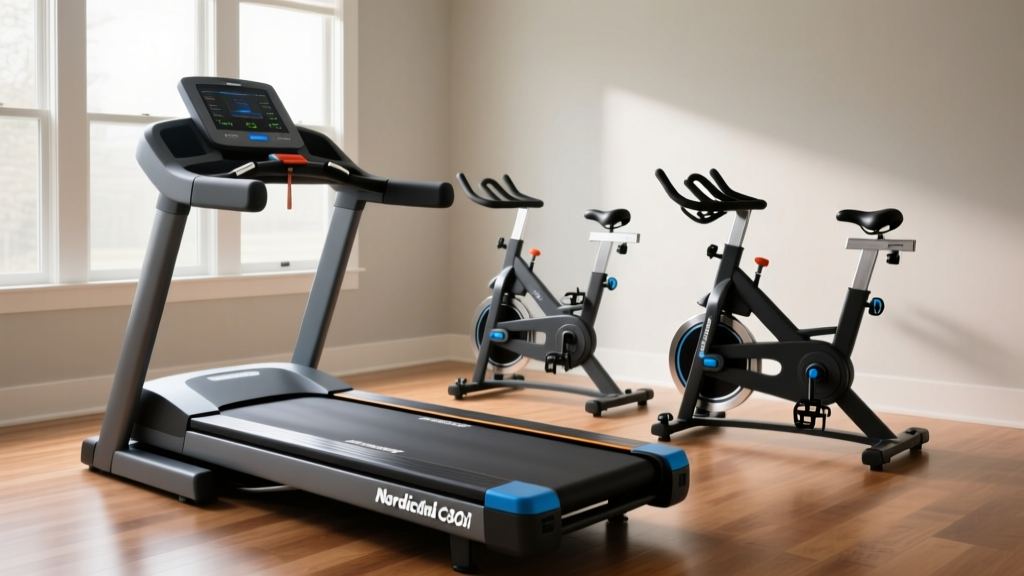
NordicTrack C850i Treadmill & Stationary Bikes: Maintenance Guide
Expert maintenance care and longevity tips for the NordicTrack C850i treadmill and all stationary bike types, including upright, recumbent, and spin bikes.

Protecting Your 2026 Cardio Investment: A Comprehensive Maintenance Protocol
Building a home gym is a significant financial commitment. With premium cardio equipment prices averaging 15% higher in 2026 than pre-pandemic baselines, protecting your investment through rigorous maintenance is no longer optional—it is essential. Whether you are logging miles on a heavy-duty NordicTrack C850i treadmill or cross-training across various stationary bike types, mechanical longevity relies on precise, scheduled care.
This guide serves as your master blueprint for maintaining the NordicTrack C850i treadmill alongside the three primary stationary bike types: upright, recumbent, and spin bikes. By understanding the unique mechanical failure points of each machine, you can extend their operational lifespan from an industry average of 7 years to well over 12 years.
⚠️ Critical Warning: Never use petroleum-based lubricants like WD-40 on treadmill decks or bicycle chains. Petroleum degrades rubber belts, attracts abrasive dust to bike drivetrains, and will void the warranty on your NordicTrack C850i and most indoor cycles.The Heavy-Duty Baseline: NordicTrack C850i Treadmill Care
The NordicTrack C850i treadmill features a 2.5 CHP continuous-duty motor and a 20x60-inch running surface. Because it is designed for sustained, high-impact use, its maintenance profile is heavily focused on friction reduction and electronic protection.
Deck Lubrication and Belt Tension
The most common cause of premature motor failure in the C850i is excessive friction between the belt and the deck. You must use a 100% silicone-based treadmill lubricant.
- Frequency: Every 150 miles or every 3 months, whichever comes first.
- Application: Loosen the rear roller bolts exactly three turns, lift the belt, and apply 0.5 oz of silicone in a zigzag pattern across the center of the deck.
- Tension Check: After re-tightening, you should be able to lift the belt 2 to 3 inches off the deck in the center. If it lifts higher, it is too loose and will slip; if lower, it will overwork the 2.5 HP motor.
Replacement belts for the C850i currently cost between $85 and $120 in 2026, making this 10-minute procedure highly cost-effective.
Stationary Bike Types: Upright, Recumbent, and Spin Maintenance
While treadmills rely on motorized belts, stationary bikes utilize complex resistance mechanisms—ranging from magnetic eddy currents to friction pads. According to equipment longevity guidelines from the American Council on Exercise (ACE), consistent preventative maintenance on biomechanical joints and drive systems is the primary factor in preventing catastrophic failure in indoor cycles.
1. Spin Bikes (Indoor Cycling): Sweat, Chains, and Bottom Brackets
Spin bikes (e.g., Schwinn IC4, Keiser M3i, Peloton Bike+) endure the harshest environmental conditions in a home gym. Human sweat has a pH ranging from 4.5 to 7.0, making it highly corrosive to exposed steel and aluminum components.
- Drivetrain Care: For chain-driven spin bikes, apply a dry PTFE (Teflon) chain lube every 100 hours of riding. Wet lubes will attract dust and create a grinding paste that destroys the rear cog. For belt-driven models, check belt deflection; experts at BikeRadar recommend a midpoint deflection of exactly 1/2 inch (12mm) under moderate thumb pressure.
- Bottom Bracket (BB) Overhaul: The BB bears the brunt of your wattage. If you hear a rhythmic clicking synced to your pedal stroke, the BB bearings are likely compromised. Replacing a standard square-taper or ISIS BB on a spin bike costs roughly $40 to $60 for the part and requires a standard 8mm Allen key and a BB removal tool.
- Sweat Guards: Wipe down the handlebar post and flywheel housing immediately after every ride using a mildly alkaline cleaner to neutralize sweat acids.
2. Upright Bikes: Sensors, Pedals, and Magnetic Resistance
Upright bikes (e.g., Sole LCR, NordicTrack VR) mimic traditional road bikes but utilize magnetic resistance and console-driven programming. The maintenance here is less about heavy mechanical wear and more about electronic calibration and joint security.
- Pedal Threading (Crucial): The left pedal on almost all upright bikes is reverse-threaded. If you attempt to remove it by turning counter-clockwise, you will strip the crank arm, resulting in a $90+ replacement cost. Always turn the left pedal clockwise to remove.
- Hall Effect Sensors: Upright bikes measure RPM via a magnet passing a Hall effect sensor near the flywheel. If your console displays erratic RPM or calorie data, use compressed air to blow dust away from the sensor housing located near the internal flywheel.
- Seat Post Lubrication: Apply a thin layer of white lithium grease to the seat post insertion tube every 6 months to prevent the steel post from seizing inside the aluminum frame tube due to galvanic corrosion.
3. Recumbent Bikes: Seat Carriages, Cables, and Pulleys
Recumbent bikes (e.g., Teeter FreeStep, ProForm REC) are designed for low-impact, high-duration sessions. The primary mechanical wear occurs on the seat adjustment mechanism and the internal resistance cables.
- Seat Carriage Rollers: The seat glides on a set of polyurethane wheels along an aluminum rail. If the seat squeaks or sticks, wipe the rail with isopropyl alcohol and apply a dry silicone spray. Avoid wet greases, which will attract pet hair and dust, eventually locking the rollers.
- Cable Tension and 'Ghost Shifting': Recumbent magnetic brakes are often controlled by a physical steel cable connected to the console motor. Over time, this cable stretches. If your bike exhibits 'ghost shifting' (the resistance changes on its own or fails to reach level 20), locate the cable barrel adjuster near the flywheel and turn it counter-clockwise by 2-3 turns to restore tension.
Diagnostic Troubleshooting Matrix
Use this matrix to quickly identify and resolve common auditory and mechanical faults across your cardio fleet.
| Equipment Type | Symptom / Noise | Root Cause & 2026 Fix |
|---|---|---|
| NordicTrack C850i | Rhythmic thumping at high speeds | Belt seam passing over a warped deck spot or debris trapped under the belt. Clean deck and inspect for warping. |
| Spin Bike | Metallic clicking under load | Loose pedal crank arm or failing bottom bracket bearings. Torque crank bolts to 35 Nm. |
| Upright Bike | Console flickers or dies mid-ride | Failing internal battery pack or loose ribbon cable. Reseat console ribbon cable; replace AA/CR2032 cells. |
| Recumbent Bike | Squeaking during seat adjustment | Dry carriage rollers. Clean aluminum rails and apply dry PTFE lubricant. |
Environmental Controls: The Invisible Longevity Factor
Mechanical maintenance is only half the battle. The environment in which your NordicTrack C850i treadmill and stationary bikes reside dictates their electronic lifespan.
Surge Protection and Grounding
The C850i's motor control board (MCB) and the digital consoles on modern recumbent bikes are highly sensitive to voltage spikes. In 2026, with smart homes drawing fluctuating power loads, plugging cardio equipment directly into a wall outlet is a risk. Always use a UL-listed surge protector rated for at least 2000 Joules. Furthermore, ensure the outlet is properly grounded; ungrounded outlets can cause static buildup that fries the console's logic board.
Humidity and Matting
Keep your gym's ambient humidity between 40% and 50%. High humidity accelerates rust on spin bike flywheels and upright bike pedal threads. Additionally, place all equipment on a high-density PVC equipment mat. This not only dampens acoustic vibration but prevents micro-dust and carpet fibers from being sucked into the C850i's motor hood cooling vents.
Frequently Asked Questions (FAQ)
How often should I replace the battery in my upright or recumbent bike console?
If your bike is not plugged into an AC adapter, replace the D-cell or AA battery cluster every 4 to 6 months. Do not mix old and new batteries, and remove them entirely if you plan to leave the bike unused for more than 30 days to prevent alkaline leakage from destroying the console contacts.
Can I use the same silicone spray on my treadmill and my recumbent bike seat rails?
No. The 100% liquid silicone used for the NordicTrack C850i treadmill deck is designed for high-friction, high-heat rubber interfaces. For recumbent bike seat rails and carriage wheels, use a dry PTFE (Teflon) spray. Liquid silicone will remain tacky, attracting dust and pet hair that will eventually jam the seat rollers.
Is it necessary to recalibrate the magnetic resistance on my spin bike?
Generally, no. Electromagnetic resistance systems (like those on the Keiser M3i) self-calibrate via internal sensors. However, if your bike uses a physical magnet moved by a tension cable (common in budget upright and recumbent models), you may need to adjust the barrel nut on the cable every 12 months to ensure Level 10 resistance matches the console's output.
More gear to consider
All reviews
Stair Climber Home Setup Guide & FreeMotion Treadmill iFIT Tips

Stair Climber vs ProForm 285T Treadmill: 2026 Guide

Under Desk Treadmill Review: Do Most NordicTrack Treadmills Fold?
Horizon LS760T Treadmill Review & Compact Portable Cardio Options

Rowing Machine Buying Guide and Lifespan Treadmill Maintenance
