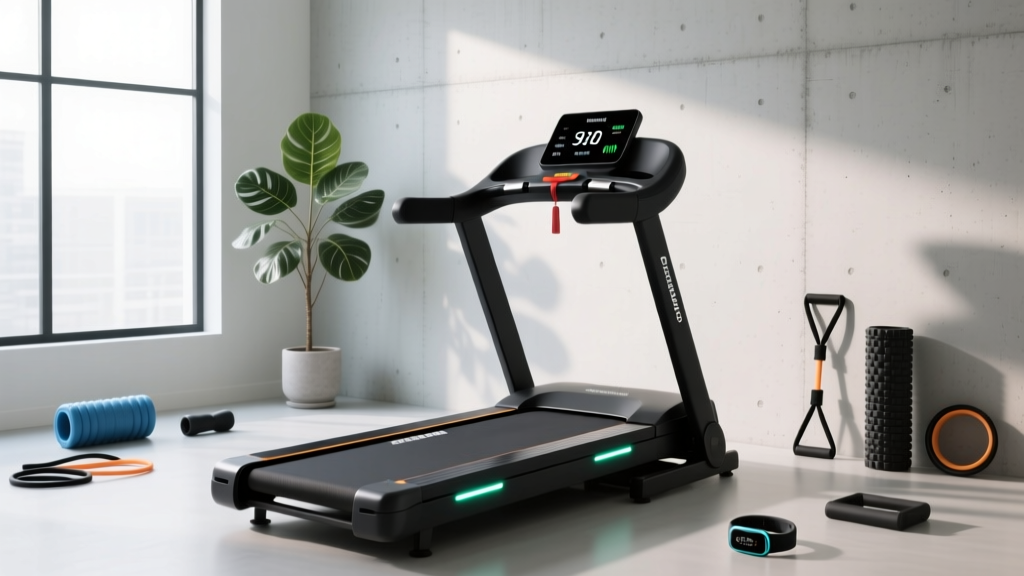
NordicTrack 2950 Treadmill Motor Size & HP Guide for Beginners
Learn how to choose the right treadmill motor size with our beginner guide, using the NordicTrack 2950 treadmill's 4.0 CHP motor as the ultimate benchmark.

Introduction: Why Treadmill Motors Matter More Than You Think
When shopping for home cardio equipment, beginners often fixate on touchscreen sizes, built-in speakers, or the number of pre-programmed workouts. However, the true heart of any running machine is its motor. A weak motor will stutter, overheat, and ultimately fail, turning a $1,000 investment into an expensive clothes rack. To understand motor sizing, we need a gold-standard benchmark. In this step-by-step beginner's guide, we will use the NordicTrack 2950 treadmill—equipped with a robust 4.0 CHP DurX™ Commercial Plus motor—to illustrate exactly how horsepower impacts performance, longevity, and your daily workout experience.
💡 The Bottom Line: The motor dictates how smoothly the belt moves under your feet. According to Consumer Reports, motor burnout is one of the top three reasons for treadmill warranty claims in the first five years of ownership. Choosing the right Continuous Horsepower (CHP) from day one saves you hundreds in repair costs.Step 1: Decoding the Horsepower Alphabet Soup
Before you can evaluate the NordicTrack 2950 treadmill's motor, you must understand the marketing jargon manufacturers use. You will typically see three different metrics listed on spec sheets:
- HP (Horsepower): A generic measurement of power. Without a qualifier, this number is largely meaningless.
- Peak HP: The absolute maximum power the motor can generate for a fraction of a second before stalling. Warning: Budget brands often use "Peak HP" to trick buyers. A "3.0 Peak HP" motor might only sustain 1.5 HP during a normal run.
- CHP (Continuous Horsepower): The amount of power the motor can deliver continuously, indefinitely, without overheating. This is the only metric that matters.
The NordicTrack 2950 treadmill utilizes a 4.0 CHP rating. This means whether you are sprinting at 12 mph for 30 seconds or maintaining a 6 mph jog for two hours, the motor is guaranteed to deliver 4.0 continuous horsepower without thermal degradation.
Step 2: Matching Motor Size to Your Biomechanics and Weight
How much CHP do you actually need? The American Council on Exercise (ACE) notes that the impact force of running can be up to 2.5 times your body weight. The motor must overcome this downward force to keep the belt moving at a constant speed. If the motor is too small, it will bog down every time your foot strikes the deck.
Recommended CHP by Activity Level
| Primary Activity | User Weight < 200 lbs | User Weight 200 - 250 lbs | User Weight 250+ lbs |
|---|---|---|---|
| Walking (2.0 - 4.0 mph) | 2.0 CHP | 2.5 CHP | 3.0 CHP |
| Jogging (4.0 - 6.0 mph) | 2.5 CHP | 3.0 CHP | 3.5 CHP |
| Running (6.0+ mph) | 3.0 CHP | 3.5 CHP | 4.0+ CHP |
Pro Tip: If you plan on doing high-incline walking (e.g., 15% grade at 3.0 mph), add 0.5 CHP to your requirement. Fighting gravity continuously draws more amperage than flat-ground running.
Step 3: Deep Dive into the NordicTrack 2950 Treadmill Motor
Let's apply the framework above to our benchmark machine. The NordicTrack 2950 treadmill is a commercial-grade unit designed for serious runners and multi-user households. Here is a technical breakdown of why its 4.0 CHP DurX™ Commercial Plus motor is engineered the way it is:
📊 NordicTrack 2950 Motor & Drive Specs
- Motor Rating: 4.0 Continuous Horsepower (CHP)
- Motor Type: DurX™ Commercial Plus (Brushless DC)
- Belt Dimensions: 22" x 60" (Requires 30% more torque to turn than standard 20" belts)
- Incline/Decline: -3% to 15% (Motor must handle regenerative braking on declines)
- Top Speed: 12 MPH
- Max User Capacity: 300 lbs
The Physics of the 22x60 Belt
Why does the 2950 need a massive 4.0 CHP motor? It comes down to belt surface area. A 22-inch by 60-inch running surface provides ample room for tall runners to stride safely, as recommended by physical therapists for joint health. However, this larger belt creates significantly more friction against the deck. A 2.5 CHP motor would struggle to pull this wider belt, resulting in a micro-stutter every time your foot lands. The 4.0 CHP motor provides the high-torque reserve necessary to keep the belt velocity perfectly constant, protecting your knees and ankles from sudden decelerations.
Step 4: Understanding Motor Failure Modes and Edge Cases
Even a premium 4.0 CHP motor can fail if subjected to edge-case abuse. According to the Mayo Clinic, proper equipment maintenance is vital for both safety and machine longevity. Here are the three primary ways treadmill motors die, and how to prevent them:
- Thermal Overload (Heat): Motors generate heat. The DurX Commercial Plus motor features an internal cooling fan and a heavy-duty flywheel that dissipates heat efficiently. However, if you place the treadmill in a non-climate-controlled garage where ambient temperatures exceed 90°F, the motor's thermal cutoff switch may trip. Solution: Keep your treadmill in a climate-controlled room between 65°F and 75°F.
- Deck Friction (The Silent Killer): If you fail to lubricate the silicone deck, the friction between the belt and deck transfers directly to the motor. The motor draws excess amps to overcome the friction, melting the internal copper windings. Solution: Lubricate the deck every 3 months or every 130 miles, whichever comes first.
- Dust and Pet Hair Ingress: Treadmills act like vacuums, sucking in dust and pet dander through the motor hood vents. This debris coats the motor housing, acting as an insulator that traps heat. Solution: Vacuum under and around the motor hood every 4 weeks.
"A treadmill motor doesn't usually die from running too fast; it dies from working too hard to pull a dry, unlubricated belt. Friction is the enemy of continuous horsepower."
Step 5: Evaluating Cost, Warranty, and Long-Term Value
As of 2026, the NordicTrack 2950 treadmill retails between $2,799 and $3,299, depending on seasonal promotions and bundled IFIT memberships. While this is a premium price point compared to entry-level $600 models, the value proposition lies in the motor warranty and lifespan.
Budget treadmills with 2.0 CHP motors typically offer a 1-year motor warranty, reflecting the manufacturer's expectation that the motor will degrade quickly under running loads. In contrast, NordicTrack backs the 4.0 CHP DurX motor with a Lifetime Warranty. When you amortize the cost of a premium motor over a 10-to-15-year lifespan, the cost-per-run drops to pennies, making it vastly more economical than replacing a cheap treadmill every three years.
Frequently Asked Questions (FAQ)
Can I upgrade my current treadmill's motor to a higher CHP?
No. Treadmill motors are matched to the machine's specific electronic control board, wiring harness, and flywheel assembly. Attempting to retrofit a 4.0 CHP motor into a frame designed for a 2.5 CHP motor will void your warranty and likely cause electrical fires due to mismatched amperage draws.
Does a larger motor use more electricity?
Surprisingly, no. A 4.0 CHP motor running at 50% capacity (during a light jog) is often more energy-efficient than a 2.5 CHP motor running at 95% capacity to maintain the same speed. The larger motor operates well within its optimal efficiency curve, drawing fewer amps and generating less wasted heat.
Is the NordicTrack 2950 treadmill overkill for walking?
If you exclusively walk at 3.0 mph on a flat surface, a 4.0 CHP motor is technically overkill. However, if you weigh over 220 lbs, plan to use the 15% incline feature for "12-3-30" style workouts, or share the machine with a spouse who runs, the 4.0 CHP motor ensures the machine will never bog down, regardless of who is using it or how.
More gear to consider
All reviews
Space-Saving Layouts & An Exercise Routine For Treadmill Desks

2026 Value: Togogym Treadmill vs Upright, Recumbent & Spin Bikes

Stair Climber Setup Guide: Plus, Does Yesoul Treadmill Incline?
Curved Manual vs Motorized Treadmill: Sole Treadmill Lube & Care

Folding Treadmill for Small Spaces: The Long Walk Screening Setup