
NordicTrack Commercial Series 1250 Treadmill & Bike Space Layout
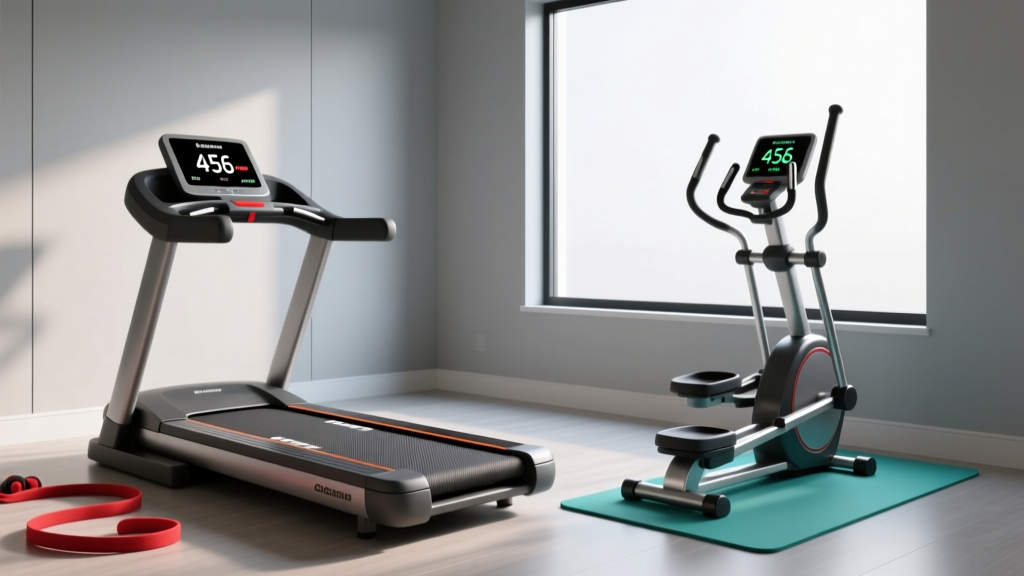
Optimize your home gym layout. Compare space needs for upright, recumbent, and spin bikes alongside the NordicTrack Commercial Series 1250 treadmill.

The Anchor: Sizing the NordicTrack Commercial Series 1250 Treadmill
Designing a multi-cardio home gym in 2026 requires treating your largest machine as the spatial anchor. For many dedicated home fitness enthusiasts, that anchor is the NordicTrack Commercial Series 1250 treadmill. Before evaluating secondary equipment, we must establish the non-negotiable footprint of this specific treadmill. The Commercial Series 1250 features a 20-inch by 55-inch tread belt, resulting in an in-use footprint of approximately 79.5 inches long by 31.5 inches wide.
However, raw machine dimensions are only half the battle. According to facility layout guidelines from the American Council on Exercise (ACE), treadmills require a mandatory 'ejection zone' for safety. You must allocate at least 78 inches of clear space directly behind the treadmill to prevent severe friction-burn injuries in the event of a fall. Laterally, you need 24 inches on both sides of the belt. This means the true operational footprint of the NordicTrack Commercial Series 1250 treadmill is roughly 157 inches long by 80 inches wide. Once this zone is mapped, we can integrate secondary stationary bike types into the remaining floor plan.
Stationary Bike Types: Upright vs. Recumbent vs. Spin Footprints
When outfitting the remaining square footage, selecting the right stationary bike type is critical. Upright, recumbent, and spin (indoor cycling) bikes serve vastly different biomechanical purposes and possess entirely unique spatial profiles. Here is how each type impacts your layout design.
1. Spin Bikes (Indoor Cycling)
Spin bikes, such as the Schwinn IC4 or NordicTrack S22i, are the undisputed champions of spatial efficiency. With an average footprint of 48 inches by 21 inches, they easily tuck into corners or against lateral walls. However, space optimization for spin bikes isn't just about the floor; it is about vertical and lateral sway clearance. During out-of-the-saddle climbs, riders require up to 36 inches of lateral sway space and 72 inches of vertical clearance. Placing a spin bike directly next to a wall with mounted mirrors or fragile smart-home hubs is a common layout failure.
2. Upright Bikes
Traditional upright bikes (e.g., ProForm 225 CSX) feature a compact base similar to spin bikes (approx. 42 x 22 inches) but with a higher center of gravity due to the console mast. They are ideal for narrow galley-style rooms. The primary spatial constraint of an upright bike is the dismount zone. Because the seat is positioned directly over the pedals, users require a 30-inch semi-circle clearance to the side or front to safely mount and dismount without kicking adjacent equipment.
3. Recumbent Bikes
Recumbent bikes, like the Schwinn 270 or NordicTrack R35, present the most significant layout challenge. While their vertical profile is low (often under 45 inches high, making them ideal for rooms with sloped ceilings or low-hanging ceiling fans), their linear footprint is massive. A standard recumbent bike measures up to 65 inches long and 28 inches wide. Furthermore, because the seat is heavily integrated into the frame and the center of gravity is low, recumbent bikes are notoriously difficult to pivot or move. They must be placed in 'dead zones' where they will not obstruct the traffic flow to the treadmill's ejection zone.
Dimensional Matrix: Equipment & Clearance Requirements
The following data matrix synthesizes the spatial requirements for your anchor treadmill and the three primary stationary bike types, factoring in operational clearances.
| Equipment Type | Base Footprint (L x W) | Operational Clearance Needed | Weight & Mobility | Best Room Placement |
|---|---|---|---|---|
| NordicTrack 1250 Treadmill | 79.5' x 31.5' | 78' rear, 24' lateral | ~240 lbs (Heavy, dual-wheel transport) | Primary wall anchor, facing door/window |
| Spin Bike | 48' x 21' | 36' lateral sway, 72' vertical | ~100 lbs (Highly mobile) | Corners, adjacent to lateral walls |
| Upright Bike | 42' x 22' | 30' semi-circle for mount/dismount | ~85 lbs (Moderate mobility) | Narrow corridors, flanking the treadmill |
| Recumbent Bike | 65' x 28' | 24' side clearance for knee extension | ~140 lbs (Low mobility, awkward pivot) | Low-ceiling zones, room perimeters |
Layout Configurations for Multi-Cardio Rooms
Integrating the NordicTrack Commercial Series 1250 treadmill with a stationary bike requires a deliberate floor plan. Based on standard 10x12 and 12x12 spare bedroom conversions, here are two highly effective layout frameworks.
The Linear Galley Layout (Best for 10x12 Rooms)
In a rectangular room, place the NordicTrack Commercial Series 1250 treadmill on the longest uninterrupted wall, ensuring the 78-inch rear ejection zone falls toward the opposite wall or an open doorway. Place a spin bike or upright bike on the exact opposite wall, facing the treadmill. This creates a 'galley' workflow. The center of the room remains entirely clear for yoga mats, kettlebell work, or simply maintaining cross-ventilation. This layout fails if you attempt to use a recumbent bike, as the combined length of the treadmill clearance and the recumbent base will exceed the 120-inch width of a standard 10x12 room.
The L-Shape Corner Flow (Best for 12x12 or Larger Rooms)
For square rooms, anchor the treadmill in the bottom-left corner, angled slightly or flush with the left wall. Position a recumbent bike flush against the top wall, perpendicular to the treadmill. This L-shape utilizes the room's corners, leaving a massive 8x8 open square in the center-right. The recumbent bike's low profile ensures it doesn't block the line of sight to a wall-mounted TV or fan placed above the treadmill's console. As Consumer Reports frequently notes in home gym evaluations, maintaining clear sightlines to entertainment or ventilation sources drastically increases long-term equipment utilization rates.
⚠️ Critical Safety Warning: The Door Swing Trap
When mapping your layout, physically tape the swing arc of your room's entry door on the floor. A common and dangerous mistake is placing an upright or spin bike in the 'blind spot' behind an inward-swinging door. If a user is on the bike and someone opens the door, the impact can cause severe injury. Always leave a minimum 36-inch buffer from the door hinge to any cardio equipment.
Infrastructure: Power Circuits and Flooring Matting
Space optimization extends beyond physical dimensions to the spatial management of power and floor protection. The NordicTrack Commercial Series 1250 treadmill features a 2.75 CHP motor that draws significant amperage, particularly during incline surges. It requires a dedicated 120-volt, 15-amp circuit. Sharing this circuit with a smart recumbent bike (which powers magnetic resistance and HD touchscreens) can trip the breaker mid-workout.
'Proper facility electrical planning dictates that high-draw motorized cardio equipment should never share a circuit with secondary electronics or climate control units to prevent voltage drops that degrade motor brushes over time.' - Facility Design Guidelines, National Strength and Conditioning Association (NSCA)
For flooring, abandon the idea of individual equipment mats. Instead, map out your total operational footprint and lay down interlocking 3/8-inch vulcanized rubber tiles. This creates a unified, waterproof barrier that absorbs the acoustic shock of the treadmill's deck impact while providing a level, non-slip base for the narrow stabilizer feet of spin and upright bikes. Ensure the rubber matting stops exactly 2 inches short of the baseboards to allow for natural material expansion and to prevent moisture trapping against the drywall.
Final Decision Framework
To finalize your layout, use this rapid decision matrix based on your available square footage and biomechanical needs:
- Choose a Spin Bike if: Your room is under 120 sq. ft., you prioritize high-intensity interval training (HIIT), and you need the flexibility to roll the bike into a closet or corner when not in use.
- Choose an Upright Bike if: You have narrow wall spaces flanking the treadmill and prefer traditional, low-impact steady-state cardio without the aggressive forward lean of a spin bike.
- Choose a Recumbent Bike if: Your room exceeds 144 sq. ft., you require lumbar support for rehabilitation or long-duration endurance rides, and you have low ceiling clearances that prohibit high-mast upright bikes.
By respecting the massive spatial demands of the NordicTrack Commercial Series 1250 treadmill and matching your secondary bike type to the remaining architectural realities of your room, you will create a home gym that is safe, functional, and optimized for decades of use.
More gear to consider
All reviews
Rogue Woodway Curve LTG Treadmill & Under Desk Office Market Trends

Is It Better to Walk Outside or on a Treadmill? Elliptical ROI
Space Guide: How Many Steps on Treadmill for 30 Minutes Speed 3 vs Elliptical

Under Desk Treadmill Review: Do Most NordicTrack Treadmills Fold?

Stair Climber vs Nordic Track Elite 3700 Treadmill Guide
