
Nordic Track Treadmill Maintenance vs Portable Cardio Costs
Compare long-term Nordic Track treadmill maintenance costs with compact portable cardio equipment. Find the best budget-friendly fitness value for your home.

The True Cost of Home Cardio: Full-Size vs. Portable
When outfitting a home gym, buyers often focus exclusively on the upfront retail price of a machine. However, the true financial footprint of fitness equipment reveals itself over years of use. Full-size machines, particularly premium treadmills, require ongoing upkeep, part replacements, and software subscriptions. Conversely, the rapidly growing market of compact portable cardio equipment options offers a radically different ownership model characterized by minimal upkeep and zero software lock-in.
In this budget breakdown and value analysis, we will dissect the long-term financial realities of full-size treadmill ownership—specifically focusing on Nordic Track treadmill maintenance—compared to the lifetime costs of compact alternatives like folding walking pads and under-desk ellipticals. By examining exact part costs, failure rates, and spatial value, you can make a data-driven decision for your 2026 home gym budget.
Nordic Track Treadmill Maintenance: A 5-Year Budget Breakdown
NordicTrack produces some of the most popular connected treadmills on the market, ranging from the entry-level T Series 5 to the flagship Commercial 1750 (Model NTL17621). While these machines deliver exceptional interactive training, their mechanical complexity necessitates a strict maintenance schedule and inevitable repair costs once the standard 1-year parts warranty expires.
Routine Upkeep and Wear Parts
Friction is the enemy of any treadmill. The walking belt and deck endure thousands of pounds of cumulative force weekly. Neglecting lubrication leads to motor strain and control board failures. Here is what routine Nordic Track treadmill maintenance actually costs out-of-pocket:
- Silicone Lubrication: Requires 100% silicone spray applied every 3 months or every 130 miles. A 3-pack of OEM-approved silicone costs approximately $18. 5-Year Cost: $36.
- Walking Belt Replacement: Over time, belts stretch and fray. A replacement 20" x 55" belt for a T-Series model costs around $110, while the heavy-duty 22" x 60" belt for the Commercial 1750 retails for $185 to $240. Factoring in one replacement in year four: $185.
- Deck Reversal/Replacement: Many NordicTrack decks are reversible (wax-coated on both sides). Once both sides wear through, a replacement MDF deck costs between $150 and $290, plus labor if you cannot calibrate the belt tension yourself. 5-Year Cost: $150.
- Incline Motor & Gear Stripping: A common failure mode in older NordicTrack models is the stripping of the plastic gears inside the incline motor housing due to heavy user weight on steep 15% grades. An out-of-warranty incline motor replacement part costs $145 to $210.
The Hidden Software "Maintenance"
Beyond mechanical grease and belts, modern NordicTrack treadmills require digital maintenance. The machines are heavily tethered to the iFIT ecosystem. Without an active iFIT subscription (currently $396 annually for a family plan or $180 for an individual), the machine reverts to a basic manual mode, locking out automatic incline adjustments and guided global workouts. Over five years, this digital upkeep adds $900 to $1,980 to your total cost of ownership.
Compact Portable Cardio: The Low-Maintenance Alternatives
If the compounding costs of full-size treadmill ownership strain your budget, compact portable cardio equipment options present a highly efficient alternative. These machines prioritize spatial economy and mechanical simplicity, virtually eliminating the need for professional servicing.
Spatial Value Metric: A standard NordicTrack Commercial 1750 requires a dedicated footprint of roughly 14 square feet (79" L x 35" W) and cannot be easily moved due to its 340 lb weight. In contrast, portable options require less than 3 square feet of active space and can be stored under a bed or sofa, yielding a vastly superior cost-per-square-foot value for apartment dwellers.1. Folding Walking Pads (e.g., KingSmith WalkingPad R2)
Walking pads have dominated the compact cardio market. The KingSmith WalkingPad R2 (retailing around $499) features a 180-degree folding hinge and a brushless 1.25 HP motor. Maintenance Profile: Unlike full-size treadmills, walking pads use low-friction, pre-lubricated multi-layer belts that rarely require silicone spraying. The primary maintenance involves using the included hex key to tighten the rear roller bolts if the belt drifts left or right—a 2-minute, zero-cost task. Because they lack complex incline motors and massive cooling fans, the electronic failure rate is exceptionally low. 5-Year Estimated Maintenance Cost: $0 to $20.
2. Under-Desk Ellipticals (e.g., Cubii JR2)
For users seeking low-impact, seated cardio, the Cubii JR2 ($299) offers a whisper-quiet magnetic resistance system. Maintenance Profile: Magnetic resistance ellipticals have zero physical friction between the flywheel and the brake, meaning there is no belt to replace and no lubricant to apply. The only moving parts are the sealed ball bearings in the pedal arms, which are rated for tens of thousands of hours. The sole "maintenance" required is replacing the CR2032 coin battery in the Bluetooth sensor once every 12 months. 5-Year Estimated Maintenance Cost: $15 (batteries).
3. Portable Magnetic Rowers (e.g., Sunny Health & Fitness SF-RW5515)
While slightly larger than a walking pad, portable magnetic rowers ($220-$280) fold vertically and offer a full-body cardiovascular workout. Maintenance Profile: Unlike water rowers that require chlorine purification tablets, or air rowers that require chain oiling, magnetic rowers use a sealed internal brake and a nylon pull strap. Maintenance is limited to wiping down the aluminum rail with a damp cloth to prevent dust buildup from causing roller stutter. 5-Year Estimated Maintenance Cost: $0.
5-Year Value Analysis Matrix
To visualize the budget breakdown, we have modeled the 5-year total cost of ownership (TCO) for three distinct cardio pathways. This matrix assumes standard usage (150 minutes per week) and includes upfront hardware, necessary maintenance parts, and mandatory software subscriptions.
| Equipment Category | Upfront Cost (2026) | 5-Yr Mechanical Maintenance | 5-Yr Digital/Subscriptions | Total 5-Yr TCO |
|---|---|---|---|---|
| NordicTrack Commercial 1750 | $2,499 | $371 (Belt, Lube, Deck) | $1,980 (iFIT Family) | $4,850 |
| KingSmith WalkingPad R2 | $499 | $0 | $0 (Free Basic App) | $499 |
| Cubii JR2 Elliptical | $299 | $15 (Batteries) | $0 | $314 |
Decision Framework: Matching Equipment to Your Lifestyle
Choosing between a full-size treadmill and compact portable cardio equipment options ultimately depends on your biomechanical needs, spatial constraints, and financial flexibility. The American Heart Association recommends at least 150 minutes of moderate-intensity aerobic activity per week. Both a brisk walk on a NordicTrack and a steady stride on a Cubii can fulfill this requirement, but the financial and logistical wrappers differ wildly.
Choose Full-Size Treadmill Maintenance If:
- You are a dedicated runner requiring a 22-inch wide deck and speeds exceeding 10 MPH for high-intensity interval training (HIIT).
- You have a dedicated, climate-controlled room for a home gym to prevent dust ingestion into the motor housing.
- You view the $396/year iFIT subscription as a necessary replacement for a boutique gym membership.
Pivot to Compact Portable Cardio If:
- You live in a multi-use space or apartment where a 300 lb machine is a spatial and structural liability.
- Your primary goal is NEAT (Non-Exercise Activity Thermogenesis) accumulation—burning extra calories via low-intensity steady-state (LISS) movement while working or watching television.
- You want a strict, predictable fitness budget with zero risk of surprise $300 control board repair bills. According to the Centers for Disease Control and Prevention (CDC), consistent, moderate daily movement yields massive long-term cardiovascular benefits, proving you do not need a 12 MPH incline trainer to achieve baseline health metrics.
Frequently Asked Questions
Can I perform Nordic Track treadmill maintenance myself?
Yes, routine tasks like belt lubrication, tensioning, and even walking belt replacement can be done at home using basic hex keys and socket wrenches. However, diagnosing and replacing internal electronics, such as the lower control board or incline motor, requires handling high-voltage capacitors and complex wiring harnesses, which is best left to certified technicians to avoid voiding extended warranties.
Do walking pads require the same electrical outlets as treadmills?
No. Full-size NordicTrack treadmills draw significant amperage, especially during incline motor engagement and belt acceleration, often requiring a dedicated 15-amp or 20-amp circuit to prevent tripping breakers. Compact walking pads and under-desk ellipticals draw minimal wattage (typically under 500W peak) and can be safely used on standard shared household circuits or even heavy-duty extension cords.
Are portable cardio machines durable enough for daily use?
Premium portable options are rated for 220 to 265 lbs and are designed for 1 to 2 hours of daily walking. However, they are not engineered for running. The smaller rollers (typically 40mm compared to a treadmill's 85mm rollers) generate more heat at high speeds, which can degrade the belt adhesive if used for jogging. For running, a full-size machine remains a mandatory investment.
More gear to consider
All reviews
Space-Saving Maintenance: ProForm CrossFit 415 Treadmill Belt Care
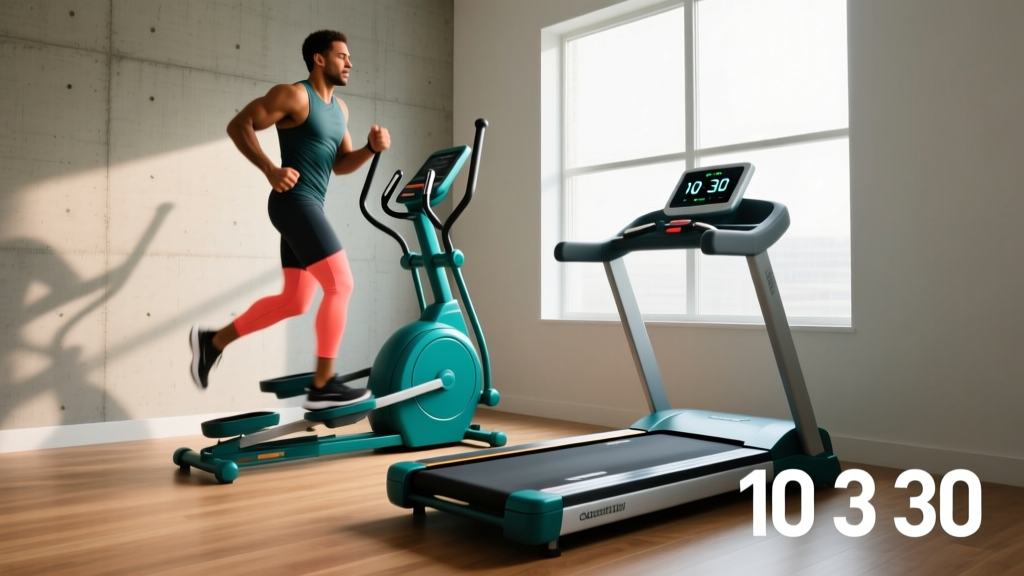
Elliptical vs Treadmill: Adapting the 10 3 30 Treadmill Routine

Stair Climber Home Guide: Mistakes & Lifetime Fitness T5 Treadmill Fixes
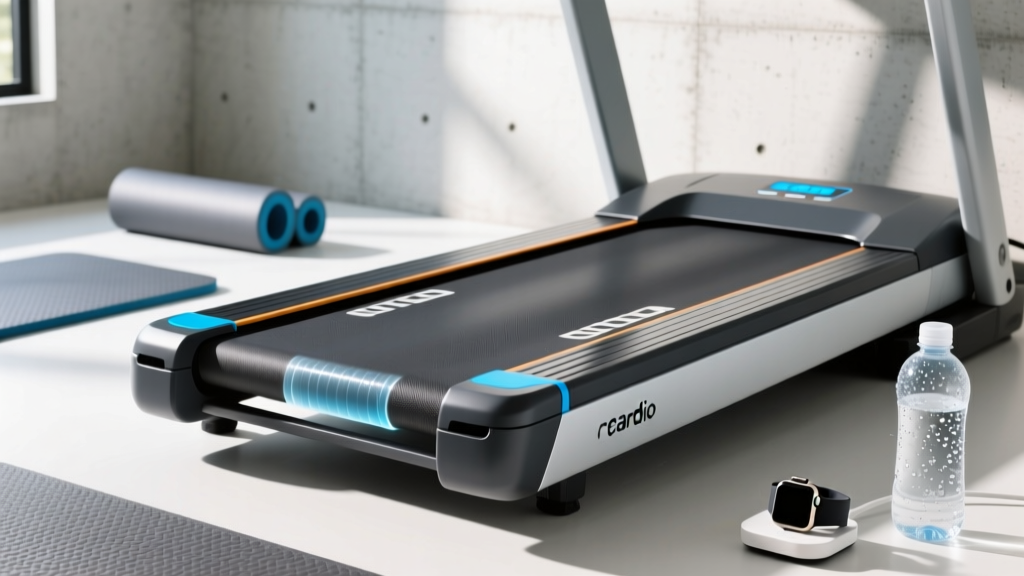
Why Your Treadmill Cord Melts: Belt Lubrication Trends 2026

Air Bike vs Assault Bike: Converting 10,000 Treadmill Steps to Miles
