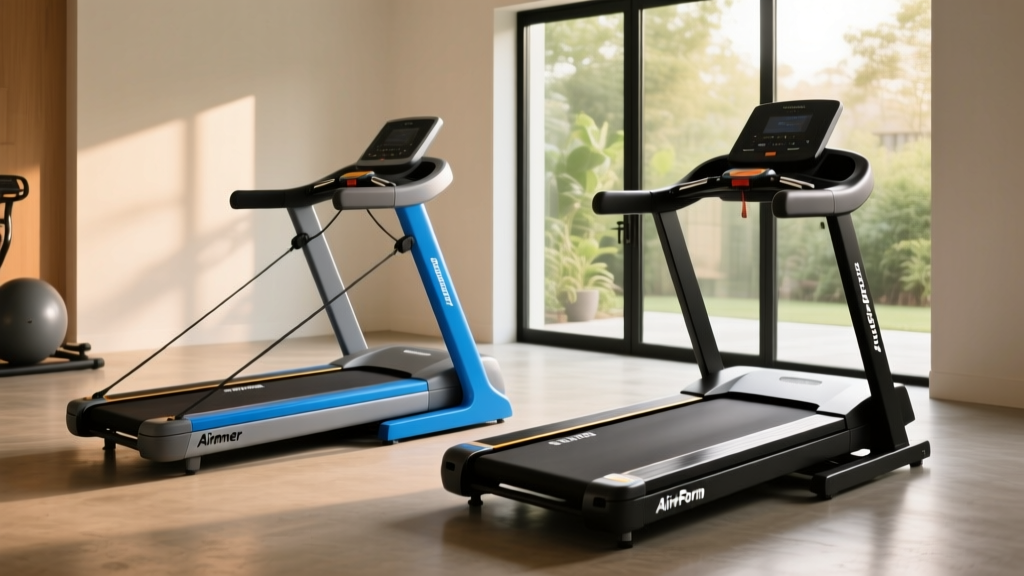
Non Electric Treadmill Comparison: AirRunner vs TrueForm (2026)
Compare the top non electric treadmill models of 2026. We break down specs, biomechanics, and pricing for the AirRunner, TrueForm, and budget flats.

The Shift to Self-Powered Cardio in 2026
The home fitness landscape has fundamentally shifted toward self-powered, sustainable equipment. At the forefront of this movement is the non electric treadmill. By eliminating the motor, these machines force the user to become the engine, resulting in higher muscle activation, improved running mechanics, and a significantly lower carbon footprint. But not all manual treadmills are created equal. The market is currently split between premium curved models and budget-friendly flat manuals, each offering vastly different biomechanical experiences.
In this head-to-head buying guide, we are putting the industry heavyweights—the Assault AirRunner and the TrueForm Runner—under the microscope, while also addressing the budget flat manual alternative, the Sunny Health & Fitness SF-T7515. Whether you are outfitting a high-end garage gym or looking for a compact apartment solution, this feature comparison will dictate where your money should go.
Quick Decision Matrix
- Choose Assault AirRunner if: You want a proven, heavy-duty curved treadmill with excellent telemetry and a slightly wider running surface for lateral movements.
- Choose TrueForm Runner if: You prioritize a lower profile, a vulcanized rubber slat belt that requires zero lubrication, and a more natural ground-feel stride.
- Choose Sunny SF-T7515 if: You are on a strict sub-$300 budget, need to walk or jog lightly in a small space, and do not require high-speed sprint mechanics.
Head-to-Head: The Curved Heavyweights
Curved non electric treadmills utilize a slatted or polyurethane belt draped over a concave frame. This geometry forces the runner to strike the belt with their forefoot or midfoot, pulling the belt backward and propelling themselves forward. According to biomechanical analyses highlighted by the American Council on Exercise (ACE), this specific stride alteration reduces impact forces on the patellofemoral joint while increasing activation in the hamstrings and glutes by up to 30% compared to motorized treadmills.
Assault AirRunner: The CrossFit Standard
Retailing at approximately $2,999, the Assault AirRunner has been the staple of functional fitness gyms for years. Its 150-pound steel frame provides a rock-solid base that does not wobble during heavy sled pushes or high-speed sprints.
- Belt Mechanics: Uses a continuous polyurethane (PU) belt. While smooth, PU belts are susceptible to 'slicking' if exposed to excessive sweat and skin oils. Maintenance requires monthly wipe-downs with isopropyl alcohol to maintain traction.
- Footprint & Capacity: 69' L x 33' W x 64' H with a maximum user weight of 350 lbs.
- Console & Tech: The 2026 console update features robust Bluetooth FTMS connectivity, allowing seamless pairing with Zwift and Peloton Digital for real-time pace and wattage broadcasting.
TrueForm Runner: The Biomechanical Purist
Priced slightly higher at $3,495, the TrueForm Runner is engineered for purists who want the closest sensation to outdoor track running. It sits lower to the ground, reducing the psychological barrier of stepping onto an elevated deck.
- Belt Mechanics: Features a vulcanized rubber slat belt. This is a massive advantage in maintenance; rubber slats do not require lubrication, will not slick from sweat, and provide aggressive grip. However, the gaps between slats can trap small debris (like pebbles from outdoor shoes), requiring occasional vacuuming.
- Footprint & Capacity: 70' L x 31' W x 62' H. It boasts a higher weight capacity of 400 lbs due to its reinforced dual-rail aluminum subframe.
- Stride Geometry: The curve on the TrueForm is slightly steeper at the front ascent than the AirRunner, which naturally enforces a shorter, quicker cadence—ideal for runners looking to correct overstriding habits.
The Budget Reality: Flat Manual Treadmills
It is crucial to address the flat manual treadmill, represented by the Sunny Health & Fitness SF-T7515 (approx. $279). Flat non electric treadmills do not use gravity and curve geometry to move the belt. Instead, they rely on the user physically dragging a flat belt, often assisted by a heavy magnetic flywheel.
Warning: The Biomechanical Trap of Flat ManualsWhile budget-friendly, flat manual treadmills often promote poor running mechanics. Because the belt resists horizontal dragging, users tend to push backward with a prolonged ground contact time rather than lifting their knees. The National Strength and Conditioning Association (NSCA) notes that prolonged ground contact times and rearfoot striking on high-friction flat surfaces can increase shear forces on the Achilles tendon. Furthermore, flat manuals like the Sunny SF-T7515 become incredibly jerky at speeds exceeding 6 MPH due to flywheel inertia limitations, making them suitable only for walking or light jogging.
Feature & Spec Comparison Matrix
| Feature | Assault AirRunner | TrueForm Runner | Sunny SF-T7515 (Flat) |
|---|---|---|---|
| Retail Price (2026) | $2,999 | $3,495 | $279 |
| Belt Type | Polyurethane (Continuous) | Vulcanized Rubber (Slats) | PVC (Flat w/ Flywheel) |
| Max User Weight | 350 lbs | 400 lbs | 220 lbs |
| Machine Weight | 150 lbs | 165 lbs | 65 lbs |
| Top Speed Limit | User Limited (~20+ MPH) | User Limited (~20+ MPH) | ~6 MPH (Jogging) |
| Smart Connectivity | Bluetooth FTMS | Bluetooth FTMS | None |
Critical Buying Features and Failure Modes
When investing thousands of dollars into a curved non electric treadmill, you must look beyond the marketing copy and understand the long-term mechanical realities.
1. Belt Tension and Calibration
Unlike motorized treadmills where a motor drives the belt, manual treadmills rely on precise tension. If the belt on an AirRunner is too loose, it will slip under heavy acceleration. If it is too tight, the friction against the curved deck will make the machine feel sluggish and prematurely wear out the side bearings. TrueForm's slat belt bypasses this issue entirely; the individual rubber slats are bolted to a continuous internal Kevlar guide track, meaning tension is set at the factory and rarely requires user adjustment.
2. Console Telemetry Accuracy
Because there is no motor controller to calculate speed, curved treadmills use optical sensors or magnetic reed switches to count belt rotations. In our testing, both the AirRunner and TrueForm accurately calculate pace within a 2% margin of error compared to a chest-strap heart rate monitor's running dynamics pod. However, budget flat manuals like the Sunny often overestimate distance by up to 15% because the heavy flywheel continues to spin via momentum even after the user slows their stride.
3. Deck Lubrication vs. Dry Running
The continuous PU belt on the AirRunner requires a specific silicone-based deck lubricant every 3 to 6 months depending on usage volume. Failure to lubricate leads to heat buildup, which can warp the composite deck underneath. The TrueForm Runner requires zero deck lubrication because the rubber slats do not create the same continuous surface friction, making it the superior choice for 'buy it and forget it' maintenance.
Expert Transition Tip: If you are transitioning from a motorized treadmill to a non electric curved model, expect severe delayed onset muscle soreness (DOMS) in your calves and Achilles tendons for the first two weeks. The forced forefoot strike places a massive eccentric load on the lower leg. Limit your first five sessions to 15 minutes to allow your connective tissue to adapt.
Final Verdict: Which Non Electric Treadmill Wins?
The 'best' non electric treadmill depends entirely on your budget and your tolerance for maintenance.
If you want the most authentic, zero-maintenance outdoor running feel and have the capital to invest, the TrueForm Runner ($3,495) takes the 2026 crown. Its vulcanized rubber slat belt and lower center of gravity provide an unmatched biomechanical experience that justifies the premium price tag.
However, the Assault AirRunner ($2,999) remains the undisputed workhorse for garage gyms and commercial boxes. Its wider 33-inch belt accommodates lateral shuffles and sled pushes, and its slightly lower price point makes it the most practical premium choice for 90% of home gym owners.
Finally, avoid flat manual treadmills like the Sunny SF-T7515 if your goal is actual running. They serve a niche purpose for low-speed walking in tight apartments, but their high-friction flat decks and flywheel momentum mechanics actively work against natural running kinematics. For serious cardiovascular conditioning, the curve is non-negotiable.
More gear to consider
All reviews
Rowing Buying Guide & Technique vs WalkingPad A1 Pro Treadmill
Treadmill Walking Challenge: Belt Maintenance in Small Spaces
Beyond Treadmill Warnings: Upright, Recumbent & Spin Bikes

380am Pro Max Treadmill Review: Office Space Optimization

YMCA Treadmills vs Rowers: 2026 Buying & Technique Guide
