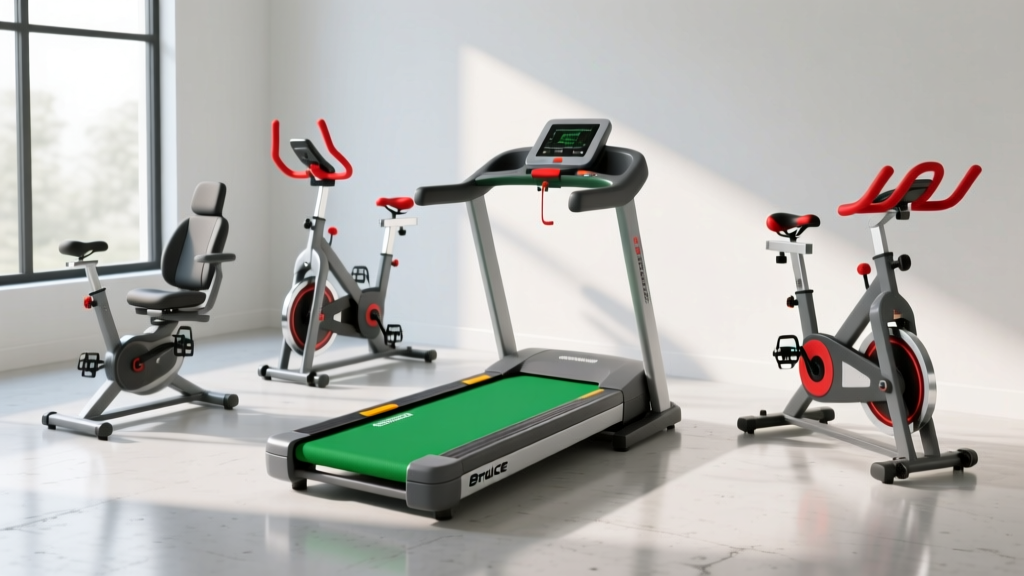
Modified Bruce Treadmill Test Protocol vs Bikes: Space Guide
Compare the spatial footprint of the modified bruce treadmill test protocol equipment vs upright, recumbent, and spin bikes for optimized home gym layouts.

The Spatial Dilemma: Clinical Testing vs. Compact Living
As at-home health tracking evolves in 2026, biohackers, cardiac rehab patients, and endurance athletes are increasingly bringing clinical-grade assessments into their home gyms. The modified bruce treadmill test protocol remains a gold standard for estimating VO2 max and evaluating cardiovascular function. Unlike the standard Bruce protocol, the modified version introduces two initial warm-up stages at 1.7 mph (0% and 5% grade), making it highly accessible for seniors and those recovering from cardiac events.
However, executing this protocol safely requires a specific class of motorized treadmill—one capable of precise 1.7 mph increments, 0-20% incline shifts, and featuring extended handrails for ECG lead wire management. The spatial footprint of such equipment is massive. For homeowners designing compact fitness spaces, this creates a critical layout dilemma: Do you dedicate 130 square feet to a treadmill for occasional testing, or do you pivot to space-saving stationary bike types (upright, recumbent, spin) for daily cardio and alternative submaximal testing?
⚠️ Safety Clearance Warning: The most common failure mode in home gym layout design is ignoring the rear drop-zone. According to the American Council on Exercise (ACE), treadmills require a minimum of 78 inches of unobstructed clearance behind the deck to prevent severe friction burns in the event of a fall. Bikes require zero rear clearance.Footprint Matrix: Treadmill vs. Stationary Bike Types
To optimize your floor plan, you must look beyond the machine's physical dimensions and calculate the total operational footprint, which includes user clearance, ventilation gaps, and safety zones. Below is a comparative matrix based on 2026 commercial and premium home models.
| Equipment Type | Reference Model (2026) | Machine Footprint | Total Safety Zone | Electrical Draw |
|---|---|---|---|---|
| Clinical Treadmill | Sole F63 / NordicTrack 1750 | 75" L x 30" W | ~130 sq ft | 15A - 20A (Dedicated) |
| Upright Bike | Peloton Bike+ / Echelon EX-5s | 59" L x 22" W | ~45 sq ft | < 3A (Standard) |
| Recumbent Bike | Sole R92 / Schwinn 270 | 63" L x 28" W | ~60 sq ft | < 3A (Standard) |
| Spin / Indoor Cycle | Schwinn IC4 / Bowflex C6 | 49" L x 21" W | ~30 sq ft | N/A (Magnetic/Manual) |
Stationary Bike Types: Space Optimization Breakdown
If your primary goal is daily cardiovascular conditioning rather than strict adherence to the modified bruce treadmill test protocol, stationary bikes offer massive spatial advantages. However, not all bikes are created equal when it comes to layout design.
1. Spin Bikes (The Minimalist Footprint)
Spin bikes like the Schwinn IC4 utilize a heavy flywheel and magnetic resistance, requiring no external power source. This eliminates the need for outlet proximity planning and cord management. With a footprint of just 49 by 21 inches, a spin bike can easily be tucked into a corner, placed in a multi-use living area, or stored on a heavy-duty wall mount. They are ideal for high-intensity interval training (HIIT) and mimic the biomechanics of outdoor cycling, though they lack the back support required for clinical cardiac rehab populations.
2. Upright Bikes (The Compact Compromise)
Upright bikes feature a smaller seat and a vertical riding posture. Models like the Peloton Bike+ or NordicTrack S22i offer integrated screens for guided submaximal testing. While they require a standard 15-amp electrical outlet, their footprint is only slightly larger than a spin bike. The primary spatial consideration for upright bikes is vertical clearance. If you are designing a basement gym with low drop-ceilings, ensure you have at least 84 inches of floor-to-ceiling height to accommodate the rider's inseam plus the pedal stroke apex.
3. Recumbent Bikes (The Long-Frame Challenge)
Recumbent bikes are the closest functional alternative to treadmills for cardiac rehab and senior fitness. The seated, reclined position minimizes orthopedic stress and allows for accurate heart rate monitoring via grip sensors or chest straps. However, models like the Sole R92 are exceptionally long (63+ inches). While they don't require the 78-inch rear safety zone of a treadmill, their elongated frame makes them difficult to place in narrow, galley-style rooms. They are best positioned parallel to a long wall or centered in a bay window to utilize dead space.
Infrastructure and Layout Design for Small Spaces
Designing a home cardio lab in 2026 requires looking beyond the tape measure. When deciding between a treadmill for the modified bruce treadmill test protocol and a stationary bike alternative, you must audit your room's infrastructure.
- Electrical Load Audit: A motorized treadmill capable of sustaining the 3-minute stages and incline shifts of the Modified Bruce protocol draws significant amperage, especially during the acceleration phases. Plugging a 2.5 CHP treadmill into a shared 15-amp circuit with a space heater or window AC unit will trip the breaker mid-test. Bikes draw negligible current, allowing you to place them anywhere.
- Acoustic and Vibration Dampening: Treadmills generate low-frequency structural vibrations that travel through floor joists. If your gym is on a second floor or above a finished basement, you must install a 3/8-inch vulcanized rubber mat under the treadmill. Spin and upright bikes generate virtually zero structural vibration, requiring only a thin PVC mat to protect hardwood floors from sweat.
- Climate Control Positioning: Treadmills require massive convective cooling. Never place a treadmill directly facing a wall or in a corner where air stagnates; the user will overheat, artificially elevating their heart rate and invalidating the test data. Bikes can be placed closer to walls, provided there is at least 12 inches of lateral clearance for mounting and dismounting.
Adapting Your Testing Protocol for Space Constraints
If spatial limitations force you to abandon the treadmill, you must adapt your testing methodology. The American Heart Association notes that while treadmill tests are standard, submaximal bike protocols are highly effective alternatives for estimating cardiovascular capacity when treadmill use is contraindicated or spatially unfeasible.
"When space or orthopedic limitations preclude the use of a treadmill, the YMCA Submaximal Bike Test or the Åstrand-Rhyming protocol on an upright or recumbent bike provides a highly reliable, space-efficient method for estimating VO2 max and tracking cardiac rehabilitation progress." — Adapted from the American College of Sports Medicine (ACSM) Guidelines for Exercise Testing.
The YMCA protocol utilizes a single-stage or multi-stage approach on a stationary bike, requiring the user to maintain a specific RPM (usually 50-60 RPM) against increasing resistance levels while heart rate is tracked. This requires only an upright or recumbent bike with a reliable digital resistance readout (measured in watts or standardized levels) and a chest strap monitor.
The Final Layout Verdict
If your home gym exceeds 150 square feet and features a dedicated 20-amp circuit, investing in a premium treadmill to perform the modified bruce treadmill test protocol at home is a viable, data-rich investment. However, for the vast majority of modern homes, apartments, and multi-use spaces, a high-quality magnetic recumbent or upright bike offers 75% of the clinical testing value while reclaiming nearly 100 square feet of vital living space. By prioritizing spatial efficiency and adapting your testing protocols, you can build a world-class cardiovascular lab without sacrificing your home's functionality.
More gear to consider
All reviews
Elliptical vs Treadmill Maintenance: Navigating Treadmill Recall News
Under Desk Treadmill Review: How Much Electricity Does It Use?

2026 Under Desk Treadmill Review: Treadmill Workout for Stamina

Rowing Machine Guide & Technique: Setup for 8.0 Incline on Treadmill

MythBusters Plane on a Treadmill: Walking Pad Setup & Comparison
