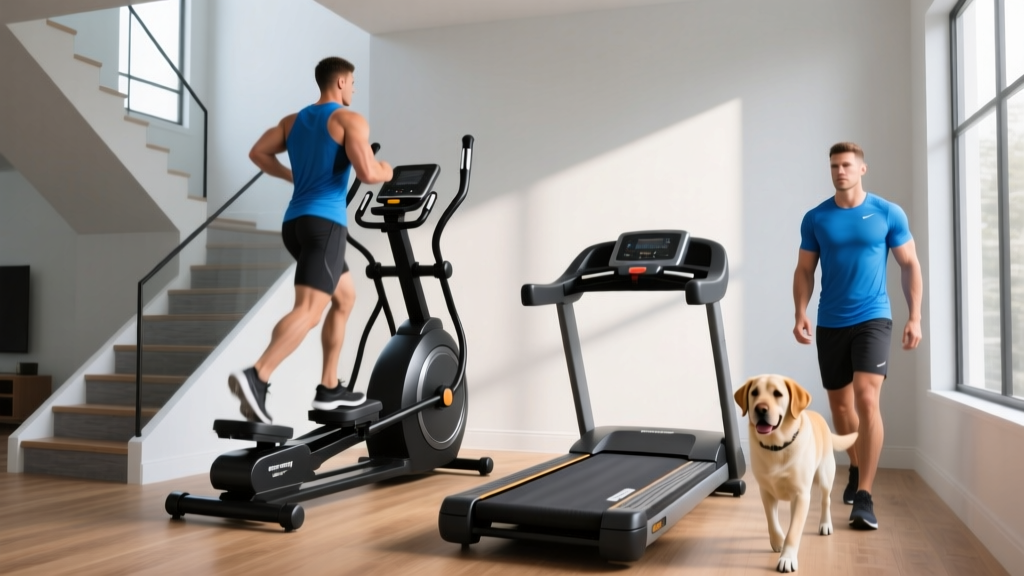
2026 Trends: Livestrong LS8 0 Treadmill vs Stationary Bike Types
Analyze 2026 cardio market trends comparing legacy treadmills like the Livestrong LS8 0 to modern upright, recumbent, and spin stationary bike types.

The Legacy Baseline: Analyzing the Livestrong LS8 0 Treadmill
The home cardio equipment market of 2026 is defined by spatial efficiency, low-impact biomechanics, and smart connectivity. To understand where the industry is heading, we must first look at the legacy benchmarks that dominated the 2010s. A prime example is the heavy-duty commercial-grade lineage seen in older models. While secondary market searches for the Livestrong LS8 0 treadmill remain steady among budget-conscious buyers looking for depreciated commercial gear, the reality of owning a legacy motorized treadmill in 2026 presents unique challenges.
Originally engineered with a robust 4.0 HP continuous-duty motor, a 20x60-inch running deck, and a 350-pound user capacity, the Livestrong LS8 0 treadmill was a powerhouse. However, its massive 80x35-inch footprint and 300-pound shipping weight are increasingly at odds with modern urban living spaces. Furthermore, the total cost of ownership (TCO) for motorized treadmills has risen. In 2026, replacing a worn deck belt costs upwards of $150, and a fried motor control board can easily exceed $350. This maintenance friction is driving a massive consumer pivot toward magnetic-resistance cardio machines.
2026 Market Insight: According to Grand View Research, the global home fitness equipment market is heavily favoring compact, low-impact machines. Stationary bikes have seen a 22% year-over-year growth in urban demographics, largely due to footprint optimization and zero-friction magnetic resistance systems that eliminate the maintenance headaches of legacy treadmills.The 2026 Shift: Why Stationary Bikes Are Capturing Market Share
The transition away from heavy treadmills is not just about saving space; it is deeply rooted in preventative health and longevity. The American College of Sports Medicine (ACSM) consistently highlights low-impact, closed-chain kinetic exercises as the gold standard for aging populations and joint rehabilitation. Stationary bikes provide high cardiovascular output without the repetitive ground-reaction forces (which can reach 2.5x body weight on a treadmill).
When evaluating stationary bike types—upright, recumbent, and spin—consumers in 2026 are looking for specific biomechanical benefits, FTMS (Fitness Machine Service) Bluetooth connectivity for app integration, and virtually zero maintenance. Let us break down the three dominant categories reshaping the cardio market.
Deep Dive: Stationary Bike Types (Upright, Recumbent, Spin)
1. Upright Bikes: The Space-Saving Workhorse
Upright bikes mimic the geometry of a traditional road bicycle but with a slightly more relaxed torso angle. They are the ultimate compromise between calorie burn and spatial efficiency.
- Market Leaders: Sole SB700, NordicTrack S10i.
- 2026 Price Range: $799 - $1,499.
- Key Specs: Typically feature a 40-50 lb flywheel, belt-drive systems for whisper-quiet operation, and a footprint of roughly 40x20 inches (saving up to 60% of the floor space required by the Livestrong LS8 0 treadmill).
- Best For: General cardiovascular health, users with limited floor space, and those transitioning from outdoor cycling.
2. Recumbent Bikes: The Rehab & Senior Market Leader
Recumbent bikes feature a bucket seat with a backrest and a forward-facing pedal position. This design completely unloads the lumbar spine and shifts the cardiovascular demand almost entirely to the lower extremities.
- Market Leaders: Schwinn 270, Life Fitness RS1, NuStep (for cross-recumbent).
- 2026 Price Range: $600 - $2,800.
- Key Specs: Step-through frames, 20-30 degree reclined seating, eddy-current magnetic resistance, and integrated heart-rate telemetry via chest straps.
- Best For: Post-operative rehab, seniors, individuals with sciatica or lower back pain, and high-volume interval training where upper-body fatigue is a limiting factor.
3. Spin / Indoor Cycles: The High-Intensity Favorite
Indoor cycles (spin bikes) are built for performance, aggressive riding postures, and out-of-the-saddle sprints. In 2026, the market has largely abandoned friction-pad resistance in favor of precision electromagnetic systems.
- Market Leaders: Keiser M3i, Bowflex VeloCore, Stages SC3.
- 2026 Price Range: $1,200 - $2,800.
- Key Specs: Critical metrics include the Q-factor (the distance between pedals, ideally 150mm-170mm to mimic real road bikes), dual-sided pedals (SPD clip-in and toe cages), and micro-adjustable 4-way fit geometry.
- Best For: HIIT (High-Intensity Interval Training), competitive cyclists, and users engaged in interactive virtual cycling platforms like Zwift or Rouvy.
Market Matrix: Legacy Treadmills vs. Modern Bike Types
To visualize the market shift, we must compare the operational realities of maintaining a legacy treadmill against investing in modern stationary bike types.
| Feature | Legacy Treadmill (e.g., LS8.0) | Upright / Spin Bikes | Recumbent Bikes |
|---|---|---|---|
| Avg. Footprint | 22 sq. ft. (80x35 in) | 6 sq. ft. (40x20 in) | 10 sq. ft. (60x25 in) |
| Resistance Type | Motorized Belt / Incline | Electromagnetic / Belt | Eddy-Current Magnetic |
| Annual Maintenance | High (Lubrication, belt tension, motor dust) | Near Zero (Wipe down, check bolts) | Near Zero (Wipe down, seat rail lube) |
| Joint Impact | High (2.5x body weight impact) | Low (Closed-chain kinetic) | Ultra-Low (Zero spinal loading) |
| 2026 Resale Value | Depreciating rapidly (Parts scarcity) | Stable (High demand for smart bikes) | Stable (Aging population demand) |
Total Cost of Ownership (TCO): The Hidden Treadmill Tax
When consumers browse the used market for a Livestrong LS8 0 treadmill, they are often lured by a low upfront cost—sometimes as low as $400 to $600 on local classifieds. However, industry repair technicians warn of the hidden TCO. A 4.0 HP motor draws significant amperage; if placed on a carpeted surface without a dedicated equipment mat, dust ingestion will fry the lower control board. Replacement boards for legacy Johnson Health Tech / Livestrong models are increasingly backordered or discontinued in 2026, turning a $500 bargain into a 300-pound paperweight.
Conversely, modern upright and spin bikes utilize electromagnetic resistance. Because there is no physical friction pad rubbing against a flywheel, and no motorized belt rolling over a wooden deck, the mechanical failure rate is astonishingly low. According to Consumer Reports reliability surveys, magnetic stationary bikes consistently rank at the top for long-term durability, requiring an average of $0 in mechanical repairs over a 5-year ownership cycle.
"The shift from motorized treadmills to magnetic resistance bikes represents a fundamental change in consumer priorities. Buyers in 2026 are no longer willing to sacrifice 20 square feet of living space and risk expensive motor repairs when an indoor cycle can deliver equal or superior cardiovascular adaptations with zero ongoing maintenance."
— 2026 Home Fitness Industry Analyst Report
The 2026 Buyer’s Decision Framework
If you are currently debating between refurbishing a legacy treadmill or investing in a new stationary bike, use this actionable framework to make your decision:
- Assess Your Spatial Reality: If your dedicated workout area is less than 60 square feet, abandon the treadmill idea. A recumbent or upright bike will fit seamlessly while leaving room for a yoga mat or kettlebells.
- Evaluate Joint Health: If you are over 45, recovering from a lower-body injury, or experience plantar fasciitis, the repetitive strike of a treadmill deck will exacerbate inflammation. Choose a recumbent bike for spinal support, or an upright bike for closed-chain knee rehabilitation.
- Determine Your Tech Ecosystem: Modern spin bikes like the Keiser M3i broadcast power data via ANT+ and Bluetooth FTMS. If you plan to use third-party apps like Zwift, TrainerRoad, or Kinomap, a smart stationary bike is mandatory. Legacy treadmills rarely support modern open-source Bluetooth protocols without expensive third-party dongles.
- Calculate the 5-Year Cost: Factor in $200 for treadmill belt lubrication, potential motor repairs, and higher electricity draw. Compare this to the $0 maintenance cost of a belt-drive magnetic bike.
Final Verdict: The Market Has Spoken
The Livestrong LS8 0 treadmill remains a testament to an era where heavy iron and massive motors were the ultimate status symbols in home gyms. It is a well-built machine for those who already own one and have the space to accommodate it. However, the 2026 market trends are undeniable. The future of home cardio belongs to stationary bike types—upright, recumbent, and spin—that prioritize spatial efficiency, joint longevity, and digital connectivity. By pivoting to a modern magnetic bike, consumers are not just saving floor space; they are investing in a sustainable, low-maintenance cardiovascular routine built for the realities of modern living.
More gear to consider
All reviews
Home Stair Climber Guide: Treadmill Time Chart Comparison
Is Walking on a Treadmill as Good as Outside? Air Bike Space Guide

Walking Pad vs Treadmill Review: Safety Magnet Guide

Elliptical vs Treadmill: 12-3-30 Routine & How Many Days a Week?
Future Glide Treadmill Review: Top Folding Picks for Small Spaces