
Ice Hockey Treadmill Training: Best Folding Models for Small Spaces
Discover how a folding treadmill for small spaces can replace a costly ice hockey treadmill. Our 2026 hands-on review covers top models for off-ice training.

The Off-Ice Dilemma: Dedicated Skating Mills vs. Compact Alternatives
When most athletes and coaches hear the phrase ice hockey treadmill, they immediately picture the massive, specialized skating mills found in elite performance centers. These dedicated machines, which utilize specialized belts and harness systems to simulate the exact friction and lateral push of ice, often cost upwards of $25,000 and weigh over 800 pounds. For the amateur player, collegiate athlete, or dedicated hockey parent living in an apartment or managing a small home gym, a dedicated skating treadmill is a logistical and financial impossibility.
However, the core physiological demands of hockey—explosive ATP-PC system activation, deep 45-degree knee flexion, and immense gluteal drive—can be effectively trained on standard cardio equipment if you know what specifications to look for. In this 2026 hands-on review, we evaluate the best folding treadmills for small spaces specifically through the lens of ice hockey conditioning. We tested over a dozen compact models to find the ones that offer the necessary deck length for a full skating stride, the motor durability for high-intensity interval training (HIIT), and the folding mechanisms required to reclaim your living space post-workout.
The Biomechanics of Skating: What Your Treadmill Must Provide
Running and skating are biomechanically distinct. Running is a linear, reciprocal gait heavily reliant on the hamstrings and calves for forward propulsion. Skating, conversely, is a lateral-dominant movement requiring massive eccentric and concentric force from the quadriceps, gluteus medius, and adductors. According to kinesiology data from ExRx.net, the deep knee bend required for a proper skating stride places immense load on the vastus medialis oblique (VMO).
To bridge the gap between a standard folding treadmill and an actual ice hockey treadmill, you must utilize maximum incline and sprint intervals. Walking or running at a 15% incline forces the body into a flexed, athletic stance that closely mimics the hip and knee angles of a skating stride. Furthermore, the American Heart Association notes that HIIT protocols are essential for training the anaerobic energy systems used in shift-based sports. Therefore, our top picks prioritize rapid speed-dial controls, high-incline capabilities, and heavy-duty shock absorption to protect joints during repetitive sprint intervals.
2026 Hands-On Review: Top 3 Folding Treadmills for Hockey Players
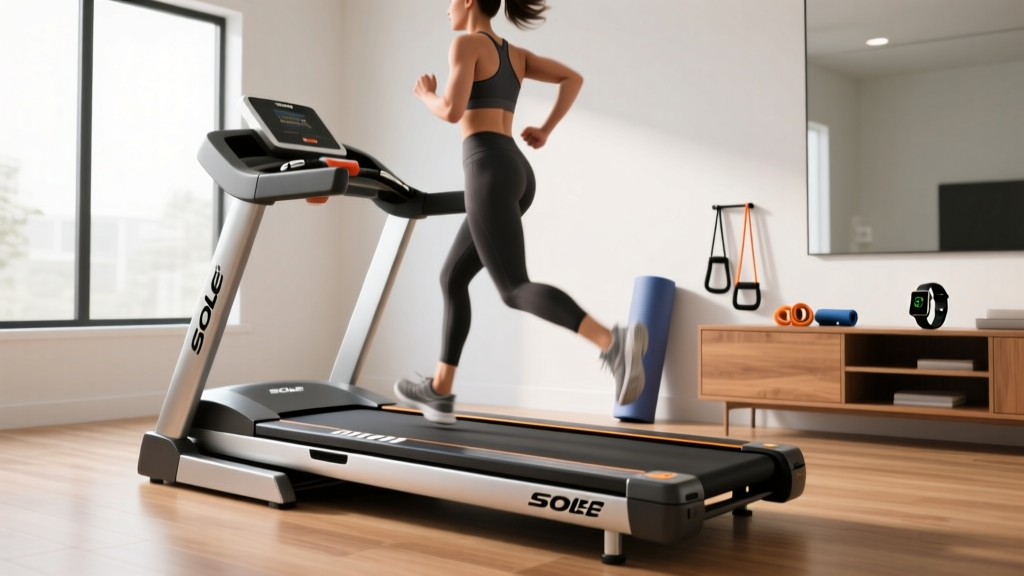
1. Sole F85: The Heavy-Duty Stride Simulator
Price: ~$1,199 | Motor: 4.0 HP | Deck: 22' x 60' | Folded Footprint: 35' x 35'
The Sole F85 remains the undisputed champion for taller defensemen and forwards who need a full 60-inch belt to accommodate a complete stride extension without clipping the front motor cowl. While many folding treadmills sacrifice deck length to save space, the F85 maintains a commercial-grade footprint while utilizing a hydraulic-assisted folding mechanism that easily locks into a vertical position.
- Hockey Application: The 4.0 HP motor does not bog down during rapid acceleration intervals (simulating breakaways). The Cushion Flex whisper-deck system reduces joint impact by up to 40%, which is critical when performing heavy incline marches to build skating endurance.
- Space Factor: Despite its large deck, the folding hinge is robust, and the integrated transport wheels allow you to roll it into a closet or corner effortlessly.
2. NordicTrack Commercial 1750: The Incline King
Price: ~$1,799 | Motor: 3.5 CHP | Incline: -3% to 15% | Folded Footprint: 34' x 39'
If your primary goal is to build the raw leg power required for explosive first-step acceleration, the NordicTrack 1750 is your best option. Its standout feature is the -3% to 15% incline/decline range. The 15% maximum incline is steep enough to force the deep knee bend necessary for skating power development.
- Hockey Application: We used the 1750 for 'Third Period' simulations: 15% incline walks at 3.5 mph with a weighted vest (20 lbs). This perfectly mimics the burning lactic acid buildup in the quads during a long defensive shift. The OneTouch controls allow you to instantly jump to 10 mph for sprint intervals without fumbling with up/down arrows.
- Space Factor: The SpaceSaver design with EasyLift folding is genuine. You can lower the deck with one hand, making it ideal for multi-use living rooms.
3. Horizon 7.8: The Budget-Friendly Sprint Machine
Price: ~$999 | Motor:3.0 HP | Deck: 22' x 58' | Folded Footprint: 32' x 36'
For junior players or those on a stricter budget, the Horizon 7.8 offers exceptional value. It features a rapid-response motor that accelerates and decelerates faster than most competitors in the sub-$1,000 category, which is vital for Tabata-style shift simulations (45 seconds on, 15 seconds off).
- Hockey Application: The Bluetooth connectivity allows you to sync with third-party interval timer apps, automating your speed changes so you can focus entirely on your stride mechanics and arm swing.
- Space Factor: It has the smallest folded footprint of our top three, making it the ultimate choice for dorm rooms, small apartments, or tight garage gym corners.
Space-Saving & Performance Matrix
| Model | Deck Size (W x L) | Max Incline | Folded Dimensions | Best For |
|---|---|---|---|---|
| Sole F85 | 22' x 60' | 15% | 35' x 35' x 73' | Tall Players / Full Stride Extension |
| NordicTrack 1750 | 22' x 60' | 15% (w/ Decline) | 34' x 39' x 70' | Power Building / Incline Marches |
| Horizon 7.8 | 22' x 58' | 15% | 32' x 36' x 71' | Budget / Rapid Sprint Intervals |
Off-Ice Drills: Simulating the Ice on a Folding Treadmill
To get the most out of your equipment, you must program your workouts to match the demands of the sport. USA Hockey emphasizes the importance of sport-specific off-ice conditioning. Here are three drills we developed during our testing phase:
⚠️ SAFETY WARNING: Never attempt lateral jumps, side-shuffles, or cross-overs on a moving linear treadmill belt. The risk of catching an edge (your shoe) and suffering a severe lower-body injury is extremely high. Save lateral plyometrics for a slide board or gym floor.- The 'Shift Simulation' Sprint Protocol: Set the treadmill to 9-11 mph (depending on your running mechanics). Sprint for 45 seconds to mimic a standard hockey shift, then jump the feet to the side rails and rest for 15-30 seconds. Repeat for 8-10 cycles. This trains the body to clear lactate rapidly, mimicking the bench rest between shifts.
- The Heavy Incline Prowler March: Set the incline to 15% and the speed to 2.5 - 3.0 mph. Do not hold the handrails. Pump your arms aggressively as if you were driving through a heavy forecheck. This isolates the glutes and hamstrings, building the posterior chain strength required for powerful edge pushes.
- Backward Deceleration Walks: (Requires strict use of the safety clip). Turn the treadmill off, straddle the belt, and start it at 1.5 mph. Carefully step on and walk backward. This targets the tibialis anterior and the VMO, helping to bulletproof the knees against the severe deceleration forces experienced when stopping on ice.
What a Folding Treadmill Cannot Replace
While a high-quality folding treadmill is a phenomenal tool for linear speed, anaerobic conditioning, and incline-based strength, it is not a complete replacement for an actual ice hockey treadmill or a well-rounded off-ice program. A standard treadmill cannot train the adductor muscles (groin) through the lateral push-off phase of a skating stride. To build a complete small-space hockey gym, you must pair your folding treadmill with a slide board (which folds flat under a bed) and a set of resistance bands for rotational core work.
Final Verdict: Building the Small-Space Hockey Gym
You do not need a $30,000 specialized machine or a massive facility to train like a hockey player in 2026. If your priority is raw durability and accommodating a long, aggressive stride, the Sole F85 is the best overall folding treadmill for small spaces. If you want to focus heavily on the deep knee-bend strength required for explosive starts, the incline capabilities of the NordicTrack 1750 are unmatched. By utilizing high-incline marches and precise interval sprinting, you can effectively bridge the gap between the gym and the ice, all while maintaining the ability to fold your equipment away when the workout is done.
More gear to consider
All reviews
Mastering Horizon 7.0 AT Treadmill Belt Maintenance & Lubrication

Apartment Cardio: 20 Minutes on Treadmill vs Quiet Machine Noise
FitNation Slimline Treadmill vs Curved Manual: 2026 Buying Guide
Sole Fitness F85 Treadmill: Feature Comparison & Buyer Mistakes

Stair Climber Guide: Setup Without a Commercial 1750 Treadmill Manual
