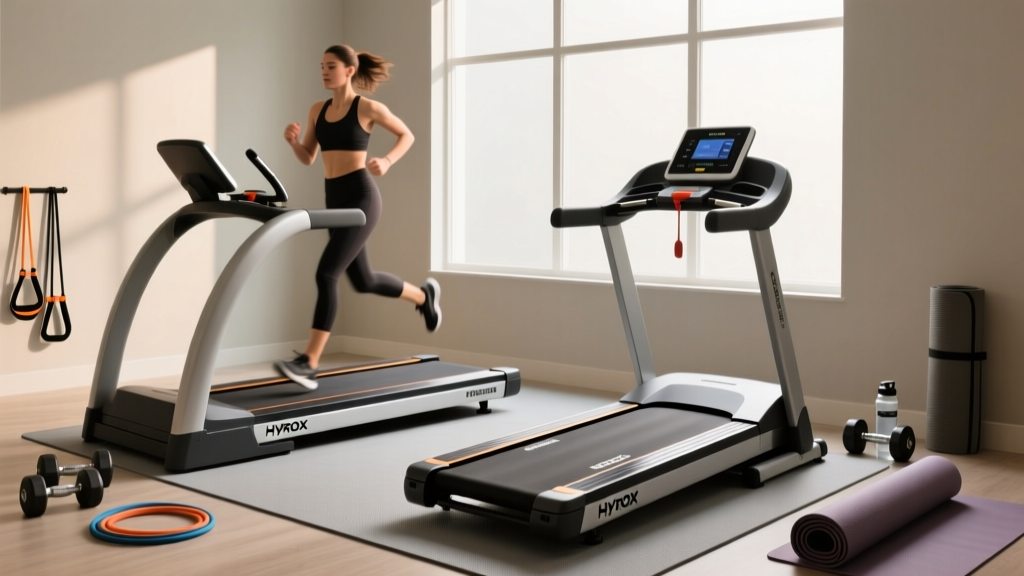
Hyrox Treadmill Guide: Curved vs Motorized for Beginners
Preparing for your first Hyrox? Discover the pros, cons, and step-by-step training differences between curved manual and motorized treadmills.

The Hyrox Running Dilemma: Why Your Treadmill Choice Matters
If you are training for your first Hyrox race, you already know the format: eight 1-kilometer runs, each immediately followed by a grueling functional workout station. That means 8 kilometers of running, which accounts for roughly 50% of your total race time. As the 2026 competitive season sees a massive influx of beginner athletes, the most common training bottleneck isn't the 152lb Sled Push or the 100m Sandbag Lunges—it is the 'compromised running' that happens when your legs are flooded with lactic acid.
To prepare for this, beginners must log serious indoor mileage. But this brings up a critical equipment question: Should you train on a curved manual treadmill or a traditional motorized treadmill? Both machines will get your heart rate up, but they demand entirely different biomechanical outputs, pacing strategies, and financial investments. This step-by-step guide breaks down the exact differences, helping you choose the right machine and structure your beginner training plan.
💡 Beginner Insight: Hyrox is not a marathon. It is an interval endurance event. Your treadmill training must reflect the stop-and-go nature of the race, rather than just long, steady-state jogging.Curved Manual Treadmills: The Biomechanical Breakdown
Curved treadmills (like the AssaultRunner Elite, retailing around $3,499 in 2026) are entirely self-powered. There is no motor; the belt only moves when you push it. The curved, slatted design forces you to strike the ground with your midfoot or forefoot, pulling the belt up and over the apex of the curve using your hamstrings and glutes.
The Pros for Hyrox Athletes
- Higher Energy Expenditure: Sports science studies consistently show that running on a curved manual treadmill requires approximately 30% more energy than running on a motorized belt at the same perceived speed. This builds massive aerobic capacity.
- Posterior Chain Activation: Because you must physically pull the belt, your hamstrings and glutes work much harder. This directly translates to the power needed for the Hyrox Sled Push and Sled Pull stations.
- Self-Regulating Pace: In a race, you naturally slow down when fatigued. A curved treadmill mimics this perfectly, preventing the injury risk of a motorized belt dragging your exhausted legs forward.
The Cons for Beginners
- Pacing Difficulty: Holding an exact pace (e.g., exactly 5:30/km) is incredibly difficult. The speed fluctuates with every stride.
- Calf and Achilles Strain: The forced forefoot strike places immense load on the lower leg. Beginners who jump straight into high mileage on a curved treadmill often develop Achilles tendinopathy.
Motorized Treadmills: The Paced Endurance Builder
Traditional motorized treadmills (such as the highly rated Sole F80, priced around $1,199) use an electric motor to pull the belt beneath your feet at a pre-set speed. Your primary job is simply to keep up with the belt's rhythm.
The Pros for Hyrox Athletes
- Strict Pace Control: If your goal is to run each 1km Hyrox segment in exactly 6 minutes, a motorized treadmill locks you into that 10 km/h pace, teaching your brain and body what that specific effort feels like.
- Forgiving on the Lower Legs: The flat, cushioned deck allows for a heel-to-toe gait cycle, reducing the acute strain on your calves and Achilles tendons during high-volume base-building weeks.
- Mental Fatigue Management: When your legs are heavy after a Burpee Broad Jump station, zoning out and letting the treadmill dictate the pace is mentally easier than forcing a heavy, dead belt to move.
The Cons for Beginners
- Over-striding Risk: Because the belt pulls your foot back, beginners often reach too far forward with their lead foot, leading to braking forces and knee pain.
- False Fitness: The motor does roughly 15-20% of the work of moving your body weight forward, meaning your cardiovascular fitness on a motorized treadmill may not perfectly translate to outdoor race-day running.
Head-to-Head Comparison Matrix
| Feature | Curved Manual Treadmill | Motorized Treadmill |
|---|---|---|
| Power Source | 100% Human (Self-powered) | Electric Motor (Plug-in) |
| Caloric Burn | ~30% Higher at same RPE | Standard baseline |
| Foot Strike | Forced Midfoot/Forefoot | Heel or Midfoot |
| Pacing Accuracy | Low (Fluctuates) | High (Exact MPH/KMH) |
| 2026 Price Range | $3,000 - $12,500+ | $800 - $3,500 |
| Best Hyrox Use | Power & Heavy-Leg Intervals | Zone 2 Base & Exact Pacing |
Step-by-Step Beginner Hyrox Treadmill Training Plan
Regardless of which machine you have access to, your training must evolve as you get closer to race day. Follow this 12-week progression framework.
Phase 1: Base Building & Form (Weeks 1-4)
Primary Machine: Motorized Treadmill
Your goal here is purely aerobic capacity and joint conditioning. Do not worry about heavy legs yet.
- Week 1-2: Run 30 minutes at a conversational pace (Zone 2, roughly 65-75% of max HR). Focus on a quick cadence (160+ steps per minute) to prevent over-striding.
- Week 3-4: Introduce 1% incline on the motorized treadmill to better simulate outdoor wind resistance and ground friction.
Phase 2: Compromised Running Simulation (Weeks 5-8)
Primary Machine: Curved Manual Treadmill (or Motorized with manual push intervals)
Now we simulate the 'heavy leg' feeling of transitioning from the SkiErg or Sled Push into your 1km run.
- The Workout: Perform 3 sets of: 20 Air Squats + 20 Kettlebell Swings + 400m Run.
- Curved Execution: When jumping on the curved treadmill with fatigued legs, do not sprint. Start with a fast walk to get the belt moving, then gradually lean in and drive with your glutes to build speed. This mimics the first 200 meters of a Hyrox race segment where you must shake out the lactic acid.
Phase 3: The 'Roxzone' Pace Lock (Weeks 9-12)
Primary Machine: Motorized Treadmill
Your aerobic base is built. Now you need to lock in your exact race-day pace so you don't burn out on the first three 1km runs.
- The Workout: 8 x 1km at your exact target race pace, with exactly 90 seconds of rest between each interval. (90 seconds simulates the time it takes to run through the 'Roxzone' transition area to the next station).
- Motorized Execution: Set the treadmill to your target speed. When the 1km is done, jump off the side rails for 90 seconds, then jump back on. This trains the neurological shock of sudden stops and starts.
The Final Verdict: Which Should You Buy?
If you are outfitting a home gym specifically for Hyrox in 2026 and have a premium budget ($3,500+), a curved manual treadmill is the superior choice. The biomechanical demand perfectly mirrors the posterior-chain exhaustion you will feel during the race, and the self-powered nature builds mental grit.
However, if you are a true beginner on a standard fitness budget ($1,000 - $2,000), or if you have a history of Achilles/calf injuries, a high-quality motorized treadmill with a strong continuous horsepower (CHP 3.0+) motor and a long deck (at least 60 inches) is the smarter, safer investment. You can easily simulate the heavy-leg demands by pairing your motorized treadmill runs with off-machine functional exercises like lunges and sled pushes.
'The treadmill doesn't build the Hyrox athlete; the transitions do. Choose the machine that allows you to safely practice the transition from heavy functional work back into a rhythmic running stride.'
Frequently Asked Questions
Can I wear my carbon-plated running shoes on a curved treadmill?
No. The aggressive grip and slatted belt of a curved treadmill will chew up the soft foam and rubber of carbon-plated race shoes (like the Nike Vaporfly). Stick to durable, everyday trainers with a solid rubber outsole.
Does Hyrox use curved or motorized treadmills on race day?
Hyrox does not use treadmills on race day. The 8 x 1km runs are completed on a marked indoor course, usually on rubberized sports flooring or turf. This is why training on a motorized treadmill with a 1% incline is highly recommended to bridge the gap between indoor belt-running and harder indoor race-day surfaces.
More gear to consider
All reviews
NordicTrack Commercial Series Treadmills: Motor HP Guide

What Is a Good Treadmill for Seniors vs Stationary Bikes? Care Guide

Air Bike vs Assault Bike Layouts: What's the Difference Between a Walking Pad and a Treadmill?

NordicTrack T9 Treadmill Review vs Walking Pads (2026 Guide)

Pictures of Treadmills vs Rowers: Buying Guide & Technique Mistakes
