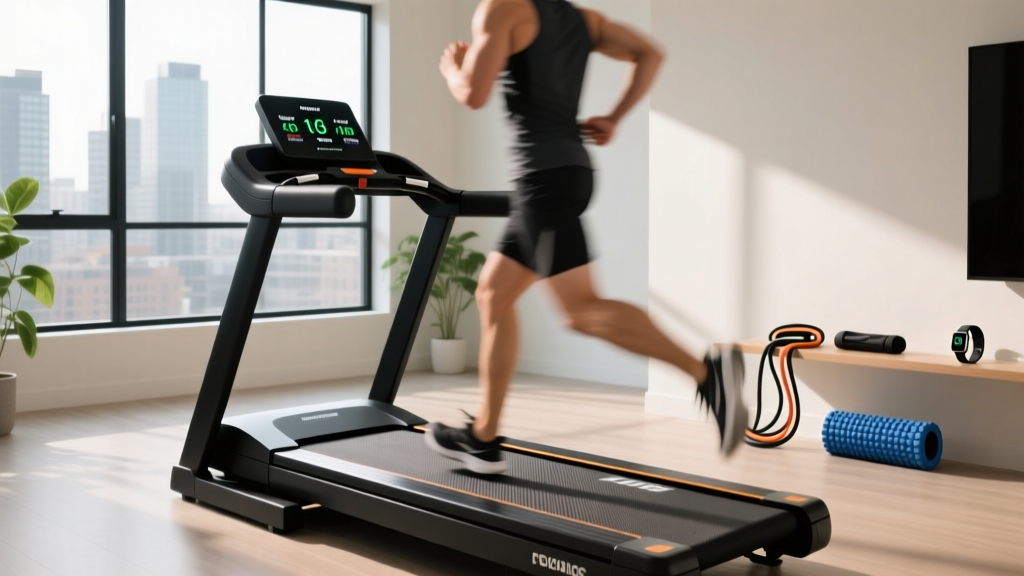
How to Work a Treadmill at the Gym & Compare Buying Features
Learn how to work a treadmill at the gym with our step-by-step beginner guide, plus a feature comparison to help you buy the right home model.

Walking into a commercial gym and facing a row of high-tech treadmills can feel overwhelming for a beginner. The consoles look like airplane dashboards, and the machines themselves are massive. If you are wondering how to work a treadmill at the gym without feeling self-conscious, you are not alone. This step-by-step beginner guide will demystify the console, teach you proper form, and then transition into a comprehensive treadmill buying guide features comparison so you know exactly what to look for when purchasing a machine for your home gym.
The 60-Second Quick Start Checklist
If you are short on time and the gym is crowded, memorize this sequence to get moving safely on any commercial treadmill model:
- Straddle the Belt: Stand on the stationary side rails, never on the belt itself.
- Clip the Lanyard: Attach the magnetic safety key to your clothing.
- Hit Quick Start: Press the green button to initiate a 1.0 mph crawl.
- Step On: Begin walking, then use the grip arrows to increase speed.
- Set Incline: Bump the grade to 1.0% to simulate outdoor wind resistance.
Step-by-Step: Mastering the Gym Treadmill
Commercial treadmills, like the Life Fitness Integrity Series or Precor TRM 835, prioritize durability and advanced telemetry over flashy touchscreens. Here is your exact sequence for a safe and effective workout.
1. Mount and Secure the Safety Lanyard
Never step onto the belt while it is moving. Straddle the belt by placing your feet on the stationary plastic side rails. Locate the bright red magnetic safety clip attached to a lanyard. Clip the magnetic end to the console and pin the other end to your shirt. If you stumble and pull the clip out, the machine will instantly engage the brakes.
2. Start the Belt and Establish Your Pace
Press the large, green START or QUICK START button. The belt will begin moving at a slow 1.0 mph. Step onto the belt and begin walking. Use the dedicated Speed (+/-) arrows on the handgrips or the main console to gradually increase your pace to a brisk 3.0 to 3.5 mph for your warm-up.
3. Adjust the Incline for Joint Health
According to the American Heart Association, adults should aim for at least 150 minutes of moderate-intensity aerobic activity per week. To hit this intensity without pounding your joints, press the Incline Up arrow to set the deck to a 2% to 5% grade. This mimics outdoor wind resistance and engages your glutes while reducing knee impact.
💡 Pro Tip: The 1% Rule
Biomechanical studies show that setting the treadmill incline to exactly 1.0% accurately simulates the energy cost of outdoor running on a flat surface, compensating for the lack of air resistance indoors.
4. Understanding Heart Rate Monitors and Programs
Most gym treadmills feature metallic contact grips on the handlebars or support Bluetooth chest straps. While contact grips are convenient, they are often inaccurate due to sweat and grip pressure. For precise zone training, pair a Bluetooth chest monitor to the console. Avoid the "Fat Burn" pre-set programs, which keep you at a low intensity. Instead, select "Manual" or "Random" to control your own intervals, which is far more effective for cardiovascular adaptation.
5. Execute Your Main Set and Cool Down
Once warmed up, increase your speed to your target running or power-walking pace. Maintain a neutral spine and avoid gripping the handrails. When finished, gradually decrease your speed by 0.5 mph every 30 seconds until you reach a walking pace. Press STOP, wait for the belt to halt completely, and unclip your safety lanyard before dismounting.
Gym vs. Home: Treadmill Buying Guide Features Comparison
Now that you know how to operate a commercial unit, what happens when you want to buy one for your home? Commercial gym treadmills cost between $6,000 and $12,000. Fortunately, you do not need to spend that much to get a reliable home workout. Below is a feature comparison matrix breaking down what you actually need based on your budget and fitness goals.
| Feature | Commercial Gym Model (e.g., Life Fitness Integrity) |
Premium Home Model (e.g., Sole F80 / NordicTrack 1750) |
Budget Home Model (e.g., Horizon T101) |
|---|---|---|---|
| Motor | 4.0+ HP AC Continuous Duty | 3.0 to 3.5 CHP DC Motor | 2.25 to 2.5 CHP DC Motor |
| Belt Size | 22" x 60" (4-ply) | 22" x 60" (2-ply) | 20" x 55" (1-ply) |
| Weight Capacity | 400+ lbs | 325 to 350 lbs | 250 to 275 lbs |
| Top Speed | 14 to 16 mph | 12 mph | 10 mph |
| Estimated Price | $7,000 - $12,000 | $1,199 - $1,999 | $599 - $799 |
| Warranty | Lifetime Frame/Parts, 3 Yr Labor | Lifetime Frame/Motor, 1-3 Yr Parts | Lifetime Frame, 1 Yr Parts/Labor |
3 Critical Features to Look For When Buying
When transitioning from using a gym treadmill to buying your own, marketing jargon can be misleading. Here is how to cut through the noise and evaluate the specs that actually matter for longevity and performance.
1. Continuous Duty Horsepower (CHP) vs. Peak HP
Many budget brands advertise a "3.0 Peak HP" motor. Peak HP only measures the motor's maximum output for a few seconds before it overheats. You must look for Continuous Duty Horsepower (CHP), which measures the motor's ability to sustain power during a 45-minute run.
The Rule: Walkers need a minimum of 2.5 CHP. Joggers need 3.0 CHP. Serious runners over 200 lbs should look for 3.5 CHP or higher to prevent the belt from stuttering under heavy footfalls.
2. Belt Ply and Deck Cushioning
The Mayo Clinic notes that while treadmill running is generally lower impact than asphalt, repetitive stress injuries can still occur if the deck lacks proper shock absorption. Avoid 1-ply belts, which are essentially thin sheets of PVC that will stretch and require constant re-tensioning. Always opt for a 2-ply or 4-ply belt with a woven nylon under-layer. Furthermore, look for brands that offer adjustable elastomer cushioning rather than cheap rubber bumpers that bottom out under heavy loads.
3. The "User Weight + 50 lbs" Rule
Treadmill manufacturers often inflate their maximum user weight capacities. If a box claims a 300 lb capacity, the motor will likely strain, overheat, and void the warranty if a 290 lb user runs on it at high inclines.
The Rule: Always buy a treadmill with a stated weight capacity that is at least 50 lbs greater than the heaviest user in your household. If you weigh 220 lbs, buy a machine rated for 275 lbs minimum.
Common Beginner Mistakes on the Treadmill
- Death-Gripping the Handrails: Holding the rails alters your natural gait, reduces calorie burn by up to 20%, and can cause lower back pain. If you feel the need to hold on, your speed or incline is too high.
- Staring at Your Feet: Looking down shifts your center of gravity forward, increasing neck strain and the risk of tripping. Pick a spot on the wall or screen directly at eye level.
- Skipping the Safety Clip: It feels annoying to clip the lanyard to your shirt, but if you experience a muscle cramp or lose your balance at 7.0 mph, the safety clip is the only thing preventing a severe friction burn from the moving belt.
Frequently Asked Questions
Is it better to run on a treadmill or outside?
Both offer excellent cardiovascular benefits. Treadmills provide a controlled environment, precise pacing, and shock-absorbing decks that reduce joint impact. Outdoor running engages more stabilizing muscles and prepares you for varying terrain and wind resistance. For beginners, the treadmill is often safer and easier to pace.
How do I lubricate a home treadmill belt?
Unlike commercial gym treadmills that use wax-infused belts or automated lubrication systems, most home treadmills require manual silicone lubrication every 3 months or 130 miles. You will need to loosen the belt tension bolts on the rear roller, lift the belt, and apply 100% pure silicone treadmill lube in a zig-zag pattern across the deck before re-tightening.
Can I use a treadmill if I live in an upstairs apartment?
Yes, but you must manage noise and vibration. Buy a treadmill with a DC motor (quieter than AC) and invest in a high-density 3/8-inch rubber equipment mat. This mat will absorb the low-frequency thumping of your footfalls, preventing noise complaints from downstairs neighbors.
More gear to consider
All reviews
Stationary Bike Types vs Horizon T401 Treadmill: 2026 Trends
ProForm XP 580s Crosstrainer Treadmill Confusion: Buying & Troubleshooting

Air Bike vs Assault Bike: Is 3.5 HP Good for Treadmill?

WalkingPad X25 Double-Fold Running Treadmill vs Bikes
Beyond Centr Treadmill Reviews: Stair Climber Setup Guide
