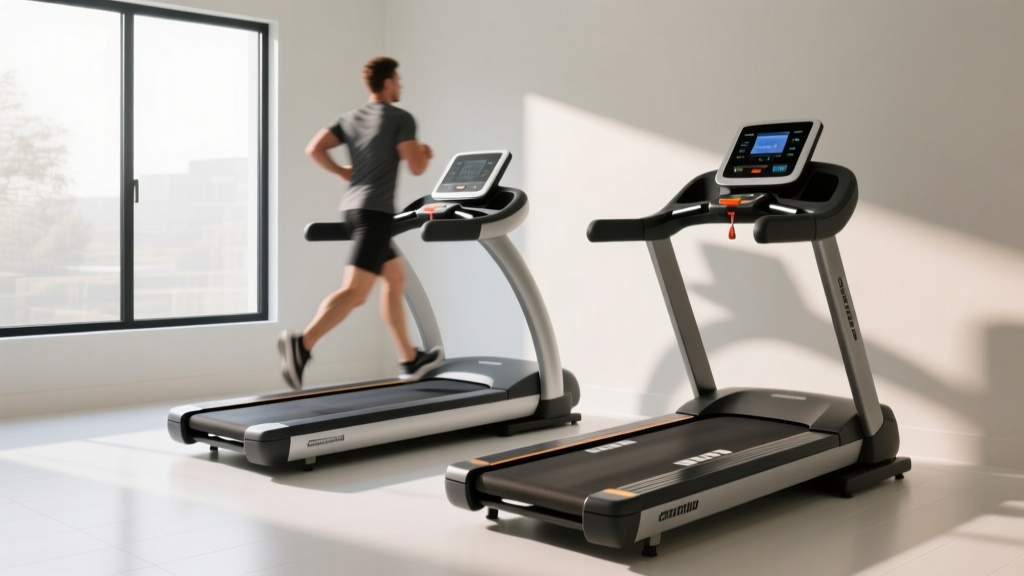
How to Buy a Treadmill: Curved Manual vs Motorized
Learn how to buy a treadmill by comparing curved manual vs motorized models. We break down biomechanics, pricing, and top picks for your home gym.

The Core Dilemma: Propulsion vs. Pacing
Figuring out how to buy a treadmill for your home gym in 2026 requires navigating a major fork in the road: traditional motorized decks versus self-powered curved manual treadmills. While both machines facilitate indoor cardiovascular training, their underlying biomechanics, maintenance profiles, and physiological demands are vastly different. Choosing the wrong type can lead to abandoned equipment, frustration, or even injury. This in-depth guide dissects the engineering, pricing, and real-world performance of both categories to help you make an evidence-based purchasing decision.
The Biomechanics: Why the Deck Shape Matters
According to the Mayo Clinic’s guidelines on aerobic exercise, maintaining proper running mechanics is crucial for joint longevity and cardiovascular efficiency. The deck shape fundamentally alters these mechanics.
On a motorized treadmill, the belt pulls your foot backward. This artificial propulsion slightly reduces the demand on your hamstrings and glutes, as the motor does a portion of the work to cycle your legs. Conversely, a curved manual treadmill features a concave, slatted deck. The downward slope at the front uses gravity and your foot strike to pull the belt down and back, while the upward slope at the rear forces you to actively lift your feet. This self-propelled mechanism heavily engages the posterior chain, mimicking outdoor overground running much more closely and increasing caloric expenditure by up to 30% at the same perceived pace.
Motorized Treadmills: The Paced Endurance Engine
Motorized treadmills remain the gold standard for paced endurance training, interval programming, and long-distance simulation. As noted in the Consumer Reports Treadmill Buying Guide, the primary metric to evaluate here is Continuous Horsepower (CHP), not Peak Horsepower.
Top Models and Specifications
- Sole F80 (Approx. $999 - $1,199): Features a 3.5 CHP motor, a 20" x 60" running surface, and a robust Cushion Flex deck. Ideal for runners up to 350 lbs.
- NordicTrack Commercial 1750 (Approx. $1,799): Offers a 3.5 CHP motor, a 14-inch HD touchscreen, and automated incline/decline capabilities (-3% to 15%).
The Motorized Advantage
Motorized units excel at enforcing a specific pace. If you are training for a marathon and need to hold an exact 8:15/mile pace for 12 miles, a motorized treadmill forces you to maintain that cadence. They also offer automated inclines, allowing for hands-free hill simulations. However, they require a dedicated 120V/15A electrical circuit and consume significant floor space (often 75+ inches in length).
Curved Manual Treadmills: The Self-Powered Sprinter
Curved non-motorized treadmills (cNMTs) have exploded in popularity among CrossFit athletes, sprinters, and HIIT enthusiasts. Without a motor, your top speed is theoretically limited only by your physical capacity, making them ideal for max-effort sprints.
Top Models and Specifications
- AssaultRunner Pro (Approx. $2,999): Weighs 280 lbs and utilizes a heavy-duty steel frame with a slat belt designed to withstand extreme torque during explosive sprints.
- TrueForm Runner (Approx. $3,495): Features a lower profile curve and a proprietary 75A durometer urethane slat belt, offering a slightly softer foot strike and quieter operation.
Expert Insight: The American Heart Association recommends at least 150 minutes of moderate-intensity aerobic activity per week. Because curved treadmills elevate heart rate and oxygen consumption (VO2) significantly faster than motorized models, users can often achieve equivalent cardiovascular benefits in 20% less time.
Head-to-Head Comparison Matrix
| Feature | Motorized Treadmill (Standard Home) | Curved Manual Treadmill |
|---|---|---|
| Price Range (2026) | $800 - $2,500 | $2,500 - $4,500 |
| Max Speed | 12 - 15 MPH (Motor Limited) | 20+ MPH (User Limited) |
| Caloric Expenditure | Baseline | +15% to +30% vs Baseline |
| Power Requirement | Dedicated 120V Outlet | None (Self-Powered) |
| Deck/Belt Type | MDF/Phenolic Deck + PVC Belt | Concave Frame + Urethane Slats |
| Footprint Length | 75" - 85" | 65" - 70" |
| Best For | Marathon pacing, long steady-state, walking | HIIT, sprint intervals, posterior chain development |
How to Buy a Treadmill: The 4-Step Decision Framework
To finalize your purchase, run your specific use case through this decision matrix:
- Assess Your Primary Training Modality: If your routine consists of Zone 2 steady-state cardio, long-distance pacing, or walking while watching TV, buy a motorized treadmill. If your routine involves Tabata, CrossFit WODs, or max-effort 40-yard dash simulations, buy a curved manual treadmill.
- Measure Your Space and Power: Curved treadmills are generally shorter and do not require a wall outlet, giving you more placement flexibility in garages or basements. Motorized units require a 20-inch clearance behind the deck for safety and a dedicated circuit to prevent tripping breakers.
- Calculate the User Weight-to-Motor Ratio: If you weigh over 220 lbs and plan to run (not walk) on a motorized treadmill, you must purchase a model with a minimum 3.5 CHP motor. Undersized motors will overheat and fail prematurely under heavy loads.
- Evaluate the Noise Tolerance: Motorized treadmills produce a low-frequency hum from the motor and a rhythmic thud from foot strikes. Curved treadmills are entirely devoid of motor noise, but the urethane slats striking the metal rails can create a loud, rhythmic clacking that may disturb neighbors or sleeping family members.
Real-World Maintenance & Failure Modes
Understanding what actually breaks on these machines will save you hundreds of dollars in warranty disputes and repair bills.
Motorized Failure Modes
The most common catastrophic failure in motorized treadmills is the Motor Control Board (MCB) frying. This rarely happens due to a defective board; rather, it is caused by high friction. If the user fails to lubricate the PVC belt with 100% silicone spray every 150 miles, the friction coefficient increases. The motor must draw excessive amperage to maintain speed, which generates immense heat and ultimately melts the MCB components. Additionally, belt delamination (where the top layer of the belt separates from the base) is common in sub-$800 models after 1,000 miles of use.
Curved Manual Failure Modes
Curved treadmills have no electronics to fail, but they suffer from mechanical vibration issues. The repetitive, high-impact force of sprinting can cause the hex bolts securing the urethane slats to the internal drive belt to back out over time. If a loose slat catches on the frame, it can snap and destroy the track. Pro-Tip: During annual maintenance, remove the slat bolts, apply a medium-strength threadlocker (like Loctite Blue 242), and re-torque them to the manufacturer’s specifications. Another edge case is rear roller bearing seizure, which occurs when fine dust and pet hair bypass the side seals and grind the bearings to a halt.
The Final Verdict
There is no universally "better" treadmill—only the right tool for your specific physiological goals. Buy a motorized treadmill if you need automated pacing, incline variations, and a forgiving deck for high-volume endurance work. Invest in a curved manual treadmill if you want to maximize caloric burn, develop explosive sprinting power, and eliminate electrical maintenance from your home gym ecosystem.
More gear to consider
All reviews
Treadmill Financing & Cardio Machine Noise Level Comparison

NordicTrack C 850s Treadmill Care & Under Desk Office Review

Rowing Machine Buying Guide and Lifespan Treadmill Maintenance

AlterG Treadmill Cost vs. Assault Air Bike Maintenance Guide

Treadmill in Garage: Cardio Machine Noise Comparison
