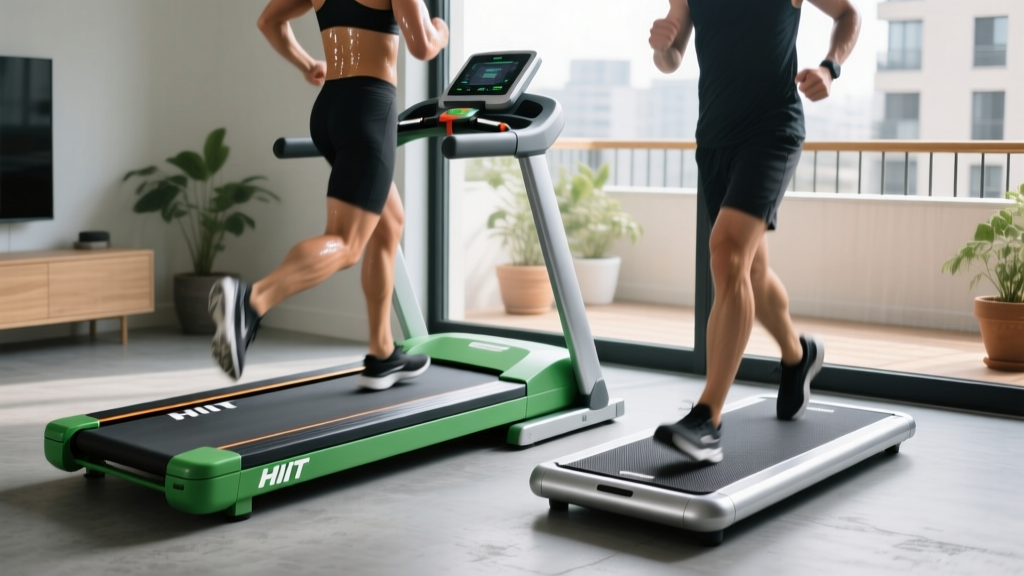
HIIT Treadmill vs Walking Pad: Top Mistakes & Fixes
Avoid costly mistakes when comparing a walking pad to a HIIT treadmill. Troubleshoot motor burnout, belt slip, and stride limits with our expert guide.

In the 2026 home fitness landscape, the line between casual daily movement and high-intensity cardiovascular training is frequently blurred by aggressive marketing. Consumers often attempt to use a compact, under-desk walking pad for high-intensity interval training (HIIT), leading to rapid mechanical failure, safety hazards, and profound frustration. Conversely, some buyers overspend on massive commercial-grade machines when a simple walking routine is their actual goal.
This guide dissects the most common mistakes buyers make when navigating a walking pad treadmill comparison, specifically focusing on the mechanical realities of high-intensity workouts. If you are attempting sprint intervals on a folding deck, or troubleshooting a stuttering belt, this expert troubleshooting matrix will help you identify the root cause and find a permanent solution.
The Biomechanical and Mechanical Divide
Before troubleshooting specific errors, we must establish the fundamental engineering differences between a walking pad and a dedicated HIIT treadmill. According to Mayo Clinic's guidelines on interval training, true HIIT requires short bursts of near-maximum effort, which translates to rapid acceleration, high top speeds (8 to 12+ mph), and heavy impact forces on the deck.
⚠️ Critical Warning: Walking pads are engineered with low-torque DC motors (typically 1.0 to 1.75 Continuous Horsepower) designed for steady-state, low-impact walking at 2 to 4 mph. Forcing a walking pad to accelerate rapidly for sprint intervals will spike the amperage draw, trip the thermal overload switch, and eventually melt the motor controller board.A true HIIT treadmill, such as the Sole F80 or Horizon 7.0 AT, utilizes high-torque DC or commercial AC motors (3.0 to 4.0+ CHP) paired with heavy flywheels. This setup ensures the belt maintains momentum and responds instantly to rapid speed changes without stuttering or lagging under the user's foot.
4 Critical Mistakes Buyers Make
Mistake 1: Falling for the 'Peak HP' Illusion
The most pervasive trap in the 2026 cardio market is the manipulation of horsepower ratings. Budget walking pads often advertise '2.5 Peak HP'. Peak HP is a meaningless metric that measures the motor's output for a fraction of a second before it burns out. When comparing machines for HIIT, you must exclusively look at Continuous Horsepower (CHP). If a machine does not explicitly state a CHP rating of 3.0 or higher, it is mechanically incapable of sustaining the repeated acceleration and deceleration required for safe interval training.
Mistake 2: Ignoring the 20-Inch Belt Width Threshold
Walking pads typically feature belt widths between 15 and 17 inches to maintain a slim, storable profile. While adequate for a controlled walking stride, this is a severe safety hazard for sprinting. National Institutes of Health (NIH) studies on treadmill biomechanics indicate that as running speed increases, lateral foot placement variance naturally widens. A 16-inch belt leaves zero margin for error during a 10 mph sprint, dramatically increasing the risk of catching a foot on the side rail and suffering a high-speed fall. A dedicated HIIT treadmill mandates a minimum 20-inch belt width, with 22 inches being the optimal standard for explosive lateral movements and sprinting.
Mistake 3: Assuming Folding Hinges Can Handle Sprint Impacts
Many hybrid 'walking pad treadmills' feature a folding hinge in the middle of the deck to allow the handrail to collapse flat. This hinge creates a structural weak point. When a 180-pound user lands on the deck during a high-knee sprint, the repetitive impact forces (which can exceed 2.5 times body weight) will eventually warp the hinge, causing the deck to click, wobble, or snap. True HIIT treadmills utilize a continuous, welded steel frame with multi-zone elastomer cushioning to absorb these impact forces.
Mistake 4: Overlooking Motor Controller Cooling
HIIT workouts generate massive amounts of heat in the motor controller due to rapid voltage changes. Dedicated HIIT treadmills feature active internal cooling fans and massive heat sinks. Walking pads rely on passive air displacement. Attempting Tabata-style sprints on a walking pad will trigger the machine's thermal safety shutoff within 10 to 15 minutes, abruptly stopping the belt while you are at a full sprint.
Troubleshooting Guide: Fixing Your Current Setup
If you are currently experiencing issues with your machine, use this diagnostic matrix to determine if the problem is a fixable maintenance issue or a fundamental hardware limitation requiring an upgrade.
| Symptom | Probable Cause | Troubleshooting & Solution |
|---|---|---|
| Belt hesitates or stutters when accelerating to 7+ mph. | Motor controller amperage limit reached; insufficient CHP for user weight. | Fix: You cannot upgrade the motor. Limit speed to walking paces. Upgrade to a 3.5 CHP HIIT treadmill for sprints. |
| Machine abruptly powers off mid-workout with an 'Error 01' or 'E1' code. | Thermal overload protection triggered due to excessive friction or continuous high-speed use on a DC walking pad. | Fix: Unplug for 30 minutes. Apply 100% silicone lubricant under the belt. If it persists, the motor is undersized for your workout. |
| Belt slips or 'grabs' when planting foot heavily during intervals. | Drive belt tension is loose, or the walking belt is over-lubricated. | Fix: Tighten the rear roller bolts exactly one-quarter turn on both sides. Wipe excess silicone from the deck edges. |
| Shin splints or knee pain after interval sessions. | Walking pad decks are typically solid MDF or thin plywood with zero shock absorption. | Fix: Place a 3/8-inch high-density EVA equipment mat underneath. For true joint protection, switch to a treadmill with variable-durometer elastomers. |
2026 Market Reality: What Your Budget Actually Buys
When conducting a walking pad treadmill comparison, price is the ultimate indicator of internal components. Here is what the current market dictates regarding hardware capabilities:
- The $250 - $450 Tier (Walking Pads): Includes models like the UREVO Strol 2E or WalkingPad X21. You get a 1.25 to 1.5 CHP motor, a 16-inch belt, and a max speed of 6 mph. Verdict: Excellent for 10,000 daily steps; dangerous and mechanically destructive for HIIT.
- The $500 - $800 Tier (Hybrid Foldables): Includes models with flimsy handrails and slightly larger motors (2.0 CHP). The belt may reach 8 mph, but the deck flex and lack of console ergonomics make interval tracking difficult. Verdict: A compromise that satisfies neither serious runners nor under-desk workers.
- The $999 - $1,800 Tier (Dedicated HIIT Treadmills): Includes the Horizon 7.0 AT and Sole F80. You receive 3.0 to 3.5 CHP motors, 20 to 22-inch belts, heavy-duty steel frames, and rapid-response Bluetooth heart rate integration. Verdict: The minimum entry point for safe, effective, and sustainable high-intensity interval training at home.
Expert Verdict: Match the Machine to the Metabolic Demand
The most common mistake in home cardio equipment purchasing is attempting to force a machine designed for low-intensity steady-state (LISS) movement to perform high-intensity anaerobic work. A walking pad is a brilliant tool for combating sedentary office lifestyles, increasing non-exercise activity thermogenesis (NEAT), and achieving baseline cardiovascular health.
However, if your programming involves 30-second all-out sprints, incline intervals, or heart-rate zone 5 training, a walking pad will inevitably fail you—both mechanically and safely. Stop troubleshooting motor burnouts on machines that were never engineered to handle the load. Invest in a dedicated HIIT treadmill with a minimum 3.0 CHP motor and a 20-inch belt, and reserve the walking pad for the recovery days in between.
More gear to consider
All reviews
Which Is Better: Treadmill or Bike? 2026 Folding Treadmill Review

Rowing Guide: Fix Mistakes vs 30 Minute HIIT Treadmill Workout

Stair Climber vs ProForm 285T Treadmill: 2026 Guide
Best Treadmill That You Power: 2026 Walking Pad Review

Air Bike vs Assault Bike: Compact Layouts & Slippery Treadmill Fixes
