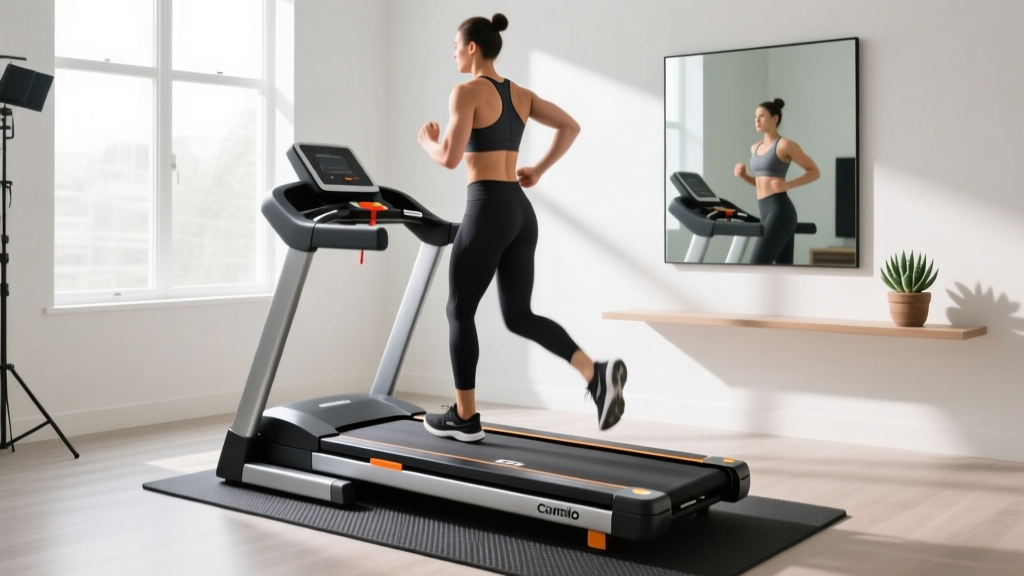
What Is a Good Incline to Walk on Treadmill? 2026 Folding Reviews
Discover what is a good incline to walk on treadmill and explore our 2026 market analysis of the best folding treadmills for small spaces.

The 2026 Market Shift: Incline Walking Meets Compact Living
The home fitness equipment market in 2026 is defined by a fascinating collision of two major consumer trends: the enduring popularity of high-incline, low-impact walking routines and the premium placed on compact, multi-use living spaces. Urban dwellers, apartment renters, and home-office workers are no longer satisfied with flat, motorized walking pads. They want the metabolic benefits of steep incline walking without sacrificing half their living room to a massive, non-folding commercial treadmill.
Historically, folding treadmills were relegated to budget-friendly, flat-deck jogging. The structural hinges and lightweight motors simply could not handle the gravitational stress and torque required for sustained 12% to 15% incline walking. However, recent advancements in dual-piston hydraulic lifting arms and high-torque continuous horsepower (CHP) motors have birthed a new category: the compact incline walker. In this trend report and market analysis, we break down the biomechanics of incline walking, the engineering constraints of folding mechanisms, and review the top folding treadmills for small spaces in 2026.
What Is a Good Incline to Walk on Treadmill?
When users ask us, 'what is a good incline to walk on treadmill,' the answer depends entirely on their specific biomechanical goals and joint health. According to the American Council on Exercise (ACE), manipulating the treadmill grade is one of the most effective ways to increase caloric expenditure without increasing the high-impact ground reaction forces associated with running.
The Three Tiers of Treadmill Incline
- The Outdoor Simulation Grade (1% to 2%): Walking or running on a completely flat treadmill (0%) is actually easier than walking outside because you lack wind resistance and minor terrain variations. Setting the incline to 1% or 2% accurately simulates the energy cost of outdoor walking on level ground.
- The Posterior Chain Activator (5% to 9%): At this moderate grade, the biomechanical load begins to shift away from the quadriceps and onto the hamstrings, glutes, and calves. This is an excellent zone for active recovery days or moderate cardiovascular conditioning without spiking the heart rate into anaerobic thresholds.
- The Metabolic Power Zone (10% to 15%): This is the grade popularized by viral fitness trends (like the 12-3-30 method). A study published by the National Center for Biotechnology Information (NCBI) demonstrates that walking at a 12% incline increases the metabolic cost and caloric burn by roughly 60% to 70% compared to level walking at the exact same speed. It heavily targets the gluteus maximus and gastrocnemius while keeping joint impact remarkably low.
Engineering Constraints: Folding Hinges vs. Incline Stress
Designing a folding treadmill that can safely reach a 12% incline presents a unique engineering challenge. When a treadmill deck is elevated, the user's center of mass shifts backward. This places immense shearing force on the folding hinge and the pneumatic or hydraulic cylinders responsible for holding the deck upright during use.
In budget models from the early 2020s, this backward shift often caused the deck to flex or the single-piston lift to buckle, creating a dangerous 'sinking' sensation mid-walk. The 2026 generation of premium folding treadmills solves this by utilizing reinforced steel crossbars and dual-hydraulic pistons that lock into place. Furthermore, incline walking requires high torque at low speeds. A motor rated at 2.0 Peak HP will quickly overheat and trip its thermal breaker when asked to push a 170 lb user up a 12% grade at 3.0 mph for 30 minutes. Therefore, a minimum of 2.5 Continuous Horsepower (CHP) is mandatory for safe, sustained incline walking.
2026 Folding Treadmill Review: Top Models for Incline Walkers
Based on our market analysis of compact cardio equipment, here are the top folding treadmills that successfully bridge the gap between small-space living and high-grade incline walking.
1. Horizon Fitness T202: The 12% Incline Standard
The Horizon T202 remains a dominant force in the 2026 compact market. It features a robust 2.75 CHP motor, which is exceptionally rare in the sub-$1,000 folding category. This motor provides the necessary torque to sustain a 12% maximum incline without thermal throttling. The 60-inch by 20-inch deck is crucial; when walking on a steep incline, your stride naturally shortens and your foot strikes closer to the rear of the belt. The 60-inch length ensures you won't accidentally step off the back of the deck. When folded via its hydraulic SoftDrop system, it occupies a footprint of just 34 x 34 inches, making it ideal for apartment corners.
2026 Market Price: ~$799
2. ProForm Carbon TL: The Budget-Friendly Compact
For users with stricter spatial and financial constraints, the ProForm Carbon TL offers a compelling alternative. It maxes out at a 10% incline, which still provides significant metabolic benefits over flat walking. The 2.6 CHP motor is adequate for users under 200 lbs walking at speeds up to 3.5 mph on an incline. The primary compromise here is the 55-inch deck length. While acceptable for walking, taller users (over 6'0") may find the deck slightly restrictive when the incline shifts their center of gravity backward. Its folding mechanism is manual but assisted by a torsion spring, reducing the folded depth to an impressive 32 inches.
2026 Market Price: ~$599
3. Sunny Health & Fitness SF-T723016: Ultra-Small Footprint Warning
Sunny Health dominates the ultra-budget, small-space market, and the SF-T723016 is their flagship incline folder. It advertises a 12% incline and a remarkably small folded footprint. However, from an engineering and E-E-A-T perspective, we must issue a caveat. The motor is rated at 2.0 Peak HP (not CHP), meaning it will struggle with sustained incline sessions for users over 160 lbs. Furthermore, the deck is only 49 inches long. At a 12% incline, the backward shift in gravity makes a 49-inch deck a potential safety hazard for users who lose focus and drift backward. It is best suited for short, 15-minute interval sessions rather than 45-minute endurance walks.
2026 Market Price: ~$320
Comparison Matrix: 2026 Compact Incline Treadmills
| Model | Max Incline | Motor (CHP) | Deck Length | Folded Depth |
|---|---|---|---|---|
| Horizon T202 | 12% | 2.75 CHP | 60 inches | 34 inches |
| ProForm Carbon TL | 10% | 2.6 CHP | 55 inches | 32 inches |
| Sunny SF-T723016 | 12% | ~1.5 CHP* | 49 inches | 28 inches |
*Note: Sunny Health advertises Peak HP; real-world continuous output is estimated lower, making it unsuitable for heavy, sustained incline use.
Buyer’s Framework: Evaluating Small-Space Incline Models
If you are shopping for a folding treadmill specifically for incline walking in a small apartment or home office in 2026, use this three-step evaluation framework to avoid costly mistakes:
- Verify Continuous Horsepower (CHP): Ignore 'Peak HP' marketing. Incline walking at low speeds generates massive heat in the motor windings. If the spec sheet does not explicitly state 'CHP' and list a number above 2.5, the machine will eventually fail under the stress of a 12% grade.
- Measure the 'Incline Drift' Clearance: When a treadmill reaches a 12% incline, the rear of the deck raises significantly. Ensure you have at least 75 inches of vertical clearance at the rear hinge point, and that no baseboards or wall outlets will interfere with the folding mechanism when the deck is fully elevated.
- The 55-Inch Deck Rule: Never purchase a treadmill with a deck shorter than 55 inches for incline walking. As the grade increases, your body naturally leans back, and your foot strike moves rearward. A 49-inch deck leaves zero margin for error, increasing the risk of stepping off the back of the belt and damaging the motor housing.
Final Market Verdict
The 2026 cardio market has finally caught up to consumer demand. You no longer need to dedicate an entire spare bedroom to a commercial-grade treadmill to reap the immense cardiovascular and muscular benefits of steep incline walking. By understanding the biomechanics of the grade and respecting the engineering limits of folding hinges and motors, small-space dwellers can safely integrate high-incline walking into their daily routines. For the best balance of spatial efficiency, motor reliability, and biomechanical safety, models with a true 2.5+ CHP motor and a 60-inch deck, like the Horizon T202, represent the smartest long-term investment for the modern home gym.
More gear to consider
All reviews
Rowing Guide: Beating Treadmills That Don't Require a Subscription

Rowing Technique & Buying Guide: Rower vs ProForm T10 Treadmill

2026 Under Desk Treadmills vs NordicTrack Treadmill Owners Manual

Sunny Health Treadmill SF-T7515 vs Walking Pads: A Beginner's Guide

Self Run Treadmill vs Motorized: Complete Setup Walkthrough
