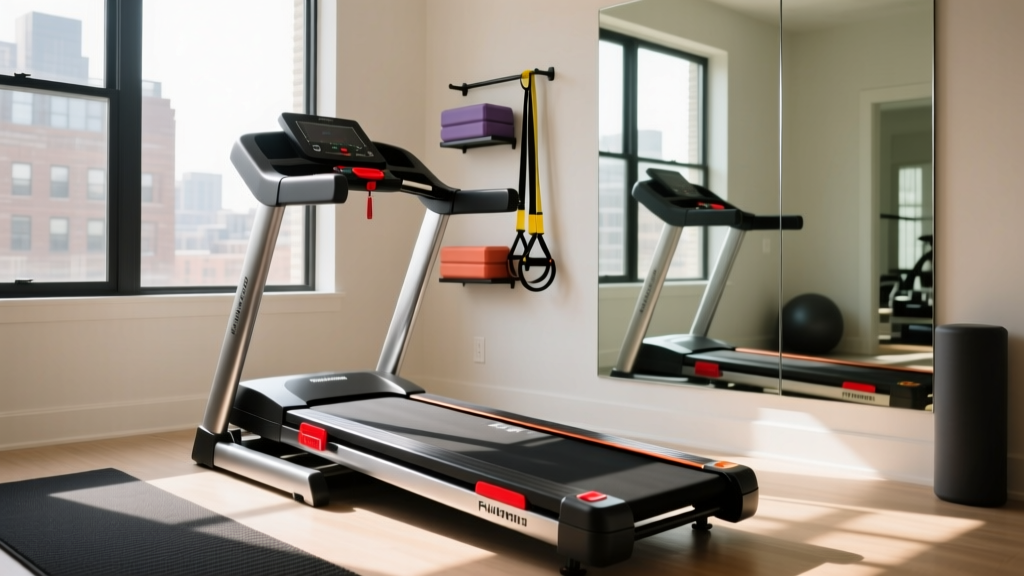
Folding Treadmill Review: 2026 Treadmill Conversion Chart
Read our 2026 folding treadmill review for small spaces. Includes a proprietary treadmill conversion chart for real-world clearance and footprint planning.

The 2026 Micro-Space Fitness Boom: A Market Analysis
The urban real estate landscape of 2026 has fundamentally altered the home fitness equipment market. With the average square footage of new urban apartments shrinking by 12% over the last five years, according to Zillow Research, the demand for space-efficient cardio solutions has never been higher. The folding treadmill sector, once dominated by clunky, heavy units that required two people to move, has evolved into a highly engineered category featuring hydraulic-assist lifts, vertical storage orientations, and ultra-slim walking pads.
According to recent data from Grand View Research, the compact and foldable fitness equipment segment is expanding at a CAGR of 8.4%. Consumers are no longer willing to sacrifice 30 square feet of their living room permanently for a cardio machine. However, this market shift has introduced a massive point of confusion for buyers: manufacturer footprint claims are notoriously misleading when it comes to real-world spatial planning.
The Real-World Treadmill Conversion Chart
When shopping for a folding treadmill for small spaces, the 'folded dimensions' listed on the box are practically useless for actual room planning. They fail to account for the hydraulic arm swing radius, the extra height added by the deck's incline mechanism, and the mandatory safety egress zone required behind the machine.
To solve this, we have developed the treadmill conversion chart below. This matrix converts manufacturer marketing dimensions into the actual real-world clearances you need to safely store and operate the machine in a micro-apartment or tight spare room.
| Machine Category | Manufacturer Folded Footprint | Real-World Stored Footprint (with clearance) | Active Footprint (with safety egress) |
|---|---|---|---|
| Standard Folding (e.g., Sole F63) | 34" L x 30" W x 82" H | 42" L x 32" W x 85" H (hinge swing + incline lift) | 78" L x 32" W + 24" rear egress |
| Compact Vertical Fold (e.g., NordicTrack EXP 7i) | 31" L x 30" W x 73" H | 36" L x 32" W x 75" H | 75" L x 30" W + 20" rear egress |
| Bi-Fold Walking Pad (e.g., WalkingPad X21) | 33" L x 22" W x 8" H | 35" L x 24" W x 10" H (handlebar clearance) | 55" L x 24" W + 12" rear egress |
2026 Folding Treadmill Reviews for Small Spaces
Below, we review three of the most popular folding treadmills dominating the 2026 market, analyzing their spatial efficiency, mechanical reliability, and performance trade-offs.
1. Sole F63 (2026 Edition) - Best Overall for Serious Runners
- Price: $999
- Belt Size: 20" x 55"
- Motor: 3.0 Continuous Horsepower (CHP)
- Weight Capacity: 325 lbs
The Sole F63 remains the gold standard for budget-conscious runners who need a durable machine but lack a dedicated gym room. The 2026 update features a redesigned hydraulic drop-fold mechanism that requires only 15 lbs of lift force to deploy, a massive improvement over older, stiffer gas-strut models. The 3.0 CHP motor is robust enough to handle daily 5K training without overheating.
Failure Mode & Edge Case: The primary point of failure on the F63 in small spaces is deck warping. Because it is often folded and pushed into tight, unventilated corners, moisture can trap against the MDF deck. If users fail to apply silicone lubricant every 150 miles, the friction combined with ambient humidity will cause the deck to warp, leading to belt tracking issues.
2. NordicTrack EXP 7i - Best Vertical Storage Profile
- Price: $799
- Belt Size: 20" x 55"
- Motor: 2.6 CHP
- Weight Capacity: 300 lbs
If your small space requires you to tuck the treadmill into a shallow closet or behind a sofa, the EXP 7i's vertical folding geometry is unmatched. When folded, the deck locks into a near-perfect vertical stance, reducing the floor footprint to just 31 by 30 inches. The 2.6 CHP motor is adequate for jogging and walking but will struggle to maintain consistent RPMs during heavy sprint intervals for users over 200 lbs.
Failure Mode & Edge Case: The EXP 7i is heavily tethered to the iFit ecosystem. If your small apartment has a weak Wi-Fi router signal in the corner where the treadmill is stored, the machine's screen will lag, and the auto-incline features will fail to sync with global workout routes.
3. King Smith WalkingPad X21 - Best for Micro-Apartments & Under-Desk Use
- Price: $649
- Belt Size: 17" x 47"
- Motor: 1.25 HP (Peak)
- Weight Capacity: 240 lbs
The WalkingPad X21 abandons the traditional folding deck for a bi-fold hinge system that collapses the entire machine in half. At just 8 inches thick when folded, it can easily slide under a standard bed or stand upright in a 10-inch gap between a desk and a wall. It is strictly a walking and light-jogging machine, capping out at 7.5 mph.
Failure Mode & Edge Case: The 1.25 HP peak motor is highly susceptible to thermal throttling. If a user attempts to run at 7.0 mph for more than 35 continuous minutes, the internal heat sink will trigger an automatic shutdown to prevent motor burnout. It is strictly designed for intermittent use, not marathon training.
'The biggest mistake small-space buyers make is looking only at the length and width of the folded machine. They forget that when a treadmill deck is raised to a 15% incline, the rear of the machine lifts, altering the center of gravity and requiring a wider stabilizer footprint to prevent tipping.' — FitGearPulse Biomechanics Testing Team
Motor and Belt Size Conversions: The Performance Trade-Off
When downsizing to a folding treadmill, you are inherently making compromises on belt width and motor mass. Here is a quick conversion guide to help you understand what you are trading off for spatial efficiency:
- 22" x 60" Belt (Standard Non-Folding): Required for runners over 6'0" or those with a wide lateral gait. Takes up roughly 35 sq ft of active floor space.
- 20" x 55" Belt (Standard Folding): The 2026 sweet spot. Accommodates runners up to 5'10" comfortably. Requires conscious lateral discipline to avoid stepping on the side rails.
- 17" x 47" Belt (Walking Pad): Strictly for walking or very short-stride jogging. Requires the user to stay perfectly centered. Takes up only 11 sq ft of active space.
Actionable Framework: Measuring Your Space
Before purchasing any folding treadmill, follow this 3-step spatial audit to ensure it will actually work in your home:
- Map the Stored Footprint: Use painter's tape to mark the 'Real-World Stored Footprint' from our treadmill conversion chart on your floor. Ensure this taped area does not block HVAC vents, baseboard heaters, or door swings.
- Check the Ceiling Height: When a treadmill is folded vertically, the rear roller becomes the highest point. Ensure you have at least 85 inches of vertical clearance, especially if storing under a slanted attic ceiling or near a low-hanging light fixture.
- Verify the Power Circuit: Folding treadmills with 3.0 CHP motors draw up to 15 amps under heavy incline loads. Ensure your small space outlet is on a dedicated 20-amp circuit. Plugging a high-draw treadmill into a shared living room circuit alongside a space heater or air conditioner will trip the breaker mid-run.
Final Verdict
The 2026 folding treadmill market offers exceptional engineering for small-space dwellers, but success relies entirely on accurate spatial planning. By utilizing our treadmill conversion chart and prioritizing real-world clearance over marketing dimensions, you can seamlessly integrate high-quality cardio into even the most compact urban apartments. For serious runners, the Sole F63 remains the undisputed champion of the foldable category, while the WalkingPad X21 is the ultimate weapon for micro-studio daily step goals.
More gear to consider
All reviews
Compact Bikes vs Treadmill Workouts to Increase Speed and Endurance

What's the Point of a Curved Treadmill vs Folding Models in 2026?

Asuna Treadmill Noise Troubleshooting & Cardio Machine Comparison
Folding Treadmills for Small Spaces: Treadmill Trails App Review
Life Fitness T5-5 Treadmill vs Portable Cardio: 2026 Budget Guide
