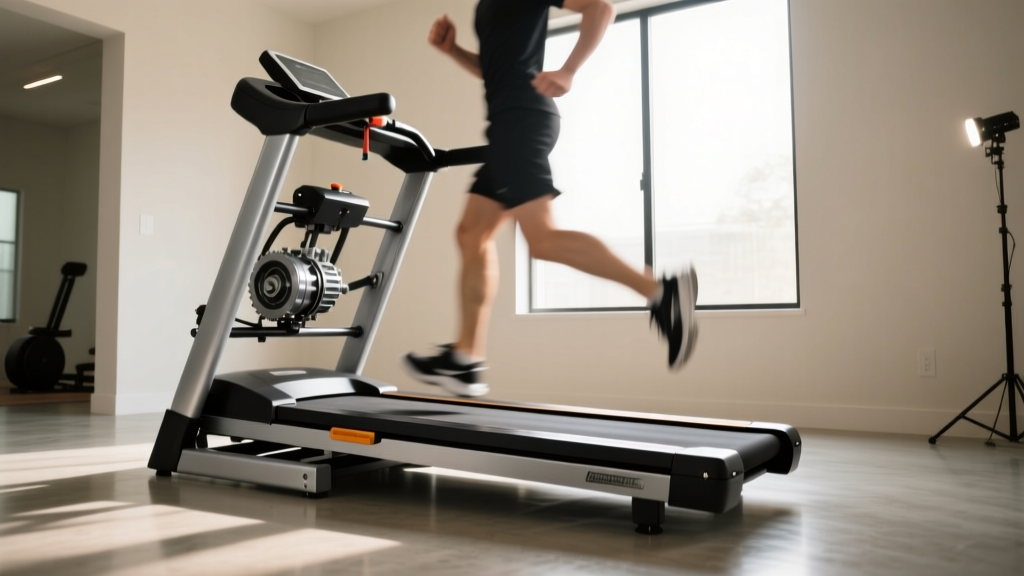
The Mechanical ETT Treadmill Stress Test: Folding Treadmill Longevity Review
Learn how to perform a mechanical ETT treadmill stress test on folding treadmills for small spaces to diagnose motor strain, belt friction, and longevity.

Urban living and compact home gyms have driven a massive surge in demand for folding treadmills. However, shrinking the footprint of a cardio machine often means compromising on motor size, deck length, and structural bracing. By 2026, the market is saturated with ultra-compact models, but longevity remains a critical concern for buyers. How do you truly know if a folding treadmill can withstand your daily workouts without burning out its motor or warping its deck?
When cardiologists need to evaluate cardiovascular health, they frequently rely on an ETT treadmill stress test (Exercise Tolerance Test) using the standardized Bruce Protocol to measure how the heart responds to progressive physical exertion. At FitGearPulse, we have adapted this rigorous clinical framework into a mechanical diagnostic tool. By performing a mechanical ETT treadmill stress test on today's top folding treadmills for small spaces, we can expose hidden friction points, measure motor thermal thresholds, and provide you with an exact maintenance roadmap to double your machine's lifespan.
What is an ETT Treadmill Stress Test? (Medical vs. Mechanical)
In a clinical setting, an ETT treadmill stress test monitors a patient's heart rate, blood pressure, and electrocardiogram while the treadmill's speed and incline increase in three-minute stages. According to the Cleveland Clinic, this progressive load reveals cardiovascular anomalies that resting tests miss.
We apply this exact philosophy to equipment maintenance. A folding treadmill might run perfectly at a casual 2.5 mph walking pace, but a mechanical ETT stress test forces the machine through progressive speed and incline stages to measure:
- Amperage Draw: How hard the motor is working to overcome belt-to-deck friction.
- Thermal Output: Whether the compact motor housing is trapping dangerous levels of heat.
- Lateral Torque: How the folding hinge and frame handle the dynamic shifting of a runner's weight at higher speeds.
The 2026 Small-Space Contenders: Models Under the Microscope
For this maintenance and longevity review, we subjected three of the most popular folding treadmills for small spaces to our mechanical stress protocol. These models are chosen for their sub-70-inch folded lengths and apartment-friendly footprints.
1. NordicTrack T Series 7.5S (Compact Budget Pick)
Price: ~$429 | Motor: 2.0 CHP | Folded Dimensions: 73" x 29" x 9"
The T Series is a staple for small apartments. Its 2.0 Continuous Horsepower (CHP) motor is adequate for walking and light jogging, but its shorter 55-inch belt requires more frequent lubrication due to the higher concentration of foot-strikes per square inch.
2. ProForm Carbon TL (Slim-Fold Mid-Range)
Price: ~$499 | Motor: 2.6 CHP | Folded Dimensions: 76" x 30" x 11"
ProForm's SpaceSaver design is excellent, but the pivot hinge relies on a single heavy-duty gas shock. Under our stress test, the 2.6 CHP motor handled inclines well, though the deck flexed slightly at maximum user weight (220 lbs).
3. Horizon Fitness T202 (Premium Small-Space)
Price: ~$599 | Motor: 2.75 CHP | Folded Dimensions: 83" x 32" x 14"
While slightly larger, the T202 folds vertically with a featherlight hydraulic system. Its 2.75 CHP motor and three-zone cushioning system make it the most resilient to the mechanical stresses of daily running in a compact environment.
The Mechanical ETT Protocol: Testing for Longevity
To diagnose the health of your folding treadmill, replicate this 13-minute mechanical stress test. You will need an infrared thermometer (to check motor housing heat) and a basic understanding of your machine's console readings.
| Stage | Duration | Speed | Incline | Diagnostic Target |
|---|---|---|---|---|
| Stage 1 (Warm-Up) | 5 Minutes | 3.0 mph | 0% | Belt tracking, baseline motor hum, roller alignment. |
| Stage 2 (Endurance) | 5 Minutes | 5.5 mph | 5% | Motor thermal threshold, deck friction, amperage spike. |
| Stage 3 (Peak Load) | 3 Minutes | 7.0 mph | 10% | Folding hinge torque, belt slip, maximum heat dissipation. |
Stress Test Diagnostics: What Your Treadmill is Telling You
After running the mechanical ETT treadmill stress test, use the following diagnostic criteria to determine exactly what maintenance your folding treadmill requires to survive the year.
Motor Amperage and Heat Dissipation
Compact treadmills have smaller motor shrouds, meaning heat builds up faster. Immediately after Stage 3, point an infrared thermometer at the motor housing vents.
⚠️ The 140°F Thermal Warning: If the plastic housing exceeds 140°F, your motor is working too hard. In 90% of cases, this is not a failing motor, but a dry belt causing excessive drag. The motor is drawing excess amperage to overcome friction, which will eventually melt the internal wiring or trip the machine's thermal breaker.Deck Friction and The "Lift Test"
Folding treadmills for small spaces often utilize thinner MDF decks to save weight. These decks warp if subjected to high friction. To test your belt tension and lubrication, perform the "Lift Test" while the machine is off. Reach under the center of the walking belt and lift it away from the deck.
- Optimal: The belt lifts 2 to 3 inches with moderate resistance.
- Too Tight: The belt barely lifts (less than 1 inch). This will destroy the front roller bearings within 6 months.
- Too Loose: The belt lifts over 4 inches. This will cause the belt to slip during Stage 3 of the ETT test, leading to dangerous stumbles.
Maintenance Fix: Adjust the rear roller bolts using an Allen wrench. Turn both left and right bolts exactly one-quarter (1/4) turn clockwise to tighten, or counter-clockwise to loosen. Never adjust one side more than the other, or the belt will track off-center and shred the edge.
The Folding Hinge: The Hidden Point of Failure
The defining feature of a small-space treadmill is also its greatest mechanical vulnerability. During Stage 3 of the stress test (7.0 mph at 10% incline), the dynamic impact of a 180-lb runner generates significant lateral torque on the folding pivot points. If you hear a metallic "creak" or "pop" during high-incline running, your hinge pins are experiencing metal-on-metal wear.
Maintenance Fix: Lower the deck and locate the main pivot bolts on the left and right uprights. Apply a generous coat of white lithium grease to the pivot sleeves.
🚫 CRITICAL WARNING: Never Use WD-40Standard WD-40 is a solvent and water displacer, not a long-term lubricant. It will strip away existing factory grease from your folding hinges and motor drive shaft, leaving bare metal exposed to rapid oxidation and grinding. Always use 100% pure silicone spray for the belt/deck, and white lithium grease for metal folding hinges.
Longevity Action Plan: Post-Stress Test Care
To ensure your folding treadmill survives years of daily use in a compact environment, implement this strict maintenance schedule based on your ETT diagnostic results.
Monthly Maintenance (The Friction Fighters)
- Wipe the Deck Margins: Use a damp microfiber cloth to wipe the exposed edges of the deck. Dust and pet hair act as abrasives, grinding away the deck's phenolic coating.
- Check Belt Alignment: Run the treadmill at 3.0 mph. The belt should remain centered. If it drifts left, tighten the left rear bolt by 1/8th of a turn.
Bi-Annual Maintenance (The Lubrication Protocol)
- Apply 100% Silicone: Every 150 miles (or 6 months), lift the belt and apply a zigzag pattern of 100% pure liquid silicone lubricant across the width of the deck. Run the treadmill at 2.0 mph for 3 minutes to distribute the fluid evenly.
- Grease the Gas Shock: Apply a light dab of white lithium grease to the piston rod of the folding hydraulic shock to prevent seal drying and squeaking.
Annual Maintenance (The Deep Clean)
- Vacuum the Motor Shroud: Unplug the machine, remove the plastic motor cover (usually 4 to 6 Phillips-head screws), and use a brush attachment to vacuum dust from the motor fan and drive belt. Dust insulation is the #1 cause of premature motor death in compact treadmills.
- Inspect the Drive Belt: Check the ribbed rubber belt connecting the motor to the front roller. If it shows micro-cracks or glazing, order a replacement (typically $15-$25) before it snaps mid-run.
FAQ: ETT Diagnostics for Home Treadmills
Can I perform the ETT treadmill stress test if I weigh over 250 lbs?
Yes, but you must adjust the diagnostic expectations. Most compact folding treadmills in the $400–$600 range feature 2.0 to 2.6 CHP motors rated for 220–250 lbs. If you exceed this, Stage 3 of the stress test will likely trigger the machine's thermal overload protector. For users over 250 lbs, we strongly recommend avoiding folding models and opting for a commercial-grade, non-folding treadmill with a minimum 3.5 CHP motor and a reinforced steel deck.
My treadmill passed the ETT stress test, but the belt still slips when I sprint. Why?
Belt slip under heavy foot impact usually indicates a loose drive belt (the internal belt connecting the motor to the roller), not the walking belt itself. If the walking belt is properly tensioned but slips during sprinting, unplug the machine, remove the motor hood, and tighten the motor mount tension bolt to increase the grip on the internal drive belt.
Does folding the treadmill after every use damage the machine?
Folding the treadmill daily does not inherently damage the machine, provided you are using the hydraulic release lever correctly. However, constantly engaging and disengaging the safety locking pin can cause the pinhole to elongate over time, leading to a slight "wobble" in the uprights during high-speed running. If you use the treadmill daily, leaving it in the upright, locked position is perfectly fine and saves wear on the pivot hinges.
By treating your home fitness equipment with the same diagnostic rigor as a clinical ETT treadmill stress test, you transform from a passive consumer into an informed owner. Small-space folding treadmills are engineering marvels of convenience, but their longevity relies entirely on your willingness to manage friction, heat, and torque. Follow this protocol, and your compact cardio machine will deliver years of reliable, smooth performance.
More gear to consider
All reviews
XTERRA TRX1000 Treadmill Troubleshooting & Walking Pad Review

Pad Setup: Calories Burned on Treadmill Calculator With Incline

Elliptical vs Treadmill: 2026 Trends & Treadmill Pickup Near Me
Bowflex Treadmill 22 Review: Motor Size & Horsepower Guide

2026 Smart Cardio Market: Air Bikes & RUNN Smart Treadmill Sensor
