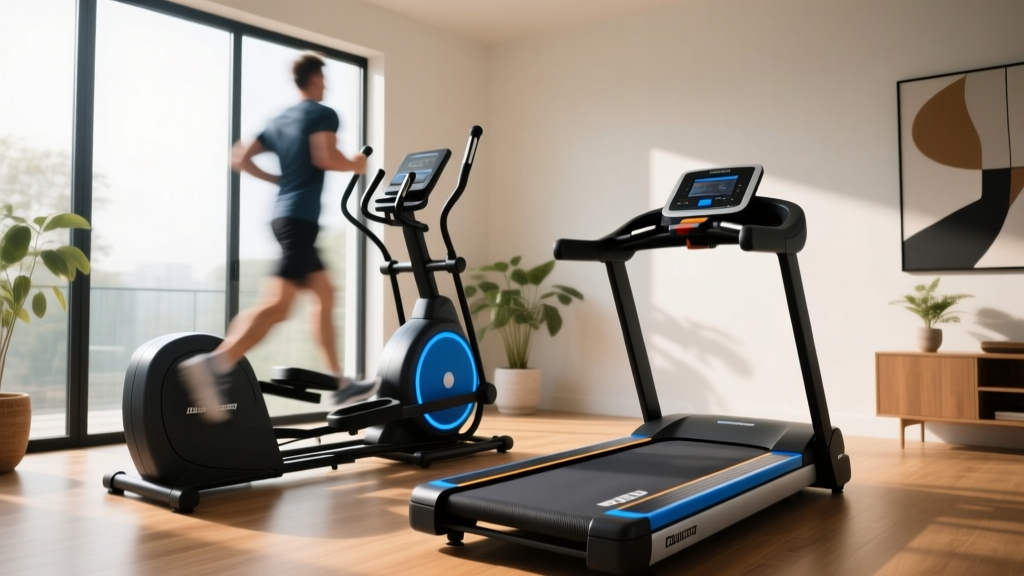
Elliptical vs Treadmill: Is Walking In Place The Same As A Treadmill?
Discover if walking in place matches a treadmill. We break down the elliptical vs treadmill budget, hidden costs, and long-term home gym value.

The Core Question: Is Walking in Place the Same as a Treadmill?
When outfitting a home gym on a budget, many buyers explore low-cost alternatives and ask a fundamental question: is walking in place the same as a treadmill? From a strict biomechanical and physiological standpoint, the answer is no.
When you walk in place—or use a budget $150 under-desk walking pad—you are primarily engaging your hip flexors and quadriceps to lift your legs against gravity. A motorized treadmill belt, however, actively pulls your foot backward. This forces your posterior chain (hamstrings, glutes, and calves) to engage for propulsion and stabilization. While walking in place can elevate your heart rate enough to meet the CDC's physical activity guidelines for moderate-intensity cardio, it fundamentally lacks the posterior chain activation, stride extension, and overall caloric expenditure of a full treadmill stride.
This brings us to the ultimate home gym debate: Elliptical vs. Treadmill. If walking in place falls short of a true treadmill experience, does an elliptical bridge the gap? More importantly, how do these two cardio titans compare when we break down the real-world costs, hidden fees, and long-term value in 2026?
Elliptical vs. Treadmill: The 2026 Home Gym Budget Breakdown
Sticker price is only the entry fee to home cardio ownership. To determine true value, we must analyze the Total Cost of Ownership (TCO) over a standard 5-year lifecycle. Below is a comparative matrix of current market leaders and their associated hidden costs.
| Cost Factor | Treadmill (e.g., Sole F80 / NordicTrack 1750) | Elliptical (e.g., Sole E35 / Bowflex Max M9) |
|---|---|---|
| Upfront Cost (Mid-Tier) | $1,199 - $1,499 | $1,099 - $1,399 |
| Upfront Cost (Premium) | $2,499 - $3,299 | $1,999 - $2,499 |
| Mandatory Subscriptions | Often $396/yr (iFIT) for full functionality | Rarely mandatory; mostly optional app integrations |
| 5-Year Maintenance | $150 - $250 (Deck lube, belt replacement) | $50 - $80 (Pivot bearing grease, pedal straps) |
| Annual Energy Cost | $45 - $75 (600W+ draw under load) | $10 - $15 (<50W draw for console only) |
| Resale Value (Year 5) | 15% - 25% of retail (High depreciation) | 25% - 35% of retail (Moderate depreciation) |
Treadmill Value Analysis: Where Your Money Goes
Treadmills are mechanical beasts. When you purchase a mid-tier workhorse like the Sole F80 ($1,199), you are paying for a 3.5 CHP (Continuous Horsepower) motor and a heavy-duty steel frame designed to absorb the repetitive impact of a 200-pound runner. However, the value proposition of a treadmill is heavily tied to its moving parts.
The Subscription Trap
⚠️ Warning: The Hardware-as-a-Service ModelIn 2026, premium treadmills like the NordicTrack Commercial 1750 ($2,499) feature massive 14-inch HD touchscreens. However, these screens are largely gated behind a $396/year iFIT subscription. If you cancel the subscription, the machine reverts to manual mode, disabling auto-incline and interactive mapping. When calculating your 5-year budget, a premium smart treadmill actually costs closer to $4,479 when factoring in the mandatory software fees.
Common Failure Modes and Maintenance
According to reliability data tracked by organizations like Consumer Reports, treadmills have the highest failure rate among home cardio equipment. The primary culprits include:
- Drive Motor Burnout: If a 220-lb user consistently runs on a treadmill with a motor smaller than 3.0 CHP, the motor controller will overheat and fail within 18 to 24 months.
- Deck Delamination: The wooden deck beneath the belt requires silicone wax lubrication every 150 miles. Neglecting this causes friction, which draws excess amperage and eventually strips the drive belt.
- Incline Motor Gear Stripping: The plastic gears inside the incline lift mechanism are notorious for snapping if the machine is frequently subjected to sudden, heavy weight shifts at maximum incline.
Elliptical Value Analysis: The Low-Impact ROI
If walking in place lacks posterior chain engagement, the elliptical solves this problem by forcing a full, guided stride extension. The American Heart Association notes that maintaining cardiovascular health requires sustained, elevated heart rates—something an elliptical facilitates brilliantly without the ground-reaction forces of a treadmill.
Mechanical Simplicity vs. Joint Preservation
Take the Sole E35 Elliptical ($1,099). It features a 25-pound flywheel and an eddy-current magnetic resistance system. Unlike a treadmill, there is no motor driving your feet; you are the motor. The magnetic brake simply applies resistance to the flywheel. This mechanical simplicity translates directly to budget value:
Pro-Tip on Flywheel Weight: Never buy an elliptical with a flywheel under 18 pounds. A lighter flywheel lacks the inertia required for a smooth stride, resulting in a 'choppy' motion that places undue shear stress on your knee joints and accelerates wear on the machine's pivot bearings.
Common Failure Modes
While ellipticals are generally more reliable than treadmills, they are not immune to wear. The most common budget-draining failures include:
- Pivot Arm Bearings: The joints connecting the stride arms to the flywheel endure massive lateral torque. If dust and pet hair infiltrate these sealed bearings, they will seize, requiring a $120 parts kit and significant labor to replace.
- Console Potentiometer Failure: The sensor that reads your RPMs and translates it to the LCD screen can lose calibration over time, causing erratic wattage readings.
Hidden Costs: Energy, Space, and Biomechanics
When deciding between an elliptical and a treadmill, the physical footprint and electrical draw are critical budget factors often overlooked in the showroom.
The Electrical Bill
A treadmill under a moderate running load draws between 600 and 700 watts. If you run for 45 minutes a day, five days a week, you are consuming roughly 130 kWh per year. At the 2026 national average of $0.16 per kWh, that is about $21 annually just in electricity. Conversely, an elliptical's magnetic resistance is entirely user-powered. The only electricity used is for the LCD console and Bluetooth receiver, drawing less than 50 watts. Over five years, the treadmill will cost you roughly $100 more in raw energy.
The Spatial Budget
Treadmills require a minimum footprint of 32 square feet, plus an additional 3 feet of clearance behind the deck for safety fall-offs. Ellipticals, particularly front-drive models, have a more compact footprint and do not require rear clearance. If you are paying $2.50 per square foot in urban rent or mortgage space costs, dedicating 50 square feet to a treadmill is a significantly higher spatial investment than a 25-square-foot elliptical footprint.
The Final Verdict: Which Machine Wins the Value War?
So, is walking in place the same as a treadmill? No. But is an elliptical a superior financial and biomechanical investment for the average home gym user? In most cases, yes.
✅ The FitGearPulse Decision Framework- Buy a Treadmill If: You are training for outdoor running events (5K to Marathon), you prioritize bone-density loading (impact is necessary for osteogenesis), and you have a budget exceeding $1,500 to afford a 3.5+ CHP motor that won't burn out.
- Buy an Elliptical If: You want maximum caloric burn with zero joint impact, you want to avoid mandatory $400/year software subscriptions, you have a history of knee or lower back pain, and you want a machine with a 5-year maintenance cost under $100.
Ultimately, the elliptical offers a higher long-term ROI for the general fitness consumer. It bridges the biomechanical gaps left by 'walking in place' alternatives, avoids the steep maintenance and subscription traps of modern smart treadmills, and provides a sustainable, low-impact path to cardiovascular health for decades to come.
More gear to consider
All reviews
Curved vs Motorized Treadmills: How to Connect Apple Watch to Matrix

Centr Runr Folding Treadmill: 2026 Feature Comparison Guide

Planet Fitness Treadmill Brand Belt Maintenance & Lubrication Guide

Rowing Machine Buying Guide & Technique: Beyond Treadmill Installation

Slave Treadmill Desk Layouts: Space Optimization Guide
