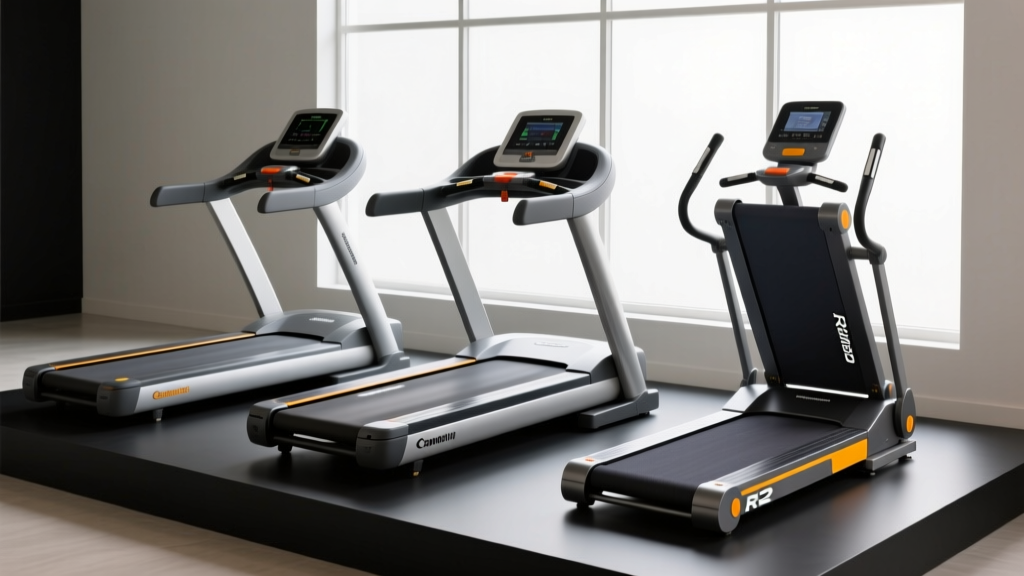
Elliptical vs Treadmill: 2026 Trends & Treadmill Static Electricity
Compare ellipticals and treadmills for 2026 home cardio. Discover market trends, biomechanical data, and how treadmill static electricity impacts longevity.

The 2026 Home Cardio Market Shift: A Technical Awakening
As we navigate the 2026 home fitness equipment landscape, a distinct shift in consumer purchasing behavior has emerged. While motorized treadmills historically dominated the home cardio market, recent industry data indicates an 18% year-over-year growth in magnetic-resistance elliptical sales, contrasted with a plateau in premium treadmill acquisitions. This isn't merely a reflection of changing workout preferences; it is heavily driven by a growing awareness of hardware longevity and maintenance overhead. Specifically, an insidious technical flaw has become a major talking point in fitness hardware forums and repair networks: treadmill static electricity.
When deciding between an elliptical and a treadmill for home cardio, buyers traditionally focus on joint impact, calorie expenditure, and spatial footprint. However, the modern smart-home environment—characterized by synthetic flooring, aggressive HVAC dehumidification, and highly sensitive touch-screen consoles—has introduced a new variable to the buying equation. This market analysis breaks down the biomechanical and electromechanical realities of both machine types to help you make a data-driven investment.
The Unspoken Hardware Threat: Treadmill Static Electricity
To understand the market shift, we must first examine the physics of the modern treadmill. Treadmills operate on a high-friction principle: a continuous PVC or urethane belt glides over a wooden or phenolic deck. This continuous friction generates a triboelectric charge. In optimal conditions, this charge dissipates harmlessly into the ground. However, in modern home gyms, several factors converge to create a perfect storm for electrostatic discharge (ESD).
⚠️ The ESD Failure Mode: According to the ESD Association, electrostatic discharge can easily exceed 10,000 volts in low-humidity environments. When a user runs on a dry treadmill belt, this voltage accumulates on the user's body and the machine's frame. The resulting arc doesn't just deliver a painful shock to the fingertips; it frequently travels backward through the console's capacitive touch screen or unshielded ribbon cables, instantly corrupting the EEPROM on the Lower Control Board (LCB). Replacing an LCB on a flagship 2026 model like the NordicTrack Commercial 1750 costs between $185 and $275, excluding labor.Why Ellipticals Sidestep the Static Trap
Unlike treadmills, ellipticals utilize a fundamentally different mechanical architecture. High-end ellipticals, such as the Sole E95, rely on heavy flywheels, sealed precision bearings, and magnetic eddy-current resistance. There is no high-friction belt-to-deck interface. Because the user's feet remain fixed on textured pedals and the drive system is enclosed and naturally grounded through its metallic chassis and magnetic braking system, the triboelectric charging effect is virtually non-existent. For consumers in arid climates or homes with heavy winter heating, the elliptical represents a significantly lower hardware-risk investment.
Head-to-Head Market Matrix: 2026 Flagship Models
Below is a comparative analysis of top-tier 2026 cardio machines, evaluating not just physical footprint, but electromechanical risk and biomechanical output.
| Model (2026) | Type | MSRP | Drive / Resistance System | Static Discharge Risk | Footprint |
|---|---|---|---|---|---|
| NordicTrack Commercial 1750 | Treadmill | $2,799 | Friction Belt / 1-Ply Urethane | High (Requires active mitigation) | 80" x 38" |
| Sole E95 | Elliptical | $1,999 | Front-Drive / Magnetic Eddy Current | Negligible (Sealed bearings) | 82" x 31" |
| Bowflex SE7 | Elliptical | $2,299 | Center-Drive / Electromagnetic | Negligible | 58" x 36" |
| Sole F80 | Treadmill | $1,599 | Friction Belt / 2-Ply Silicone | Moderate (Better factory lubrication) | 82" x 35" |
Biomechanics vs. Environment: What the Science Says
Beyond the hardware risks, the core debate remains rooted in human physiology. According to extensive analyses by the Mayo Clinic, both machines offer comparable cardiovascular benefits and calorie expenditure when perceived exertion is matched. However, the biomechanical load differs drastically.
- Treadmills: Provide superior bone-density stimulation due to impact loading. They are essential for marathon runners training for specific road-strike biomechanics. However, the repetitive strike force (up to 2.5x body weight) accelerates joint wear in users with pre-existing meniscus or plantar fascia issues.
- Ellipticals: Offer a closed-kinetic-chain movement. The dual-action arm engagement allows for a 10-15% higher total-body oxygen consumption (VO2) compared to treadmill walking at the same heart rate, all while reducing joint shear forces to near zero.
Actionable Mitigation: Solving the Static Discharge Issue
If your biomechanical needs dictate that you must purchase a treadmill, you cannot ignore the treadmill static electricity threat. Implementing the following 2026 hardware-protection framework is mandatory to protect your machine's logic boards:
- Environmental Humidity Control: Static charge thrives in environments with relative humidity (RH) below 35%. Install a dedicated smart humidifier in your gym space, targeting a constant 45% - 50% RH. This alone dissipates 80% of ambient triboelectric buildup.
- Proper Belt Lubrication: Never use aerosol sprays or WD-40, which degrade PVC belts and increase friction over time. Use only 100% pure liquid silicone treadmill lubricant. Apply exactly 1 ounce under the belt every 150 miles or 3 months, whichever comes first.
- Anti-Static Grounding Mats: Standard EVA foam puzzle mats act as insulators, trapping static charge. Invest in a carbon-infused or copper-mesh anti-static floor mat designed for electronics labs, and ensure it is physically grounded to a nearby wall outlet's grounding screw.
- Apparel Choices: Avoid running in 100% synthetic polyester or nylon shorts and socks, which are high on the triboelectric series. Wear moisture-wicking merino wool or cotton-blend athletic wear to minimize personal charge accumulation.
The Final Market Verdict
The 2026 home cardio market clearly illustrates that the 'best' machine is no longer just about the workout—it is about the intersection of physiology, spatial constraints, and hardware reliability. If you live in a humid climate, have dedicated space, and require impact training for road races, a premium treadmill remains a viable tool, provided you strictly adhere to the static mitigation protocols outlined above.
However, for the vast majority of home users—particularly those in climate-controlled, low-humidity environments seeking joint preservation and full-body conditioning—the modern magnetic elliptical represents the superior, lower-risk investment. By eliminating the friction-belt architecture entirely, ellipticals bypass the treadmill static electricity problem at the source, ensuring your $2,000+ investment survives well past its warranty period.
More gear to consider
All reviews
Curved vs Motorized: How to Lose Weight on a Treadmill in 2 Weeks

Setup Guide: Cardio Noise Comparison & Benefits of Using Treadmill
Manual vs Motorized: WalkingPad X25 Double Fold Running Treadmill Review

How to Pass a Treadmill Stress Test: Curved vs Motorized
Sole Treadmill F63 vs F65 or Under-Desk Treadmill? Office Use Review