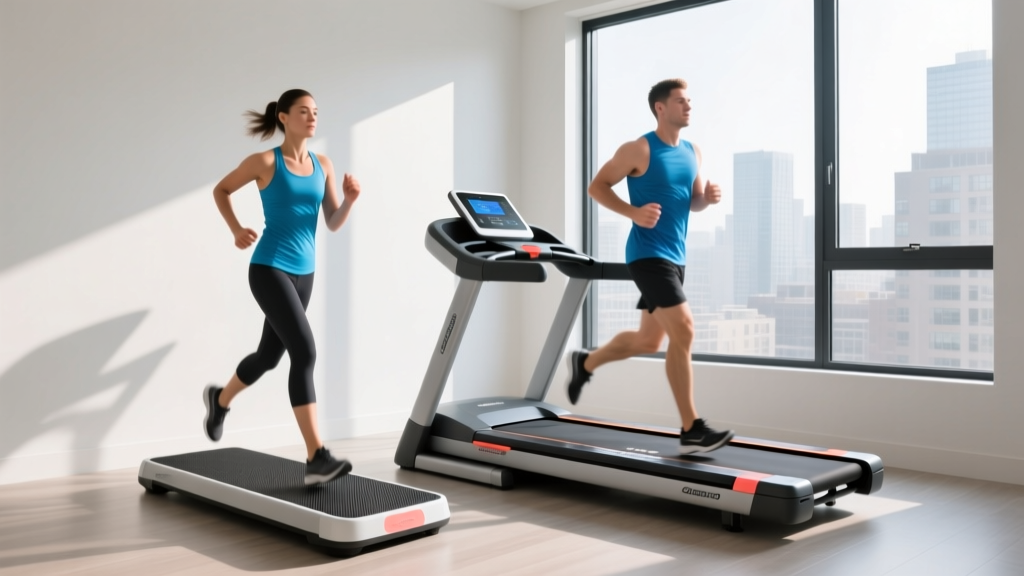
Does Walking on a Treadmill Build Leg Muscle? Pad vs Treadmill Guide
Discover if walking builds leg muscle. Our 2026 step-by-step guide compares walking pads and treadmills for hypertrophy, featuring top model reviews.

The Big Question: Does Walking on a Treadmill Build Leg Muscle?
If you are setting up a home gym in 2026, you have likely asked yourself: does walking on a treadmill build leg muscle? The short answer is yes, but with a major caveat. Walking is primarily a cardiovascular exercise that engages Type I (slow-twitch) muscle fibers in your calves, quadriceps, hamstrings, and glutes. While it will improve muscular endurance and tone, achieving actual hypertrophy (muscle growth) requires progressive overload. According to the Mayo Clinic, increasing the intensity of your walk—specifically through incline and resistance—is the key to transforming a simple cardio session into a legitimate lower-body muscle-building workout.
This beginner-friendly, step-by-step guide will walk you through the biomechanics of walking for muscle growth, compare traditional treadmills to the increasingly popular walking pads, and review the best 2026 equipment to help you reach your fitness goals.
Step 1: Understand the Biomechanics (Flat vs. Incline)
To build muscle, you must challenge the tissue beyond its current capacity. Walking on a completely flat surface at 3.0 mph only requires your leg muscles to move your body weight forward horizontally. This builds endurance, not size.
Expert Insight: The Incline Multiplier
When you introduce a 10% to 15% incline, the biomechanical demand shifts dramatically. Your gluteus maximus and hamstring muscles must contract with significantly more force to propel your body weight upward against gravity. Studies highlighted by the American Heart Association show that incline walking not only spikes cardiovascular demand but heavily recruits the posterior chain, mimicking the muscle activation patterns of stair climbing and lunges.
Step 2: Walking Pad vs. Traditional Treadmill Comparison
Before buying equipment, you need to understand the hardware limitations of walking pads versus traditional treadmills. Here is a side-by-side comparison matrix to help you decide which machine supports your muscle-building goals.
| Feature | Standard Walking Pad | Traditional Treadmill | Impact on Leg Muscle Growth |
|---|---|---|---|
| Max Incline | 0% (Mostly Flat) | 10% - 15% (Motorized) | Critical. Incline is mandatory for hypertrophy. |
| Max Speed | 4.0 - 7.5 mph | 10.0 - 12.0 mph | Moderate. Speed aids cardio, incline aids muscle. |
| Handrails | None or Minimal | Full Front & Side Rails | High. Rails allow you to lean back and push heavier inclines safely. |
| Belt Width | 15 - 17 inches | 20 - 22 inches | Low. Wider belts allow for a natural, muscle-engaging stride. |
Step 3: 2026 Equipment Reviews for Muscle Growth
Not all cardio machines are created equal. If your primary goal is answering 'does walking on a treadmill build leg muscle' with a resounding 'yes', you must choose equipment that supports progressive overload. Here are three specific models dominating the 2026 market.
1. The Muscle Builder: Sunny Health & Fitness SF-T723016 Incline Treadmill
Price: $349.99 | Max Incline: 12% | Max Speed: 8.0 mph
This is a budget-friendly traditional treadmill that punches above its weight class for muscle building. The 12% motorized incline is steep enough to trigger significant glute and calf activation. Real-world edge case: The belt is 20 inches wide, which is standard, but the console lacks advanced Bluetooth tracking. You will need to pair it with a third-party app like Strava or Apple Fitness via your smartwatch to track your elevation gains accurately.
2. The Compromise: UREVO Strol 2E Smart Walking Pad
Price: $459.00 | Max Incline: 5% (Manual Adjustment) | Max Speed: 7.6 mph
Walking pads are famous for being completely flat, which makes them poor choices for leg muscle growth. However, the 2026 UREVO Strol 2E introduces a rare feature: a manual 5% incline adjustment. While 5% is not enough for massive hypertrophy, it provides a noticeable burn in the calves and tibialis anterior during long 45-minute steady-state walks. Failure mode warning: Because the incline is adjusted via physical pegs under the front feet, changing the incline mid-workout is clumsy and interrupts your heart rate zone.
3. The Endurance Tool: KingSmith WalkingPad R2
Price: $499.00 | Max Incline: 0% | Max Speed: 7.5 mph
The KingSmith R2 is a marvel of folding engineering and perfect for under-desk walking. However, from a strict muscle-building perspective, it falls short. Without an incline, your leg muscles will quickly adapt to the flat 3.0 mph walking motion, leading to a plateau in muscle development within 3 to 4 weeks. Buy this for step-counting and NEAT (Non-Exercise Activity Thermogenesis) calorie burn, not for building leg muscle.
Step 4: The 4-Week Progressive Overload Walking Protocol
To force your leg muscles to grow, you cannot just walk aimlessly. Follow this step-by-step beginner protocol designed to progressively overload your lower body using a treadmill with at least a 10% incline capability.
- Week 1 (Base Building): Set incline to 5%. Walk at 3.0 mph for 20 minutes. Focus on heel-to-toe striking and squeezing your glutes at the top of each step. Do not hold the handrails.
- Week 2 (Volume Increase): Set incline to 8%. Walk at 3.2 mph for 30 minutes. Your calves will experience delayed onset muscle soreness (DOMS). This is normal and indicates muscle fiber micro-tears necessary for growth.
- Week 3 (Intensity Spike): Set incline to 12%. Walk at 2.8 mph for 35 minutes. The slower speed prevents cardiovascular redlining while maximizing mechanical tension on the quadriceps and hamstrings.
- Week 4 (Interval Hypertrophy): Alternate between 10% incline (3.5 mph) for 2 minutes and 15% incline (2.5 mph) for 2 minutes. Repeat for 40 minutes total.
Beginner Rule of Thumb: If you can easily hold onto the side rails and lean back while walking at a 15% incline, you are cheating your leg muscles out of up to 40% of the workload. Let your arms swing naturally to force your legs to carry your true body weight.
Step 5: Troubleshooting Common Beginner Plateaus
Even with the right equipment and protocol, beginners often hit a wall. Here is how to troubleshoot the most common issues when using a treadmill for leg muscle growth.
- Shin Splints (Tibialis Anterior Pain): This usually happens when transitioning from flat walking to high inclines too quickly. Fix: Drop the incline by 3%, ensure your footwear has adequate heel drop (8mm to 10mm is ideal for incline walking), and incorporate toe-tapping stretches post-workout.
- Glute Amnesia: If your quads are burning but your glutes feel nothing, your stride is likely too short. Fix: Consciously push through the heel of your foot and extend your hip fully backward at the end of each step. Think about 'pushing the belt away' rather than just stepping on it.
- Lower Back Fatigue: A weak core can cause your lower back to take the brunt of an incline walk. Fix: Brace your core as if preparing for a light punch to the stomach, and keep your chest proud. Do not hunch over the console.
Frequently Asked Questions
Can I build leg muscle using only a walking pad?
You can build muscular endurance and improve calf definition using a walking pad, but significant hypertrophy (size) is highly unlikely. Walking pads lack the motorized incline necessary to create the mechanical tension required for muscle growth. For size, a traditional incline treadmill or stair climber is required.
How many times a week should I do incline walking for muscle growth?
For optimal muscle recovery and growth, aim for 3 to 4 incline walking sessions per week, lasting 30 to 45 minutes each. Ensure you are consuming adequate protein (roughly 0.7 to 1 gram per pound of body weight) to support the repair of the slow-twitch muscle fibers you are breaking down.
Does walking on a treadmill build leg muscle faster than outdoor walking?
A treadmill can build muscle faster than outdoor walking because it allows you to precisely control and sustain steep inclines that are difficult to find in most neighborhoods. Furthermore, the moving belt forces a consistent cadence, preventing you from unconsciously slowing down on steep hills as you would outdoors.
More gear to consider
All reviews
Sole Fitness F85 Treadmill: Feature Comparison & Buyer Mistakes

Compact Portable Cardio vs Super Runners Shop Gait Analysis Treadmill
Upright, Recumbent, Spin Bike Care & FitThrill Treadmill Maintenance

Curved vs Motorized: Long Walk Movie Treadmill Screening Mistakes

Curved vs Motorized: Troubleshooting Treadmill Weight Limit 300 lbs
